Table of Contents (click to expand)
The oldest language we can actually read is Sumerian, first written in Mesopotamia around 3100 BC. Spoken language is far older, but speech leaves no fossils, so no single tongue can truly be crowned the first. Living contenders like Tamil, Hebrew and Arabic are ancient but hotly debated, and "oldest language" claims are often more political than scientific.
What makes us considerably more intelligent than all the other persisting life forms on planet Earth? Most scholars would point out the fact that we can communicate with one another as what really sets us apart. Sure, animals can signal to each other, but none of them can speak to one another about metaphysics or their individual futures. Only humans seem to possess that level of intelligence. Linguists claim that the dawn of humanity itself could only have begun with an abstract conversation.
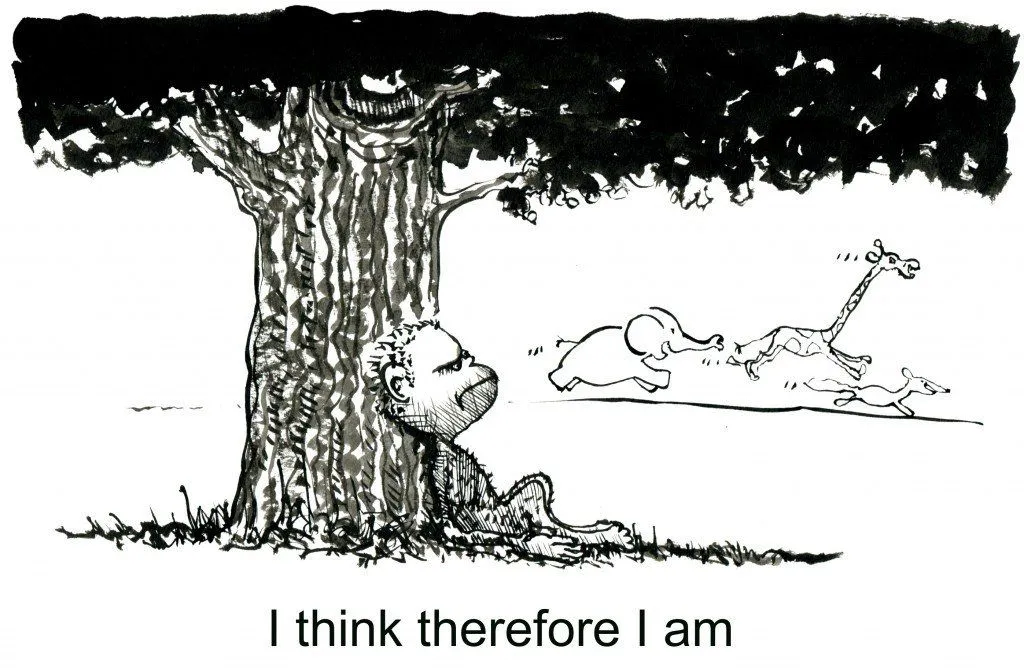
Nobody knows exactly when humans first started talking. Estimates for the dawn of spoken language run anywhere from 50,000 to well over 100,000 years ago, back when our ancestors were still finishing off the modern human skull and vocal tract. Whatever that very first tongue was, linguists call it the Proto-Human Language. Technically, that would be the oldest human language of all, but reconstructing it is essentially impossible, since spoken words leave no fossils and no traces survive. For the sake of a “proven” argument, we shall not be discussing this hypothetical language in particular.
Instead, what we are discussing here is one particular branch of languages that went on to include speakers from all across the world. This branch of languages is called the Indo-European language family. Most people today can speak at least one language from this family. It includes a wide range of languages, including English, German, Farsi, Hindi, Afrikaans, and many others. Strangely enough, these languages can be traced back to one specific ancient language.
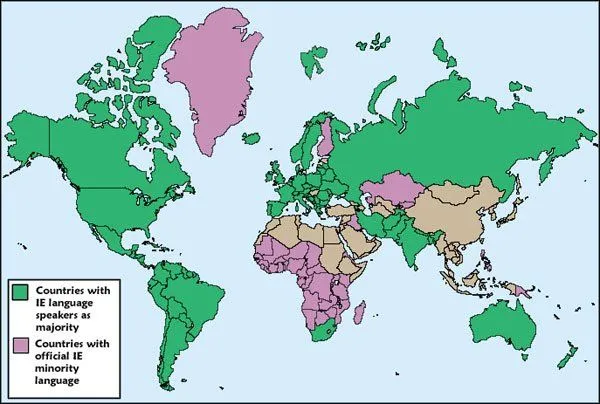
Note: There are many other languages outside the Indo-European family, such as those in the Dravidian family and the Afroasiatic family. They, too, each have their own ancestors, which are also extremely ancient. However, again, the research is lacking in comparison. In this article, we will only be concentrating on the Indo-European family of languages. It is also worth separating two very different questions. If you ask which is the oldest language we can actually read, the answer is fairly clear: Sumerian, the language of ancient Mesopotamia (modern Iraq), first appears in cuneiform writing around 3100 BC and is widely regarded as the oldest written language on record. Ancient Egyptian and Akkadian follow close behind. If you instead ask which living language is the oldest, there is no clean winner. Tamil, Hebrew, Arabic, Chinese and a few others are all put forward as contenders, but the dates are fiercely debated, and as Scientific American points out, these claims tend to be as much political as they are scientific. So rather than crowning any one of them, it is more honest to say each has roots stretching back thousands of years.
Note 2: What must be understood is that asking the question ‘Which is the oldest language’ is quite complex in and of itself. The evolution of language is highly complex and interconnected, and the study of historical linguistics hardly ever has any solid evidence to back it up. There are languages older than even the Indo-European family, called the Nostratic family of languages. These languages connect the IE family with the other language families. However, can these languages even be called ‘languages’ if we know practically nothing about them? This is a question I will leave for the readers to decide.

Yes, yes, I am getting to the point. Promise.
Discovery
When the early Orientalists began studying Sanskrit, they began to see the similar words and similar grammatical patterns between Sanskrit, Ancient Greek and Latin. Obvious patterns began to emerge the more they studied the languages comparatively. These patterns were visible only in the Indo-European regions and some parts of Africa. Languages like Mandarin and Japanese seemed to have arisen from a whole different mother language. Therefore, linguists focused their attention solely on the languages that were spoken in Eurasia.
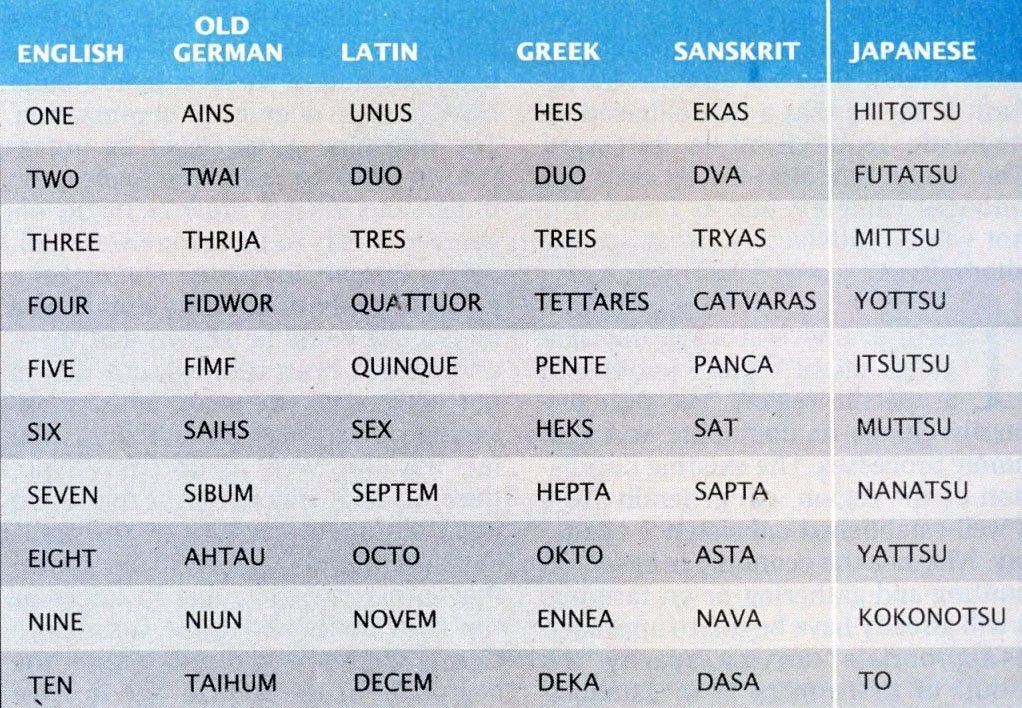
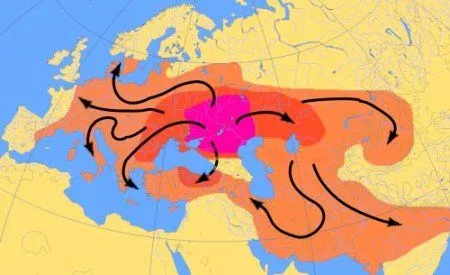
Linguists started building a vocabulary of words that were similar in all the ancient Indo-European languages. They did this because they figured that if there were so many similarities between these languages, there must have been an ancestral language that was spread throughout Eurasia to result in its numerous contemporary forms. They called this ancestral language Proto-Indo-European (PIE). Theoretically, it was spoken roughly between 4500 BC and 2500 BC. The source of this language, however, is hotly debated amongst scholars. The long-standing "Steppe" (or Kurgan) hypothesis holds that it began among herders on the Pontic-Caspian steppes north of the Black Sea around 4000 BC and then spread outward. A rival "Anatolian" hypothesis, championed by archaeologist Colin Renfrew, instead traces PIE several thousand years further back to early farmers in Anatolia (modern Turkey). The debate is far from settled. A major 2023 study in the journal Science, led by Paul Heggarty and colleagues, used Bayesian analysis of more than 160 languages to propose a hybrid answer: the family may be around 8,100 years old, with an ultimate homeland just south of the Caucasus and a later, secondary spread across the steppe. In other words, both camps were partly right.
The Sheep And The Horses
In 1868, German linguist Dr. August Schleicher first wrote a written sample for this language. He first wrote a parable called ‘The Sheep And The Horses’ and then translated it into PIE to experiment with its vocabulary.
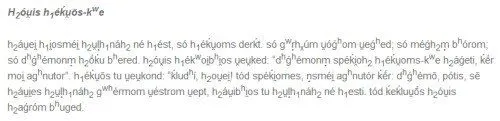
Here is the passage translated in English:
‘A sheep that had no wool saw horses, one of them pulling a heavy wagon, one carrying a big load, and one carrying a man quickly. The sheep said to the horses: “My heart pains me, seeing a man driving horses.” The horses said: “Listen, sheep, our hearts pain us when we see this: a man, the master, makes the wool of the sheep into a warm garment for himself. And the sheep has no wool.” Having heard this, the sheep fled into the plain.’
Pronunciations were derived and refined over many years, but it wasn’t until fairly recently that somebody attempted to read this passage out loud. In 2013, linguist Dr. Andrew Byrd, a professor at the University of Kentucky, recorded himself reading it for Archaeology magazine, building upon three centuries worth of research on this fascinating topic.
Isn’t that incredibly cool? The fact that none of us have ever heard a word of this language, nor have we ever found any written records of it? Yet, through 300 years of persistent research, we can now hear what our ancestors might have sounded like. This simple 45-second audio file is probably one of linguistics’ finest achievements, if not all of humanity’s!
Final Note: If any of you are interested in hearing how Proto-Indo-European is reconstructed and pronounced, then this YouTube video might be exactly what you’re looking for. In it, YouTuber Xidnaf walks through an ancient passage rendered in PIE. Several of these sounds are tricky for English speakers, but they tend to come more naturally to speakers of languages that have kept older features, such as many South Asian and Slavic tongues.
References (click to expand)
- What's the World's Oldest Language? Scientific American
- Sumerian language. Encyclopaedia Britannica
- New insights into the origin of the Indo-European languages (Heggarty et al., 2023). Max Planck Society
- Origins and Evolution of Human Language: Timeline. William Marsh Rice University
- Evolution of Human Languages. The Santa Fe Institute
- Proto-Human language. Wikipedia