Table of Contents (click to expand)
Alexander the Great is called ‘great’ because he never lost a battle and, in barely a decade, built one of history’s largest empires, stretching from Greece and Egypt across Persia to the Indus River in northwestern India. His conquests spread Greek culture across three continents, though external factors (his father’s army, a crumbling Persia) helped build that ‘greatness’ too.
Alexander the Great, Alexander III of Macedon, was born in 356 BCE in Pella, the Macedonian capital, the son of King Philip II of Macedon and Queen Olympias. From the ages of 13 to 16 he was tutored by the philosopher Aristotle, who shaped his ideas of kingship and kingdom. He became king in 336 BCE, at the age of 20, after his father was assassinated.
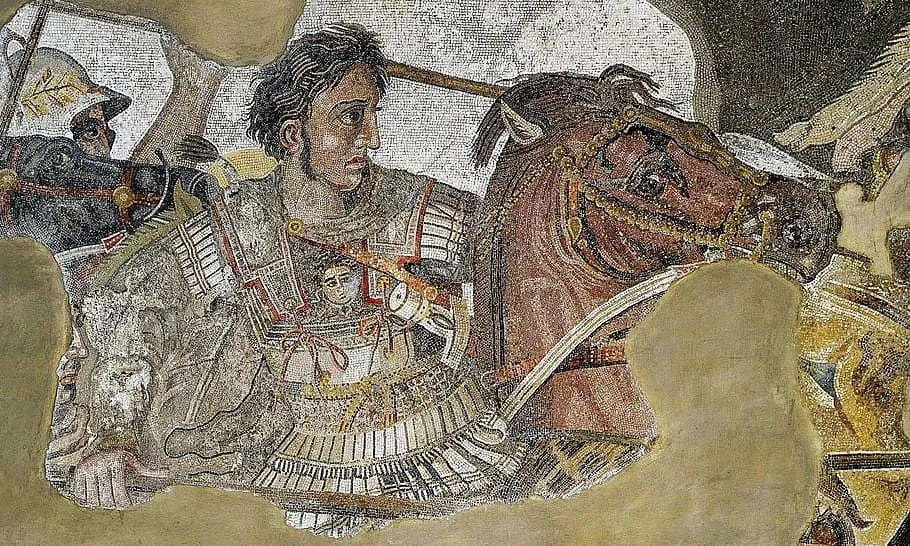
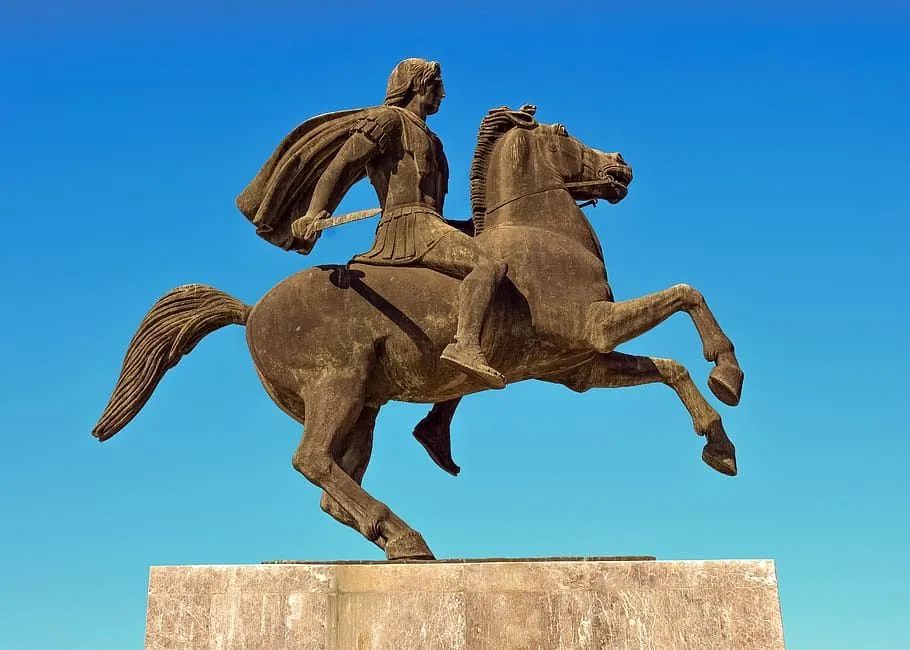
Alexander the Great, as one might guess from his name, is considered one of the greatest military commanders in history. Famously, he never lost a battle. Riding his beloved warhorse Bucephalus, he won decisive victories at the Granicus (334 BCE), Issus (333 BCE), and Gaugamela (331 BCE), the last of which broke the Persian Empire of Darius III. By the time he was done, he had conquered territories that stretched from Greece and Egypt, through Persia (where tales often called him Iskandar), across large parts of Central Asia, all the way to the Indus River in what is now Pakistan and northwestern India.
So did he actually conquer India? Not quite. He defeated the Indian king Porus at the Hydaspes River in 326 BCE, but his exhausted, homesick army refused to march any further east. At the Hyphasis (today’s Beas River), they mutinied, and Alexander, for once, turned back. India proper was never his.
He was also a skilled leader and strategist (essential to conquer that much land) who could rapidly adapt to changing circumstances on the battlefield.
His world-conquering spree also led to new trade routes and expanded commerce between Europe, Asia, and Africa by uniting them under a common command. This laid the groundwork for the Silk Road and other trade networks that would eventually connect the ancient world.
Cultural Impact
Alexander’s conquests spread Greek culture and ideas across the lands he conquered, creating an explosive amalgamation of Greek and Eastern cultures (known as Hellenistic culture). This served to foster a sense of proto-cosmopolitanism, a sense of belonging to a global community in a rudimentary form, leading to a greater exchange of ideas, knowledge, and cultural practices across his dominion.
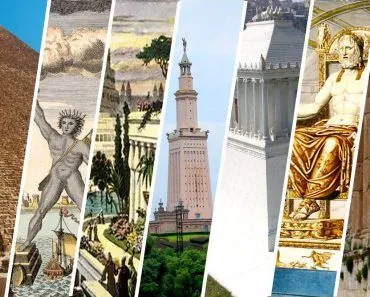
He also founded several cities, including Alexandria in Egypt (housing one of the largest and most important libraries of the ancient world, as well as a lighthouse), incorporating diverse populations into an overarching political structure, which became a microcosm for the blend of learning and culture of two continents. This idealistic approach to conquest aligned with his belief in the superiority of Greek civilization (though he was technically Macedonian…) and his desire to establish a lasting impact.
This fusion had a profound impact on arts, literature, philosophy, and architecture. It is for this reason that Alexander became an important figure many centuries later during the Renaissance, which sought to revive classical Greek and Roman culture through the men, women and gods that lived through it. Renaissance humanists thus saw him as a symbol of glory, courage, wisdom, and cultural achievement.
Political Impact
Alexander’s empire-building also influenced what we now call “political philosophy” by shaping the notions of an ideal monarchy and the relationship between ruler and ruled. He projected his power as unwavering (whether it was truly unwavering or not is up to your interpretation of history) and within that projection, his desire to conquer the world by whatever means necessary.
One could speculate to an extent that Alexander’s conquests were driven by the need to secure resources for the Greek ruling class and expand their economic power; however, they were also fueled by his own quest for glory and imperial success.
Alexander’s conquests then, were imperialistic, serving the interests of the ruling elite and perpetuating systems of exploitation and inequality.
Alexander understood the importance of maintaining the loyalty and support of the diverse peoples that he conquered. Through calculated moves and a combination of diplomacy, coercion, and military might, he implemented policies that painted the picture of a culturally diverse, but united empire.
His marriage to Roxana, a Bactrian princess, and his adoption of Persian dress and customs, were all in furtherance of this goal. By adopting local customs and marrying into local royalty, Alexander gained the support and legitimacy he needed. His armies were also multi-ethnic in this fashion.
The Great Man Theory
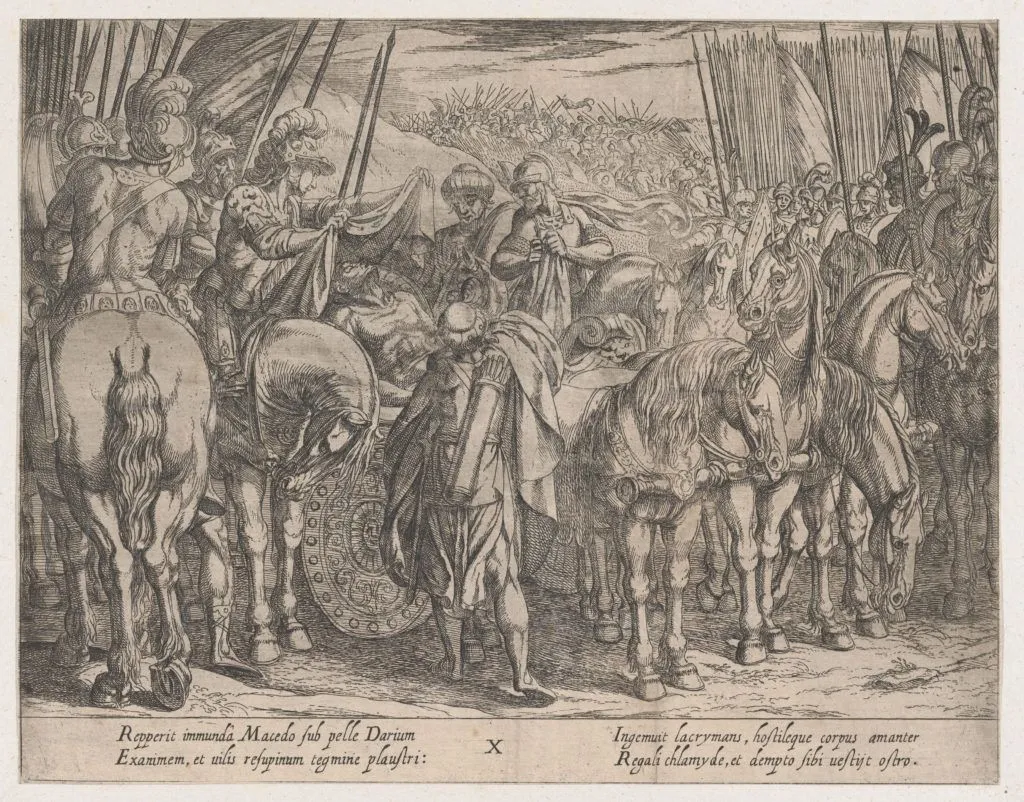
The multifaceted nature of Alexander’s historical significance can be put through one more interpretation. The Great Man theory, also called the Heroic theory, emphasizes the role of exceptional individuals in shaping history. According to this perspective, influential figures, known as “great men,” have a significant impact on historical events and social change.
Originating in the 19th century, this theory, championed by Thomas Carlyle, suggests that studying the lives and actions of extraordinary individuals with distinct qualities and abilities provides insights into the course of nations and their transformative influence on society.
All that we read often borrows on this theory to paint Alexander as an inhumanly gifted individual, but many socio-cultural and political factors helped him become the ‘great’ man he was. Alexander’s rise to power cannot be solely attributed to his personal qualities as a great man. External factors played a significant role in his success.
The geopolitical landscape of the time, characterized by the disintegration of the Persian Empire, created favorable conditions for his epic ambitions. The power vacuum and internal divisions within the empire provided an opportunity for Alexander to expand his influence.
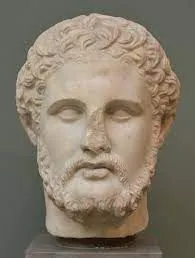
Moreover, Alexander benefited from the political and military infrastructure established by his father, King Philip II of Macedon. Philip’s reforms and military advancements provided Alexander with a solid foundation for his conquests. The professionalized Macedonian army, known for its innovative tactics and cohesiveness, gave him a formidable force to command.
Conclusion
The true impact of his conquest is put into perspective when we realize that he conquered much of the known world at the time. Alexander’s greatness stemmed from the choices he made as a king with countless people and resources at his disposal.
His exploits and larger-than-life persona were romanticized and idealized over the centuries by the countless who either looked up to him or sought to match his fame (though it seems unlikely that anyone ever would!). After his death in Babylon in 323 BCE, at just 32 years old, his generals carved up the empire into successor kingdoms, chiefly the Seleucid dynasty in Asia and the Ptolemaic dynasty in Egypt. His influence rippled outward to later powers, from the Roman Empire to the Byzantine Empire, shaping the course of human history. His choices caused political and territorial entities to fall and rise, and even after he died, new empires emerged as a part of his legacy.
References (click to expand)
- L Pearson. (1955) The Diary and the Letters of Alexander the Great.
- P Merlan. (1954) Isocrates, Aristotle and Alexander the Great.
- Hellenistic Age. Encyclopaedia Britannica.
- B Perrin. (1895) Genesis and Growth of an Alexander-Myth.
- CD Hamilton. (1995) The Revolution in Greek Warfare.
- Alexander the Great. Encyclopaedia Britannica.