Table of Contents (click to expand)
Most countries are reluctant to adopt cryptocurrency because it is too volatile to be reliable money and sits outside any central bank’s control. That undermines monetary policy, the tool central banks use to manage inflation and the money supply. Even El Salvador, the first to make Bitcoin legal tender, reversed course in 2025.
Cryptocurrencies like Bitcoin, Dogecoin and Ethereum have taken the economy by storm, but central banks worldwide remain skeptical about adopting them. Some have outright classified them as gambling. El Salvador, the first country to make Bitcoin legal tender, even reversed course in 2025. Let’s dive in to understand why central banks stay wary of cryptocurrency.
How Does Anything Become Currency?
We’ve often seen in shows and movies that prison inmates use commodities as a medium of exchange for goods. This system was also present during the barter age, where one commodity was exchanged for another, so long as both parties had use for each other’s commodities. However, searching for a person who wants the same commodity you wish to give up and would offer a commodity you need in return is inconvenient.

Here comes currency.
Currencies value the same good in monetary terms, by eliminating the time-consuming process of searching for a buyer willing to offer what you need. The assurance of its nominal value is also instilled by the central banks of the country. Individuals trust the central bank of their country, which is why they trade in currency terms.
No one will use currencies as a medium of exchange if it is volatile; in other words, what one dollar buys me today will be the same that it buys me tomorrow. Granted, in 10 years, it probably won’t buy me the same amount of goods, but on a year-by-year basis, the value remains fairly stable, as central banks closely monitor their respective currencies. The entire world cannot adopt one currency because their policy intervention role would be hampered.
The Mechanics Of Cryptocurrency
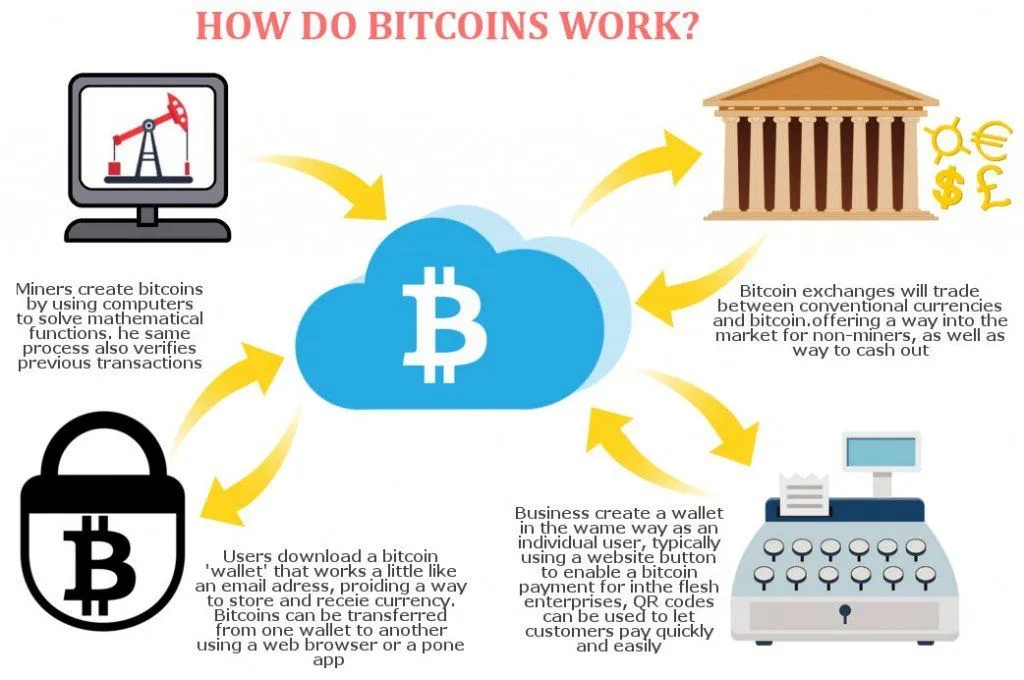
Cryptocurrency is touted as the most significant fintech innovation in recent history. Whenever a transaction is incurred using a cryptocurrency, each transaction links itself to a block; hence you can record the entire journey of a coin by looking back at its transaction history, with timestamps recorded in a ledger called a blockchain.
The blockchain only records the journey of a coin; it does not disclose the purpose of the transaction or the counter-parties involved, thereby granting privacy. The process of recording the journey of each cryptocurrency coin is to ensure that each one in circulation is unique. This record is then broadcasted to all the computers in the network. Hence, it does not need any financial or social institution monitoring its authenticity.
Wonderful, right?
If no institution monitors a currency, it surpasses all biases and politics in the system. On the flip side, we’ve seen that for a currency to be used as a medium of exchange, it must first be universally accepted. Second, it must depict stability before being widely adopted for mediating transactions. However, there are some outlets that accept Bitcoin as payment for goods/services offered. However, the problem is the whole stability aspect.

Let’s look at the figures for Bitcoin. The price swings are wild. Bitcoin climbed to a record of roughly $126,000 in October 2025, then slid to around $62,000 by mid-2026, a drop of about 50% in just months. Compare that to the wider history: it traded near $47,000 in early 2022 before falling under $19,000 later that same year. A swing of this size in such a short window makes the currency very unstable. These fluctuations result from a combination of factors ranging from demand and supply to government regulation and investor sentiments.
How Are Cryptocurrencies Created?
Just as central banks mint coins and print their respective currencies, cryptocurrencies are similarly “mined”. Mining is where the term cryptocurrency came into the picture because it is the process of miners solving cryptographic puzzles that require high-speed supercomputers and consume massive amounts of electricity. Once the puzzle is solved, a coin is added to the supply, which belongs to the miner and is also part of the overall circulation.
Mining is a very expensive affair! For some perspective, the volume of electricity consumed is so massive that miners can strain a national grid. That energy drain was one reason China cracked down on crypto in 2021, but it was not the main one. The People’s Bank of China was far more worried about financial instability, money laundering, and capital quietly slipping out of the country past its strict controls, along with the threat private coins posed to its own digital currency, the e-CNY.
Central Banks’ Stand On Cryptocurrencies
Only two countries ever made Bitcoin official legal tender, and both have since backed away. El Salvador adopted it in 2021, and the Central African Republic followed in 2022, partly because their economies were fragile and partly for geopolitical reasons we will not delve into here.
Neither experiment lasted. The Central African Republic repealed its legal-tender law in 2023, and in 2025 El Salvador stripped the obligation to accept Bitcoin (gutting its legal-tender status) as a condition of a $1.4 billion International Monetary Fund loan. No other country has stepped in to replace them. Most major economies have instead chosen to regulate crypto rather than crown it: the European Union’s Markets in Crypto-Assets (MiCA) rules became fully applicable across the bloc in December 2024, and the United States passed its first federal stablecoin law, the GENIUS Act, in 2025. Allowing private currencies to spread freely could give birth to a parallel economy that threatens the social fabric, as it would make the impact of policy decisions redundant.

Policy-making is an integral part of a central bank, as it regulates the flow of credit in the economy, thereby controlling interest rates. If this critical feature is taken away, then the whole system is under threat.
The role of monetary policy executed by central banks is to ensure price stability (control inflation) and aid the growth of an economy by managing economic fluctuations. This management is done by regulating the supply of currency, which is impossible with cryptocurrency, as anyone can mine it.
Thus, if a centralized agency does not monitor the supply of money to some extent, how can we ensure its value to be stable?
Tellingly, central banks are not simply slamming the door on digital money. Many are building their own version instead, called a central bank digital currency (CBDC). China already runs its e-CNY, the European Central Bank is preparing a digital euro that could launch around 2029, and the US Federal Reserve has studied (but not committed to) one. A CBDC gives people the convenience of digital cash while keeping the supply, and the monetary policy that depends on it, firmly in public hands. That is the opposite of a coin anyone can mine.
Moreover, the cost of the heavy electricity consumption for mining often tends to be higher than the currency’s face value. This is bad, as the face value is lower than the cost price of holding the currency! Finally, it is also a security threat because cryptocurrencies, if used in financing illegal affairs, can never trace the counter-parties involved. Although this threat exists with cash, if cryptocurrency is widely adopted, illegal cross-border transactions will be even easier.
Similarly, suppose some cryptocurrencies are widely adopted, despite these consequences; in that case, there is still going to be someone who manages that currency. In that case, the manager/entity would practically control the national economy. This poses a massive risk, as this entity will not be held accountable for acting in a country’s best interest, unlike a central banking institution.
All of this draws our attention to the direction of cryptocurrency. If it cannot be a store of value because of its fluctuations and it has no intrinsic value like gold, then is it just another speculative instrument that has taken the world by storm. At the end of the day, if the majority of people decide to stop using Bitcoin, its value will collapse to nothing.
References (click to expand)
- Bitcoin: A Peer-to-Peer Electronic Cash System. Bitcoin.org
- Bitcoin in El Salvador. Wikipedia
- CAR to drop crypto as legal tender. Central Banking
- Markets in Crypto-Assets Regulation (MiCA). European Securities and Markets Authority
- Central Bank Digital Currency (CBDC) FAQs. Board of Governors of the Federal Reserve System
- Bitcoin. Encyclopaedia Britannica