UK barristers and judges started wearing wigs in the 1680s, after Charles II brought the French fashion (popularised by Louis XIV) into his court. Wigs were dropped from civil and family hearings in 2008 and from the UK Supreme Court entirely. They are still worn in criminal courts, though the Bar Council made them optional in 2025.
You’ve probably laughed at the makeup and wigs in period films, or, if you’re motivated enough and have a bone to pick with the legal profession, you may have ridiculed the absurd attire donned by barristers and judges in UK courts.
Perhaps it’s time to frame some of those jokes in their proper history…
How Did England Distinguish Its Judges?
It seems that a strong judiciary often has a strong sense of fashion. In the 14th century, this style happened to be a long robe, a cowled full hood that would fall on and cover the shoulders, and a cloak. The inspiration behind this look was the dress code one was supposed to follow while attending the royal court to see the monarch.
In 1635, a guide was published in the Judges’ Rules that formalized appropriate court dress. According to this guide, the correctly dressed judge was one who wore a black robe faced with miniver (a light-colored fur) in winter, and violet or scarlet robes, faced with shot-pink taffeta, in summer (they were quite specific about color palettes and tones).
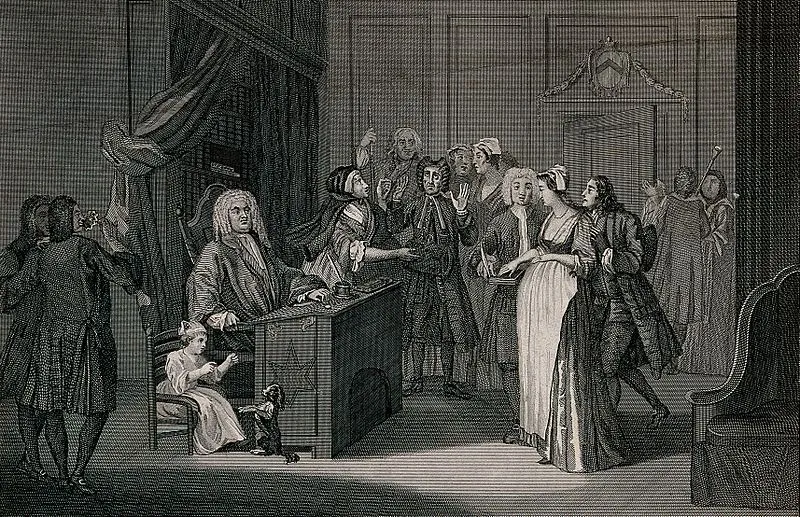
The black silk gown, which we might recognize from modern times, only came around with a change of court. When the High Court was created by the Judicature Acts of 1873–75, it absorbed the functions of quite a few existing courts, including those of Chancery, Probate, Matrimonial Causes and Admiralty. The judges of those courts had already been wearing black gowns, and the habit carried over into the newly formed court. These gowns remain the accepted mode of dress in most courts today.
How Did The Tradition Of Wearing Wigs Start?
Funnily enough, the tradition really took off in France around 1655, when a teenage Louis XIV started losing his hair and hired a small army of wigmakers to cover the problem. The balding effect of syphilis (and the mercury used to treat it) had already made wigs both a fashion choice and a useful cover-up across Europe. Until the late 17th century, however, lawyers in England were still expected to keep short hair and beards, in order to look clean and polite.
Wigs only “wiggled” their way into English courtrooms in the 1680s, once the rest of polite society in Charles II’s court was wearing them. Charles, who was Louis XIV’s cousin, had picked up the habit about five years after Louis did. Since the judges’ attire mimicked the dress codes of the monarch’s court, the wig inevitably joined their courtroom accoutrements.
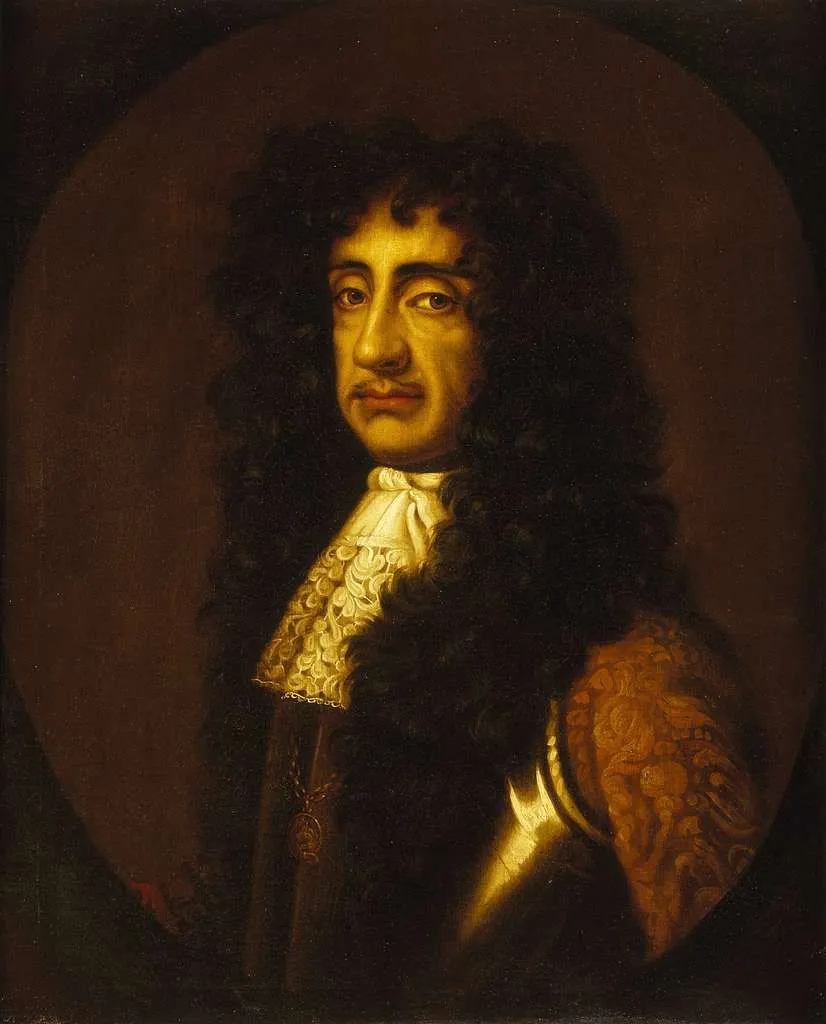
Obviously, the grandiose (and perhaps awkward) nature of wigs made them a hard sell, and judges took a while to get used to them. With good reason, though, the solemn proceedings of the court could not be subjected to anything and everything that was deemed in vogue outside its walls.
Are Wigs Still Worn?
By the end of the 18th century, wigs were going out of fashion (for good reason) outside of courtrooms. Eventually, their use became restricted to specific professions, one of which was the law.
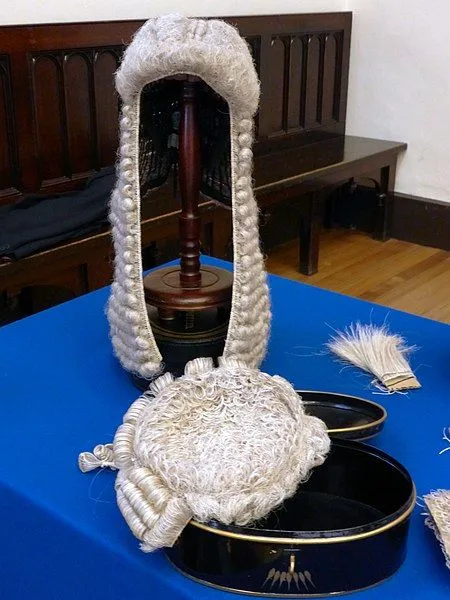
At this point, we should distinguish between the two kinds of wigs judges were supposed to wear: bench wigs (also called bob-wigs or tie-wigs), which were short and tightly curled; and full-bottomed wigs, which were longer and fell to the shoulders. The latter were the dress worn until the 1780s, after which, the former took “precedence” in day-to-day wear, while the latter became mostly ceremonial. A breakthrough came in 1822, when Humphrey Ravenscroft patented the “forensic wig” (a tie-wig with fixed curls that no longer needed daily powdering, pomatum or frizzing). It is essentially the wig barristers still pull on today.
So, are wigs still worn? Yes, but a lot less than they used to be. Following reforms announced by the Lord Chief Justice and brought in on 1 October 2008, judges of the Court of Appeal and the High Court stopped wearing wigs (along with wing collars and bands) when sitting in open court in civil and family proceedings. The Justices of the UK Supreme Court, which opened in October 2009, sit unrobed in ordinary business attire (no wig, no gown). In criminal cases, however, the wig held on; High Court Judges adopted a single set of red robes year-round in 2008, but the headgear stayed. In July 2025 the Bar Council went a step further and updated its court dress guidance: barristers in criminal courts can now decline to wear a wig if it is uncomfortable or impractical, with automatic exceptions for those wearing a headscarf, kippah, turban or certain hairstyles, and a 12-month dispensation route for medical or other reasons.
What Are The Wigs Made Of, And Why Are They White?
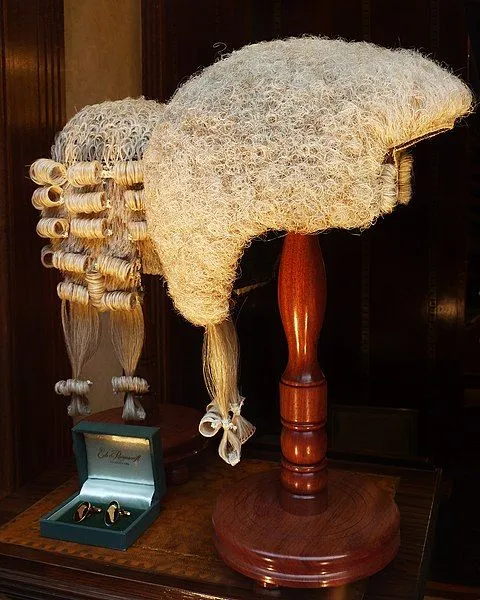
Strip away the ceremony and the modern legal wig is a surprisingly humble object: rows of tightly rolled curls made from horsehair, hand-stitched onto a base and shaped by the same craft for two centuries. The pale, grayish-white color that reads as “white” from the public gallery is simply the natural shade of the horsehair. There is no dye and, since Humphrey Ravenscroft’s 1822 patent, no powder either. His forensic wig used whitish-gray hair precisely so that it would look permanently powdered without any of the daily fuss.

Making one is slow work. Ede & Ravenscroft, the London robe-makers who still produce them, build each wig by hand using Ravenscroft’s original method, curl by boiled-and-steamed curl. A short barrister’s tie-wig from them currently costs around £699, and a judge’s full-bottomed ceremonial wig, with its cascade of curls to the shoulders, costs considerably more.
Oddly, a brand-new wig is something to be a little embarrassed about. A bright white wig marks its owner as a newcomer, while one that has yellowed and dulled with years of wear signals experience, so many barristers quietly prize a grubby, aged wig as a badge of seniority. When Helena Normanton first appeared in 1922, a newspaper pointedly noted that her wig was “a little newer and whiter than those of the other counsel”.
Why Were Wigs Worn?
The reason is simple. The legal system in England is one that relies on formal procedure, precedent, active lawyering, in-court case presentations and progress. All of these motivated the use of wigs to continue, especially as the rest of the legal attire toned down from pinks and lilacs to a less eye-catching black.
The barristers and judges also wanted to adhere to the formality of a uniform, a ceremonial aspect that added to the prowess and supremacy of the law, something that distinguished them from everyone else in the court. Since the precedent in court attire was one that involved wig-wearing, the practice never really died out.
It has, however, faded considerably today. Wigs in family or civil courts are no longer the norm, and many times the judges have discretion while the lawyers can choose for themselves whether or not to wear one. They are still regularly worn in criminal proceedings, though, since the Bar Council’s July 2025 update, even that last stronghold is now opt-in rather than obligatory. So all is not lost, but the tradition is being quietly trimmed at the edges.
Do Female Barristers Wear Wigs Too?
Yes. The wig is not a male preserve, and it never really was once women were allowed in. When the first women were called to the Bar of England and Wales in 1922, the question of what they should wear was settled almost at once. On 31 March 1922, a Committee of Judges and Benchers ruled that women barristers should wear “ordinary barrister’s wigs” that “completely cover and conceal the hair”, meaning the same short horsehair tie-wig their male colleagues wore, with no feminine variation permitted.
Helena Normanton, the first woman to practise as a barrister in England, duly appeared in exactly that wig. Insisting on identical dress was partly about the dignity of the court and partly about leveling the field: a uniform head to toe took appearance out of the equation and placed women on the same footing as the men across the aisle. More than a century later, female and male barristers still wear the identical wig.
The modern relaxations apply to everyone, regardless of gender. Under the Bar Council’s 2025 guidance, a barrister who wears a headscarf and would struggle to fit a wig over it is automatically excused, as are those wearing a kippah, turban or certain hairstyles. In other words, the rule that once forced everyone into the same horsehair now bends to accommodate the people underneath it.
Conclusion
Wearing wigs in the courtroom was an attempt to add to the prestige of the court and differ the wearers from those who approached the law.
Barristers and judges in the UK, unlike those in the rest of the world, have gone one step beyond the black robe and white collar by regularly wearing wigs. Depending on who you are, you may love or hate this tradition (I, for one, love the dramatic aspects of the law). However, the idea and custom behind separating the enforcers and agents of the law from those who come under its scrutiny with formal visible distinction in attire is still a relevant consideration, and a tradition that is likely to continue.
References (click to expand)
- History of Court Dress - Courts and Tribunals Judiciary. Judiciary.uk
- Yablon, C. M. (1995). Judicial drag: an essay on wigs, robes and legal change. Wis. L. REv., 1129.
- Megarry, R. (1982). Barristers and Judges in England Today. Fordham L. Rev., 51, 387.
- Robson, R. (2021). Why Don't We All Just Wear Robes? St. John's Journal of Civil Rights and Economic Development, 34(2), Article 5.
- Schoff, G. (2016). Farewell to the wig. Victorian Bar News, (159), 38–40
- Modern Court Dress - Courts and Tribunals Judiciary. Judiciary.uk
- Update on court dress and wigs guidance. The Bar Council of England and Wales, July 2025.
- Horsehair Bar Wig - Ede & Ravenscroft, robe and wig makers.
- Women barristers and legal costume. Middle Temple Library Blog.