Real Vikings did not wear horned helmets. The image is a 19th-century invention: Swedish artist August Malmström added horns to his Frithiof’s Saga illustrations, and costume designer Carl Emil Doepler cemented the look with horned helmets for Wagner’s 1876 opera. The horns are pure myth, not history.
In an inclement Nordic village, nestled among craggy fjords and lush forests, lived a man named Erik. He was the embodiment of a quintessential Viking, tall and sturdy, with a wild mane of fiery red hair and a beard that cascaded like a waterfall of flames. Erik was known throughout the lands for his fearless spirit and unyielding strength.
One feature that set Erik apart was his distinctive horned helmet. Crafted from iron and adorned with intricate carvings, it bore two imposing horns that curved majestically from each side. When Erik donned his helmet, he looked like a warrior straight out of legend, ready to conquer the seas and claim new lands.
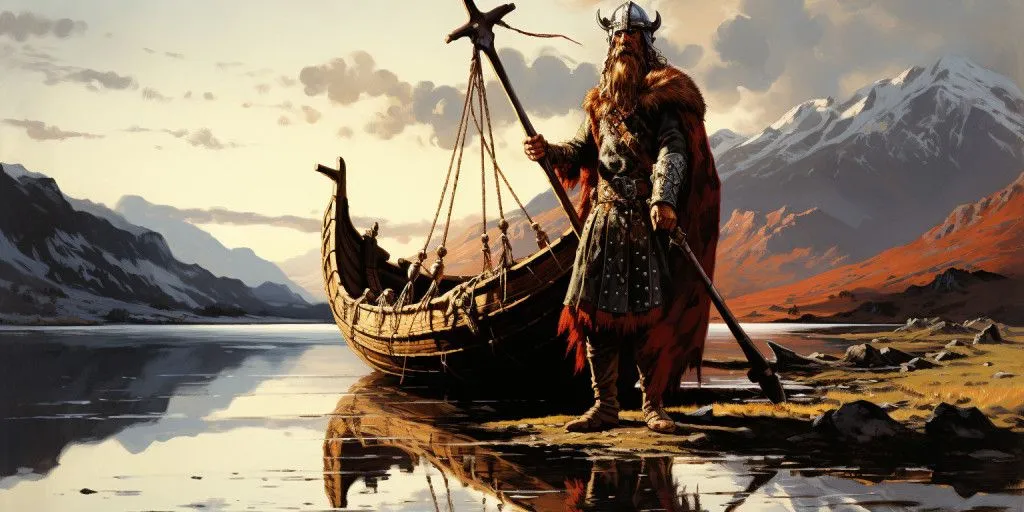
However, it seems that Erik should not be in a horned helmet, that is, if Erik exists in a historically accurate narrative. Scandinavians likely armed themselves with sturdy headgear, but we should dismiss the notion that this gear boasted fearsome horns.
Did Horned Helmets Exist In Europe?
Horned helmets did indeed exist in northern Europe, yet they predate the Viking Age by more than 1,500 years, originating in a Bronze Age culture that predates recorded historical accounts in the region. Archaeological finds like these are emissaries from a time when myths were born, or when myths were lived, and are the only way we know of these helmets.
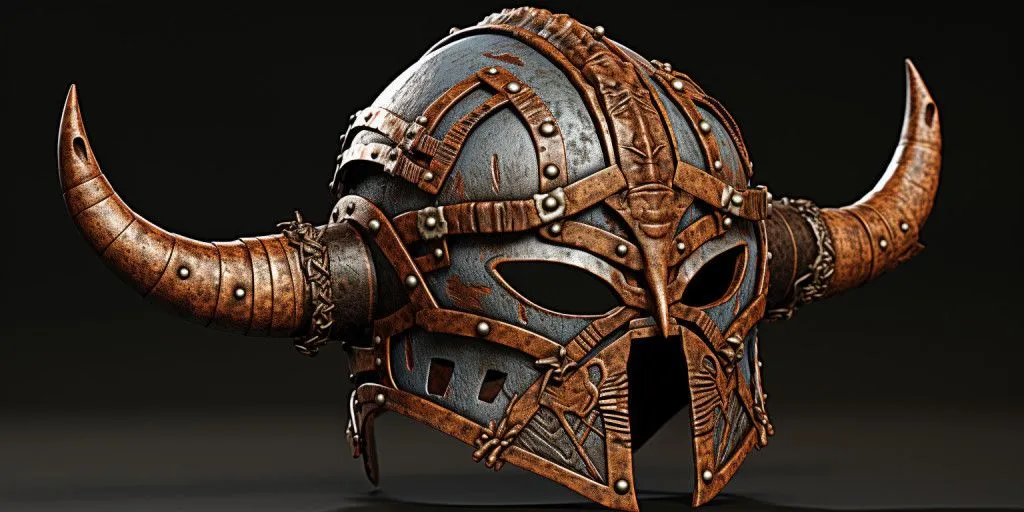
Two helmets, known as the Viksø helmets, marked by intricate embellishments, such as a gracefully curving beak and prominent eyes situated on the forehead, were excavated in 1942 from a peat bog near Copenhagen and date to roughly 900 BCE. Forged entirely from bronze, these helmets, which include twisted horn-like appendages resembling those of bulls, were probably not intended for use in actual battle. Instead, they likely held religious significance.
These however, had nothing to do with the Age of Vikings.
How Did The Vikings Get Associated With These Helmets?
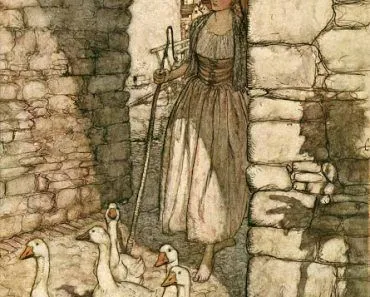
This depiction of horned Vikings dates back to the 1800s, an era marked by the creative musings of Scandinavian artists like Sweden’s August Malmström. These artists, driven perhaps by artistic flair and a dash of imagination, introduced the now-iconic horned headgear to their portrayals of the storied raiders. Esaias Tegnér had penned his epic poem Frithiof’s Saga in the 1820s, but it was Malmström’s lavishly illustrated 1876 edition that gave the story’s kings helmets adorned with small lateral horns and even dragon wings. The symbolism is clear; these helmets are laden with mythical connections, connecting the warriors to the realms of legendary monsters.

The genesis of the horned helmet’s firm grip on the popular imagination can be traced to that same decade. In 1876, the illustrious composer Richard Wagner staged the first complete performance of his ambitious opera cycle, Der Ring des Nibelungen (referred to commonly as “The Ring Cycle”), at Bayreuth, set against the backdrop of ancient Norse sagas. Behind the scenes, costume designer Carl Emil Doepler breathed life into the opera’s characters by adorning them with horned helmets.
Little did they know that this artistic embellishment would lay the foundation for a persistent and captivating stereotype…
What Does It Signify?
The persistent fascination with the Viking horned helmet image underscores the human tendency to romanticize and mythologize the past. The allure of myth and legend, intertwined with the excitement of historical discovery, often shapes popular perceptions of historical figures and epochs. The popular image of the imposing Viking warrior, adorned with a fierce horned helmet, has etched itself deeply into our collective consciousness.
This image serves as a testament to the dynamic relationship between history and the creative expressions that interpret and reinterpret it for generations to come. Art has the ability to transcend temporal boundaries and wield influence far beyond its creation. The Viking horned helmet image, while potentially inaccurate in its historical portrayal, has become an enduring symbol that bridges the gap between past and present, as well as fact and fiction.
What Did Actual Viking Helmets Look Like?
While imposing extensions like horns could instill fear in enemies and potentially inflict injuries, their propensity to weigh down warriors or become lodged in shields raises doubts about their battlefield utility. These vulnerabilities would make them rather terrible gears of war.
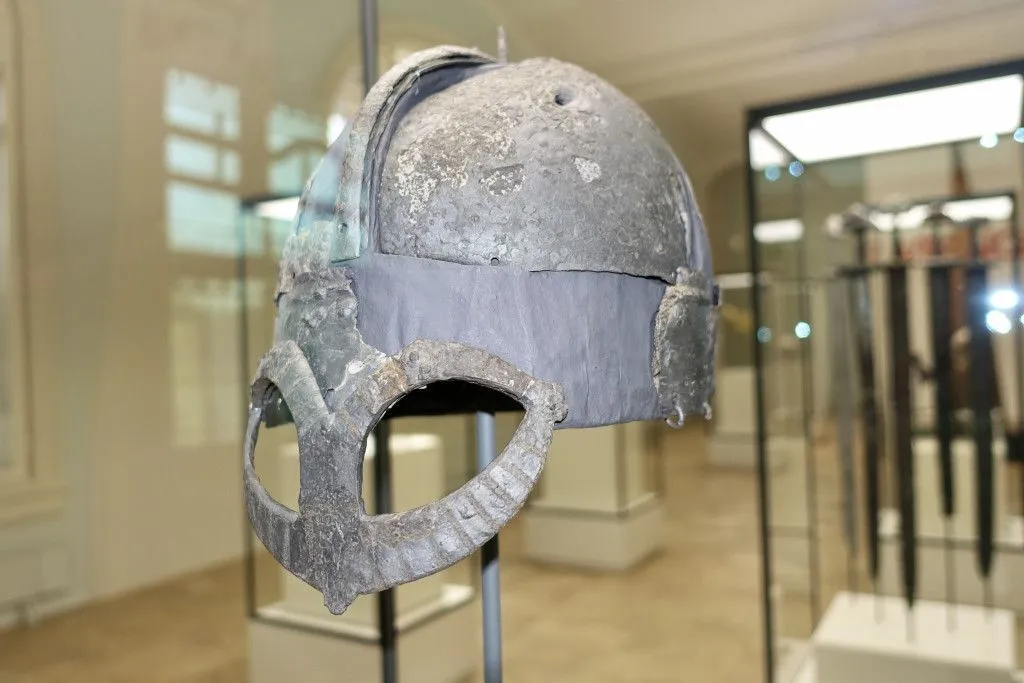
The preservation of helmets from the Viking era is remarkably sparse. Only a handful of finds survive, and just one of them, the Gjermundbu helmet from Norway, is complete enough to be reconstructed; the rest are scattered fragments. Interestingly, this lone near-complete helmet lacks the iconic horns that have come to symbolize the Vikings in our popular imagination. Unearthed from a burial mound in 1943 and dated to the 10th century, the Gjermundbu helmet is a rounded iron cap fitted with a “spectacle” guard, a metal mask designed to safeguard a warrior’s eyes and nose during battle (something horns would only have gotten in the way of).
Conclusion
The iconic image of the Viking in a horned helmet is a testament to the complex interplay between history and artistic interpretation. It was born from the brushstrokes of artists like August Malmström and blossomed in theaters through Wagner’s operas. Yet, the historical accuracy of this image is shrouded in uncertainty.
While it’s unlikely that Viking warriors routinely donned helmets adorned with imposing horns, the enduring legacy of this image speaks volumes about humanity’s fascination with the past, the allure of myth and legend, and the transformative power of art to shape historical narratives.