We like listening to sad music because it makes us feel understood, lets us vent bottled-up emotions, and often evokes nostalgia and being moved rather than pure sadness. People high in empathy enjoy it most. For most listeners it lifts mood, though it’s worth separating healthy grieving from rumination, which can harm mental health.
When the weight of existence descends upon my shoulders, my first instinct is often to put on a playlist of tremendously depressing songs on my phone. There have been so many times when I’ve listened to sad music and ended up feeling better! While this is apparently the case for many people, isn’t it a little strange?
On the surface, listening to happy music seems like the logical thing to do when we want to uplift our mood. Why, then, do we usually play the sad songs when we find ourselves feeling blue, and why don’t the happy ones seem to help?

Why Do We Listen To Sad Music When We’re Sad?
Listening to sad music makes us feel more understood. When the words in a song speak to us of our experiences and the music conveys emotions that are similar to ours, we instantly feel like we’re not as alone in it. We feel better about our situation when we believe that someone else has experienced something similar and understands exactly how we feel.
More importantly, it reassures us that there’s nothing wrong with how we feel. The heart-wrenching tunes give us validation, helping us realize that what we’re feeling is completely natural and human, allowing us to then move on more easily.

Listening to sad music is believed to facilitate catharsis from negative emotions. In other words, it allows listeners to bring their own negative emotions to the surface and vent them out, thereby reducing tension and stress. Aristotle, in fact, actually suggested catharsis as an explanation for people’s enjoyment of tragic art.
Why Do We Hate Listening To Happy Music When We’re Sad?
Listening to happy music seems like a normal thing to do when you want a distraction from the sadness inside yourself, but why doesn’t it always work? More often than not, you end up feeling worse than before!
This is because, while sad music comes across as an empathic person trying to console you, happy music may instead seem like a perky person telling you to smile when you’re annoyed.
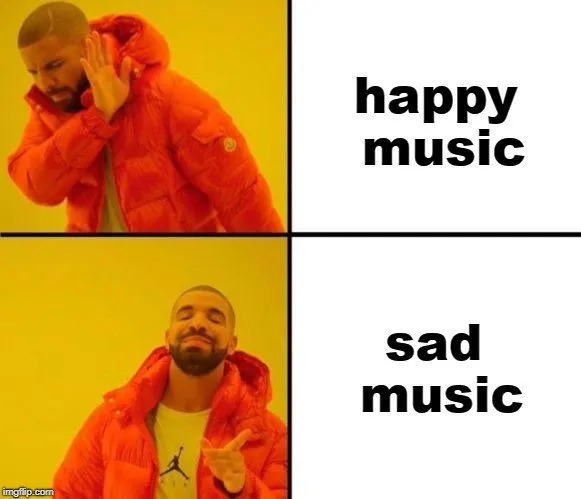
Why Do We Enjoy Sad Music Even When We’re Not Sad?
Many people prefer sad music even when they’re not particularly upset. This is surprising, given the nature of music. Why would anyone want to risk messing up a perfectly good mood by listening to something gloomy?
Part of the answer is that sad music doesn’t actually leave most of us feeling sad. In a large online survey of 772 listeners, researchers Liila Taruffi and Stefan Koelsch found that the emotion most often evoked by sad music wasn’t sadness at all, but nostalgia, followed by peacefulness and tenderness. They identified four rewards that keep us coming back: the pleasure of imagination, emotion regulation, empathy, and the safety of an emotion with no real-life consequences.
Sad Music Is ‘Moving’
Happy music, by itself, is often trite and boring. Just because a song expresses happiness doesn’t mean that people will always want to listen to it.
Most people who enjoy sad music would say that it’s more ‘moving’ than any other form of music. One study found that sad music evoked, in addition to sadness, a range of positively toned aesthetic emotions. It also found that the people who scored high for the trait of empathy most appreciated and enjoyed the beauty of sad music. They simply enjoy the emotional arousal that sad music evokes.
In fact, researchers have found that the pleasure of sad music is largely carried by this feeling of being moved, rather than by sadness itself. When liking for a sad piece rises, it is the sense of being moved (a poignant, bittersweet stirring) that does most of the work, and people high in empathy feel it most strongly.

Romanticism In Sad Music
Sad music, unlike the situation of actually being sad, comes with a sort of romanticism, which poses no immediate threat. It offers no direct danger or harm (unlike the actual emotion of sadness experienced in everyday life), which allows listeners to enjoy an unpleasant emotion like sadness.
Prolactin: A Tempting Theory That Didn’t Hold Up
For years, one popular explanation pointed to the hormone prolactin. Apart from its connection to lactation, prolactin is released in both males and females in response to grief, sadness or other forms of stress. Music psychologist David Huron proposed in 2011 that sad music might trigger this same comforting release, with prolactin producing feelings of tranquility and consolation that keep grief from escalating, leaving the listener with a pleasant glow.
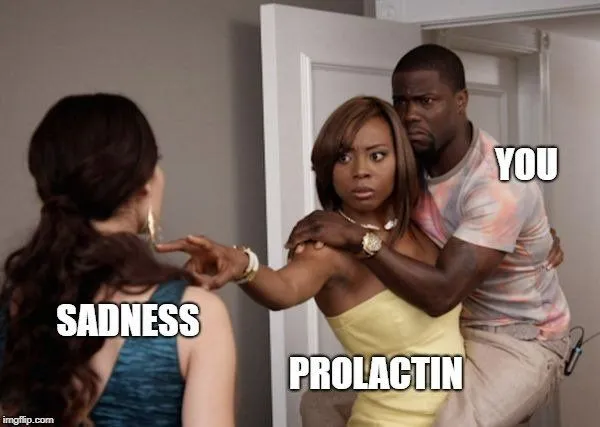
It was a neat idea, but it turned out to be wrong. When the theory was finally put to the test in a 2021 laboratory study, sad music produced no measurable rise in prolactin, and the listeners who reported the most pleasure didn’t have higher prolactin levels either. Huron himself published a short paper in 2023 with the blunt title “The Prolactin Theory of Sad-Music Enjoyment is Wrong,” retracting his own hypothesis. So while it’s a tidy story, prolactin almost certainly isn’t the reason sad music feels good. What does seem to matter is something psychologists call aesthetic distance: even when a song makes you a little sad, you know it’s only music, so the sadness never carries the full weight of a real tragedy.
Have Yourself A Good Cry
Many people listen to sad music just to cry and release their bottled-up emotions, even when they aren’t feeling particularly sad about anything.

Sad music also allows people to reflect on important negative life events and make sense of them, even though the listener may experience some sadness while listening. Certain kinds of sad music help this process of thinking over past events, resolving issues and reaching positive conclusions about them.
Depressive Realism
One might suppose that people become pessimistic when they’re sad; however, a classic 1979 study suggested the opposite, that mildly sad people can actually be more realistic. This idea, nicknamed “sadder but wiser” or depressive realism, holds that sadness encourages more detail-oriented thinking and less judgment bias. It’s worth flagging that the effect is debated: later, better-controlled studies have struggled to reproduce it, and the size of any real effect appears small. Still, the underlying notion that a low mood can sharpen attention to detail is part of why some people find sad music a useful companion for thinking things over.
Is Sad Music Actually Bad For Us?
Different people experience sadness differently, and some people are more susceptible to sadness than others. These differences may be due to gender, social and cultural norms, past experiences, physiology and physical fitness.
The effects of listening to sad music may have adaptive or maladaptive outcomes, depending on the factors above. While some people listen to sad music and have pleasurable outcomes of enjoyment or cleansing, some others will ruminate and obsess over their emotions, as though they are being forced into focusing on unpleasant aspects of life. The latter are attracted to sad music, despite the fact that it perpetuates their misery.

It’s very important to draw a line between a natural grieving process and rumination. However, since rumination is associated with clinical depression, it may seldom be a person’s voluntary goal to ruminate. Instead, it may simply be the result of an involuntary bias of the listener towards negative stimuli, a trait that characterizes many mood disorders.
In short, listen to sad music whenever you need a good cry, but don’t let yourself ruminate for too long!
References (click to expand)
- Garrido, S., & Schubert, E. Negative Emotion in Music: What is the Attraction? A Qualitative Study. Empirical Musicology Review (Ohio State University).
- Taruffi, L., & Koelsch, S. (2014). The Paradox of Music-Evoked Sadness: An Online Survey. PLOS ONE.
- Vuoskoski, J. K., Thompson, W. F., McIlwain, D., & Eerola, T. (2012). Who Enjoys Listening to Sad Music and Why? Music Perception. University of California Press.
- Vuoskoski, J. K., & Eerola, T. (2017). The Pleasure Evoked by Sad Music Is Mediated by Feelings of Being Moved. Frontiers in Psychology (PMC, NCBI).
- Huron, D. (2011). Why is Sad Music Pleasurable? A Possible Role for Prolactin. Musicae Scientiae. SAGE Publications.
- Huron, D. (2023). The Prolactin Theory of Sad-Music Enjoyment is Wrong. Empirical Musicology Review.
- Alloy, L. B., & Abramson, L. Y. (1979). Judgment of Contingency in Depressed and Nondepressed Students: Sadder but Wiser? Journal of Experimental Psychology: General (APA).