Table of Contents (click to expand)
Women’s clothes have buttons on the left side because the convention was set in the Victorian era, when wealthy women were dressed by right-handed maids. With the buttons mirrored onto the wearer’s left, they sat on the dresser’s right—much easier for the maid to fasten. Men, who generally dressed themselves, kept buttons on their own right. The convention stuck, and it persists today.
If you’re wearing a shirt right now, take a look at the position of the buttons on it. If you’re a male, then the buttons would likely be on the right side, but for a female’s shirt, the buttons are usually found on the left.
It seems to be something we all naturally accept, but what’s the reason behind that? Women's clothes button on the left because the convention was set in the Victorian era by wealthy women dressed by right-handed maids; the mirrored placement made fastening easier.

Short answer: There is no definite reason behind this stylistic norm, but there are a few plausible hypotheses, one being that this trend was set by the elite women of the mid-1800s who were dressed by their maids. Buttons on the left side made it more convenient for the maids to button their mistresses up.
Like so many other historical customs and events, there is no definitive, indisputable reason why females’ clothes are designed to have buttons on the left side. But as mentioned, there are some good hypotheses, so let’s take a closer look.
Note: All of the following hypotheses rest on the assumption that there are (and have been) more right-handed people in the world than left-handed ones.
Left-sided buttons are more convenient if one is being dressed by someone else
This is one of the most popular hypotheses, and one that does sound quite plausible. According to this idea, the trend of buttons-on-the-left was set by the wealthy women of the Victorian era (1830s to 1900s).
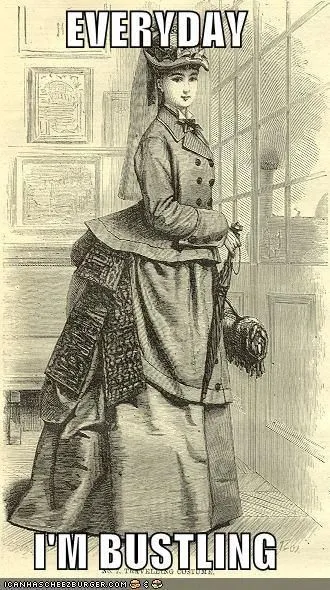
You see, both men and women at that time wore a lot of clothes. However, women’s clothing used to be both complex and elaborate, consisting of corsets, petticoats, bloomers, bustles, gowns and a whole range of different accessories. Therefore, they invariably needed assistance while getting dressed. With this in mind, cloth-makers designed articles of clothing that were easier for other people, i.e., maids and servants, to button up.
On the other hand, men’s clothing did not have as many components and was not as elaborate as women’s fashion. Given that, men could manage to button themselves up without external assistance, hence the right-sided buttons. Such designs of clothing became more and more popular over time, and eventually became the standard still being followed to this day.
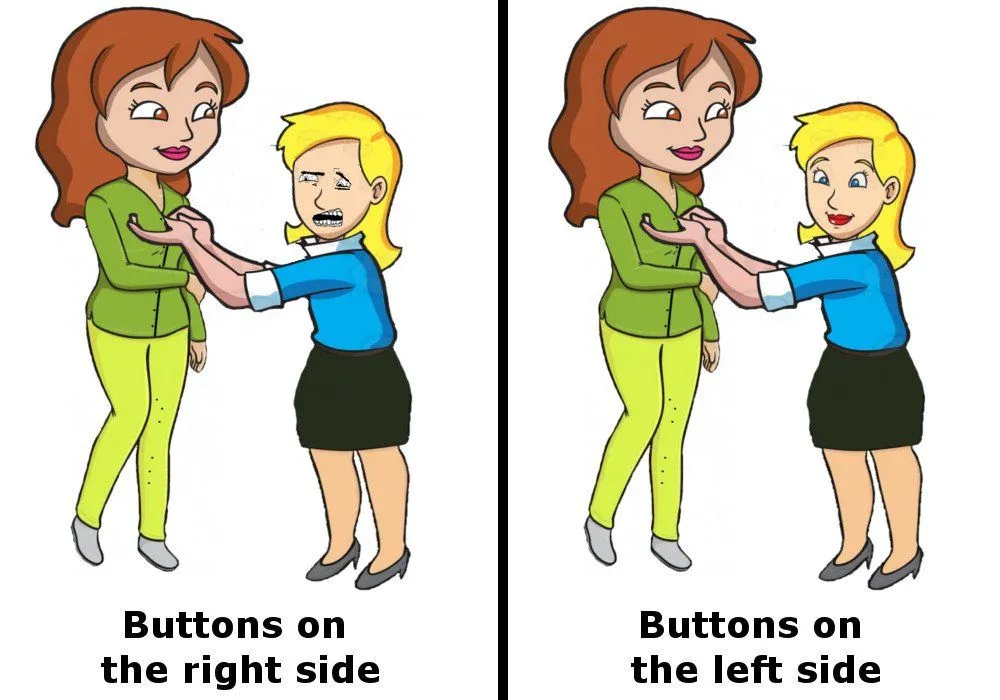
You can see this for yourself the next time you button up a shirt; it’s always easier for you (the wearer) to do the buttons when they’re on the right side. However, when you’re buttoning up someone else, left-sided buttons seem more convenient. That also varies from person to person, and is almost completely subjective.
Which Side Are The Buttons On, And Why Are Men’s On The Right?
If you just want the quick answer before getting dressed or sorting laundry, here it is: on a woman’s shirt or blouse, the buttons sit on the left side and the buttonholes on the right, so the right flap laps over the left. On a man’s shirt, it is the mirror image. The buttons are on the right and the left flap laps over the right. So a fast way to tell a men’s shirt from a women’s on the rack is to look at which side the buttons are on as you face it.

Notice that the hypotheses above all try to explain the women’s side of the story, but there is a parallel question that gets less attention: why do men’s buttons sit on the right in the first place? The popular explanation here is the sword. Since the overwhelming majority of people are right-handed (in Western populations, roughly 85 to 90 percent, according to the U.S. National Library of Medicine), a gentleman would wear his sword on his left hip and draw it across his body with his right hand. Paul Keers, in his book A Gentleman’s Wardrobe, suggests that men’s garments were designed to button left over right so the fabric would not snag on the pommel of the sword as it was drawn. This masculine convention then carried over to ordinary menswear.
It is worth stressing that, like the women’s-side theories, this is a plausible story rather than documented fact. Buttoned closures only became common in European clothing around the 13th century, well before mass-produced shirts existed, and fashion historians such as JuYoung Lee and Caroline Kobia (both of Mississippi State University) note that the true origin of the opposite-side convention is genuinely uncertain. What is not in dispute is the assumption underpinning every one of these ideas: most people, then and now, do most of their fiddly tasks with the right hand. If you are curious about how lopsided that split really is, we have written about left- and right-handedness and even whether other animals are right-handed like us.
Breastfeeding
There is a more recent hypothesis regarding women’s clothing that has gained quite a lot traction in the past decade. Women who are right-handed tend to hold their babies in their left hand, keeping their right hand free. Therefore, it becomes more convenient for them in a buttons-on-the-left design shirt to undo the buttons and breastfeed their babies with ease.
The Socio-cultural Impact
Another hypothesis derives from a prevalent belief from the Victorian era that ‘the left hand is inferior to the right one’. Putting buttons on the left side of women’s garments was a subtle indication-cum-reminder for women that they were the inferior race and shouldn’t forget their ‘right place’ in society.
Napoleon’s Obsession
Out of the various propositions presented to explain the left-side buttons on women’s clothes, this is my personal favorite. It is said that Napoleon Bonaparte, an eminent French general and political leader, desperately wanted to stop women from mocking him. You see, one of the most famous portraits of Napoleon features him with his right hand stuck beneath his waistcoat.
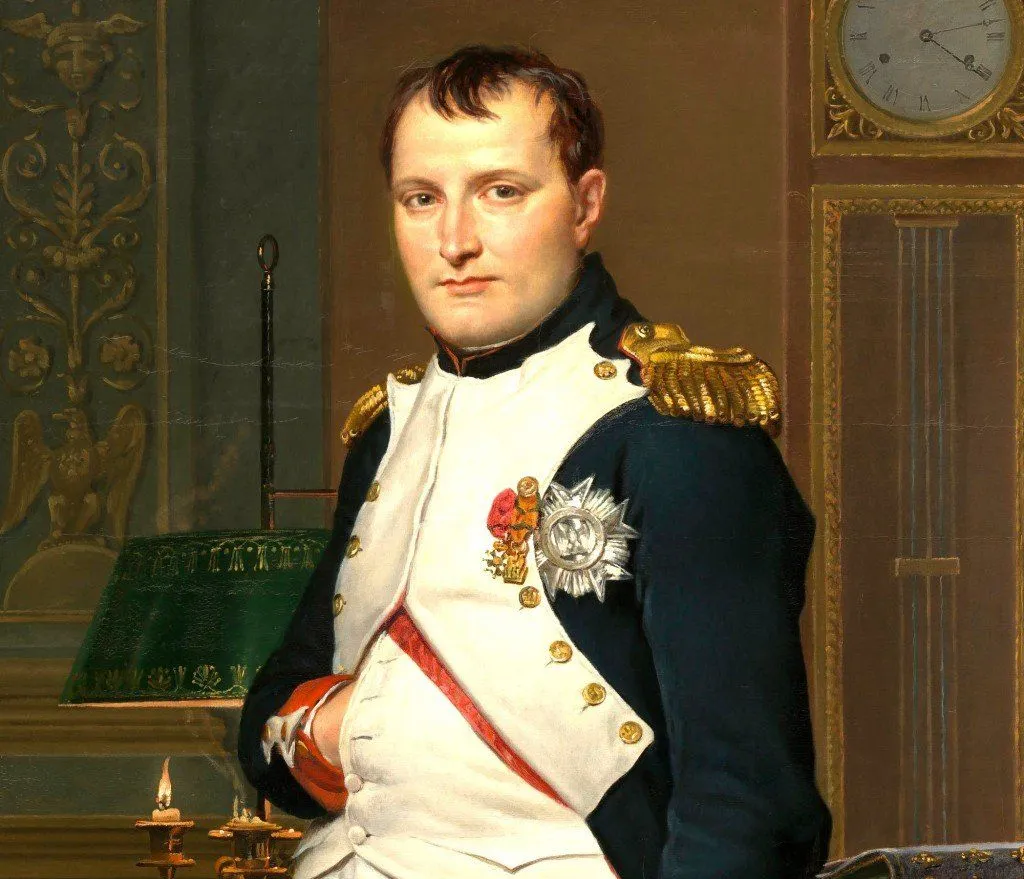
It is believed that women used to mock his iconic pose by sticking their right hands beneath their garments. In a bid to put an end to this growing fad, which obviously disturbed the great ruler, he made it mandatory that women’s clothing should only have buttons on the left side, so that they could no longer make a mockery of his quintessential pose.

However, it’s highly unlikely that Napoleon’s orders pertaining to women’s clothing single-handedly managed to sway the entire world’s opinion as to how ladies’ clothes should be designed.
There are a few other hypotheses regarding this particular detail of women’s clothing (you can read more about them from the articles in the references section), but none of them can be accepted as the de facto reason why they put buttons on the left side of women’s garments. Perhaps it will always remain a mystery!
References (click to expand)
- Why Are Men's and Women's Buttons on Opposite Sides?. Live Science
- The Curious Case of Men and Women's Buttons - The Atlantic. The Atlantic
- Here's Why Men's and Women's Clothes Button on Opposite .... Smithsonian
- The REAL reason women's shirts button on the left - Daily Mail. The Daily Mail
- Why are buttons and zippers on different sides of men’s and women’s clothes?. The Conversation
- Handedness. MedlinePlus Genetics, U.S. National Library of Medicine