Table of Contents (click to expand)
Yes. Competition swimsuits help you swim faster by cutting drag, the force water exerts against you. Smooth, water-repellent fabrics reduce skin-friction drag, while bonded (not sewn) seams trim another few percent. The compression also squeezes the body into a more streamlined shape. The banned full-body polyurethane suits added buoyancy too, which is why World Aquatics outlawed them in 2010.
Humans are amazing creatures. They can walk on the ground, fly through the air, and also swim in water. This is undoubtedly an amazing set of abilities that we are gifted with. Swimming, at first, was crucial for man to ensure his survival, and has become a very popular recreational activity. However, it is more than recreational in nature; it is also considered one of the best aerobic exercises that we can perform to stay healthy.
Many swimmers also wear a special piece of clothing while swimming, which is quite different from what people wear on a daily basis. What’s the reason for this peculiar habit, however? Animals don’t wear special clothing or material when they swim, just their natural fur, skin, or scales. Perhaps there is another reason… Do swimsuits affect the speed of swimming?
The Difference In Media
People who swim are well aware of the tiredness that it can cause after just a few minutes. Why is the tiredness so intense when compared to jogging or running?
After a full lap of a few meters, one is invariably found panting, more so if they have been swimming fast. The main difference between swimming and running is very obvious: the medium.
While you run, you are running through air that surrounds you; also your feet have a firm grip on the ground due to gravity and friction. Although gravity acts on the body of a swimmer too, the medium for swimming is decidedly different. Water is not as merciful as air in terms of supporting movement through it.
Drag: The Force Against You
There are rather strong fluid forces of water that act against your movement when you swim. What they do is oppose your motion as you push through them, applying force with all their might to resist your progress in the forward direction. These forces, which fight your motion, are collectively called drag.
Swimmers actually battle three flavors of drag at once. Skin-friction drag is the rubbing between your body (and your suit) and the thin layer of water sliding past it. Pressure drag (also called form drag) comes from the difference in water pressure between the high-pressure water piling up in front of you and the low-pressure, churning wake left behind. Wave drag is the energy you lose making waves as you travel along the surface. A swimsuit can do little about the waves, but it can meaningfully chip away at the first two.

Therefore, when you push water out of your way, it pushes you back in reply. At racing speed, near the surface, pressure drag and wave drag end up doing most of that pushing back.
You can feel that ‘pushing back’ sensation when you stick your hand out of a moving car and hold your palm vertically against the wind. Doesn’t it feel like someone is pushing your hand back? The same thing is true as you push through the water.
Let’s Talk About Swimsuits
Shape: Although they look pretty plain (since we are so used to seeing them now), swimsuits are especially made to help you glide through water. The most important aspect here is the hydrodynamic shape. The tight fabric ensures that the wearer’s body is compressed into its most streamlined form, smoothing out the bumps and curves that would otherwise catch the water and add pressure drag. NASA, which helped Speedo test fabrics in a wind tunnel, found that this compression alone improved a swimmer’s efficiency by up to 5%.
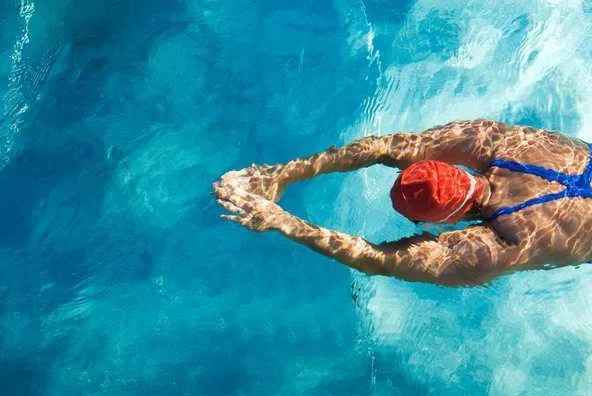
Material of the suit: The fabrics of the swimsuit can be made from nylon or spandex, both of which impart lightness to the swimsuit and agility to the wearer. Suits made of hydrophobic (water-resistant) microfilament fabrics can reduce drag by a staggering 8%. These suits resist contact with water, which essentially means they push water away from the wearer’s body, helping them move through the water quicker.
Seams: The material used in swimsuits is not the only factor in their effectiveness; how fabrics are put together also plays a vital role. Did you know that bonded seams result in an almost 6% reduction in drag over those seams that are traditionally sewn?
Controversy
Since swimming is a very popular sport, there have been many experiments in the design and material of swimsuits, which has occasionally led to controversies. The most talked-about one surfaced in 2008-09.
It began with the Speedo LZR Racer, a groundbreaking full-body suit developed with help from NASA, whose Langley engineers tested roughly 100 fabrics and coatings in a wind tunnel and pinned down which materials and bonded seams shed the most drag. The LZR Racer cut skin-friction drag by about 24% over Speedo’s previous fabric. At the 2008 Beijing Olympics, swimmers wearing it (Michael Phelps among them) rewrote the record books, and in the following 18 months more than 130 world records fell.
Rivals raced to copy and out-do it with suits made of pure polyurethane, such as the Arena X-Glide and the Jaked 01. These coated the body in a water-repellent skin that also trapped air, adding buoyancy and lifting the swimmer higher in the water to slash drag. At the 2009 World Championships in Rome, an astonishing 43 world records were broken, and critics began calling it "technological doping." Swimming’s governing body, then known as FINA (now World Aquatics), had seen enough: in July 2009 it voted to require suits made only of woven textile (no polyurethane), and banned the full-body super-suits from January 1, 2010.

Today, the rules are strict. Legal racing suits must be made of woven textile only, and they cannot cover the whole body: a man’s suit can stretch no further than from the waist to the knee, while a woman’s can run from the shoulder to the knee. So the modern "tech suit" still trims drag through smart fabric, compression, and bonded seams, but it can no longer turn a swimmer into a human pool float.
So yes, it is pretty evident that specially designed swim suits not only look sleek (if one wants to flaunt their body), but also genuinely affect the speed of the swimmer, giving them an edge over their competitors. For the rest of us, however, a good suit might just be the upgrade our aquatic wardrobe has needed!
References (click to expand)
- Space Age Swimsuit Reduces Drag, Breaks Records. NASA Spinoff
- How Speedo Created a Record-Breaking Swimsuit. Scientific American
- Effect of swim suit design on passive drag. Medicine & Science in Sports & Exercise (PubMed)
- Fast suits and Olympic swimming: a tale of reduced drag and broken records. The Conversation
- Can a swimsuit make you swim faster? HowStuffWorks