No, ordinary humans cannot walk on water. Our bodies are about 985 kg/m³, just slightly less dense than water (1,000 kg/m³), so we float low and sink the moment we stop swimming. Physicist Glasheen and McMahon estimated that a human would need to run roughly 30 m/s (about 108 km/h or 67 mph) and have legs over twice as large to plane across water the way a basilisk lizard does.
How many of us have tried to run into a swimming pool when we were kids, hoping to make it across without sinking? I’m pretty sure that many of us would have at least given it a try. I certainly did, but to my dismay, it only resulted in me splashing idiotically underwater just a few seconds later. The main reason I wanted to do this was one of the stories I’d heard growing up. One of the most famous Christian miracles involves Jesus Christ walking on water, proof of him having powerful spiritual abilities. Many mythical creatures are also believed to have this ability, but is it possible for normal human beings to perform such an extraordinary task?

Water, as you know, comprises nearly 70% of the total surface area of the Earth, which makes the oceans extremely important modes of travel. It would have been much easier for us if we could simply traverse the lengths of the seas and oceans without the help of boats, ships or any other kind of air transport. This is especially difficult because, as you know, we can’t stand upright on water without eventually sinking. However, the reason we sink whenever we try to walk on the surface is because the water is just not dense enough. That being said, there is an easy way that we can make the water dense enough. In order to understand how we would go about doing this, you first need to know the reason why we sink.
Why Do We Sink?
This might seem quite obvious if you believe that humans are simply too heavy to stand water, but I’m afraid it’s a little bit more complicated. The principle that determines whether a body can sink or not is called Archimedes’ Principle. It states that, for a body to float, it needs to displace the exact same amount of water with a weight equal to the total weight of the floating body. The weight of the displaced water exerts a force on the body, causing it to float. This force is called buoyant force and we can change its value by changing certain characteristics of water.
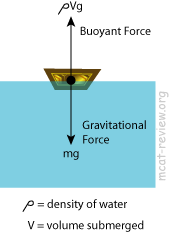
The condition for floating is quite simple: the buoyant force should be greater than or equal to the weight of the body. If the value of buoyant force is large enough, then a body floats; otherwise, it sinks. The only thing we need to worry about is how we can increase this buoyant force.
So… How Can We Walk On Water?
Method 1: Increase The Density Of Water
The amount of water displaced by the body is equal to the volume of the submerged part of the body. Therefore, if the density of water increases somehow, then the weight of the displaced volume of water also increases, which in turn increases the buoyant force, making it easier for the body to float. Water density depends on a number of factors:
1. The content of salt inside the water affects its density. The density of salt water is more than that of fresh water. Therefore, it is easier to float in the sea than a river.
2. Density of water increases with a decrease in the temperature, so it is easier to float in colder water.
3. Increase the amount of water displaced by increasing the volume of the submerged body. This is why ships have a big hollow base – to give it more volume.
As you can see, these basic factors can be tweaked to increase the buoyant force experienced by a floating body, making it easier to stay afloat.
Method 2: Increase The Viscosity Of Water
When we ride a bike, the wind pushes against our bodies, slowing us down. This is due to the friction we experience from the air particles. Similarly, when we are underwater, we experience drag force. This quality of the fluid to resist force or inhibit motion is called the viscosity of the fluid. The viscosity of the fluid is directly proportional to the friction force that a moving body experiences. We can harness this feature of water to actually walk on water! But How?
If the viscosity is strong enough, the friction force exerted upwards by the fluid could actually stop us from sinking. This force, along with the buoyant force, can let us walk on water more easily.
One possible way to walk on water is to run extremely fast – much faster than humanly possible. We wouldn’t sink while running at high speeds because the friction force experienced due to water also depends on the relative speed at which the body is moving when it is underwater. The Science Channel says that Usain Bolt, the fastest man on Earth, has a speed that tops out at about 10.4 meters per second. To run on water, you’d have to zip over the top three times as fast – around 30 meters per second!

Method 3: Oobleck
The viscosity of a fluid is not a constant; it changes when the characteristics of a fluid are changed. Some fluids have enough viscosity to be able to support the weight of a human body under the right conditions. Oobleck is nothing but a mixture of corn starch in water and can easily be made inside your kitchen. What’s special about this is that it is a non-Newtonian fluid, which means that its viscosity increases if the pressure applied on it increases. Hence, the faster we move in this fluid, the harder it is to overcome the friction force. This property of Oobleck can easily be exploited if we move over its surface with enough speed. A person walking over it at a brisk pace can easily move through without any fear of sinking, due to the high amount of reaction force from the fluid. However, on the other hand, if a person doesn’t move quick enough, the Oobleck will swallow him like quicksand.
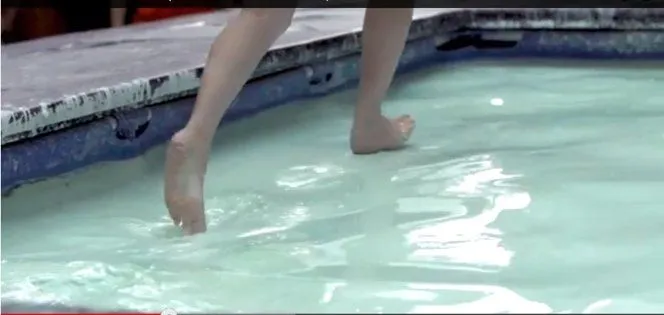
Technically speaking, walking over pure water isn’t possible. The only way it can be done is by converting it to a high density fluid or one with high viscosity. Also, if you think you can run at 108 km/hr (30 m/s), then you’ll have the ability to run across water. However, personally, I think that someone with that incredible ability would prefer the road!
How Do Insects Like Water Striders Walk On Water?
If walking on water is impossible for us, then how do those little insects skate across the surface of a pond without sinking? The answer is a force we haven’t talked about yet: surface tension. Water molecules cling to one another so strongly that the surface behaves like a thin, stretchy skin, and water happens to have one of the highest surface tensions of any everyday liquid (roughly 0.072 newtons per metre at room temperature).

The champions of this trick are water striders (also called pond skaters). Their legs are coated in thousands of microscopic, water-repelling (hydrophobic) hairs that trap a layer of air and refuse to get wet. Instead of piercing the surface, each leg simply presses down and creates a tiny dimple, the way you might dent a trampoline without falling through. Spread across those long, splayed-out legs (which work rather like snowshoes), the insect’s weight is shared over a large area. In fact, a water strider’s legs can support around 15 times its own body weight before the surface gives way, and it rows itself forward by sculling its middle legs against those dimples.
So why can’t we borrow the idea? Because surface tension only holds up things that are very small and very light. The supporting force depends on the length of leg touching the water, while weight depends on volume. Scale a water-walking creature up ten times in size and its weight balloons by roughly a thousandfold, while the leg length in contact with the surface grows only about tenfold (as MIT’s John Bush has pointed out). The math turns hopeless almost immediately, which is why surface-tension walking stays the preserve of insects and a few spiders and is utterly out of reach for anything as heavy as a human. Tip a drop of detergent into the pond and even the water strider sinks, because the surfactant destroys the very surface tension it depends on.
The Basilisk Lizard: The Animal That Really Runs On Water
There is one animal big enough to actually watch that genuinely runs across open water, and it has earned the nickname the “Jesus Christ lizard” for the feat. The basilisk lizard of Central America sprints upright on its hind legs across ponds and streams to escape predators, and it does so without any help from surface tension.

Researchers Glasheen and McMahon worked out exactly how it manages this in a classic 1996 study. Each foot does two things in a fraction of a second: it slaps the surface, and then strokes downward, opening up a pocket of air around the foot. Pushing against that air cavity is what holds the lizard up, and it yanks its foot back out before the cavity collapses and water rushes in. The slap alone provides only part of the lift; most of the support comes from the downward stroke.
Crucially, this is a game of body weight. The same researchers found that a tiny 2-gram hatchling can generate well over twice the upward push it needs to stay on top (about 225% of its body weight), while a hefty 200-gram adult can barely manage it (around 111%). The bigger and heavier the basilisk, the harder it becomes, which is exactly why juveniles dash across water far more easily than their parents.
And a human? Glasheen and McMahon estimated that for a person to hold themselves up this way, they would have to slap their feet against the water at more than 30 metres per second (about 108 km/h or 67 mph) while producing roughly 15 times the muscle power our legs can actually deliver. That is why ordinary water-running is firmly off the table for us. The one loophole, confirmed by a 2012 experiment, is gravity: with small rigid fins strapped to their feet, people were able to run in place on water once researchers unloaded their body weight to lunar-gravity levels or lower. On the Moon, it seems, the miracle would be merely difficult.
References (click to expand)
- Walking on water - Wikipedia. Wikipedia
- Buoyancy - Wikipedia. Wikipedia
- Could Humans Walk on Water? | Live Science. Live Science
- A hydrodynamic model of locomotion in the Basilisk Lizard. Nature
- Size-Dependence of Water-Running Ability in Basilisk Lizards. Journal of Experimental Biology
- Humans Running in Place on Water at Simulated Reduced Gravity. PLOS ONE
- How is it possible for insects and spiders to walk on water? Scientific American
- Species Spotlight - Water Striders. U.S. National Park Service