Table of Contents (click to expand)
- Basic Components Of A Cricket Pitch
- Performance Aspects Of A Cricket Pitch
- Different Types Of Cricket Pitches
- Logic Behind The Behavior Of A Cricket Ball Upon Impact With The Pitch
- How Does A Cricket Pitch Change During A Match?
- How Do Overhead Conditions And Dew Affect Play?
- What Is The Perfect Pitch Recipe?
The cricket pitch decides which bowlers and batters thrive in a match. Grassy or green pitches favor fast bowlers because seam and swing get more grip. Dry, dusty pitches turn sharply and reward spinners. Hard, even pitches without grass become "dead" or "batting-friendly", where runs come easily and bowlers struggle.
Why is the pitch given so much importance in cricket? How can it assist fast bowlers vs spinners? Let’s find out!
Have you noticed that cricket teams from Australia and England have some of the best fast bowlers in the world? However, when they play on subcontinent pitches in India or Pakistan, they prefer to include at least one spinner on their team. Similarly, teams like India and Sri Lanka, with some of the best spinners in the world, prefer to include more fast bowlers in their teams when they play in Australia and New Zealand.
So why do teams change their playing strategy based on the location of play?
Well, it all has to do with the type of pitch on which the match is being played. Different pitches favor different types of bowlers, so teams have to adjust their lineups accordingly. For example, fast bowlers tend to be more effective on bouncier pitches, while spinners do better on more sluggish surfaces.
By taking into account the type of pitch, teams can give themselves a better chance of success by fielding the right combination of players. The question is… how does the pitch come into the play? Let’s dive in!
Basic Components Of A Cricket Pitch
A good cricket pitch is made of clay (around 50-60%), coarse sand (less than 10%), calcium carbonate and sodium (less than 5%) and organic matter (less than 5%) (Source: West Indian Journal of Engineering, 2006).
The clay content in the soil affects the speed and bounce of the ball. High clay content is ideal for fast bowlers, but can also lead to cracking of the pitch. A higher silt content will make the ball turn more, making it ideal for spin bowlers. However, a pitch with high silt content tends to deteriorate faster and can cause unpredictable bounce as the game progresses.
Performance Aspects Of A Cricket Pitch
There are several factors that affect how well a cricket pitch performs. The most important ones are listed below.
- Shrinkage: This is an important factor in determining the quality of a pitch. It determines the ability of a pitch to retain its form as it dries. A higher shrinkage limit means that the pitch is less likely to develop cracks, which can cause unpredictable bounces and make it more difficult for batsmen to play well.
- Swelling: When the pitch gets wet with rain, the soil will begin to swell. This creates air spaces in the soil, making it less compact and spongy. As a result, the pitch will absorb more of the impact energy from the ball, resulting in a slower pace and a lower bounce.
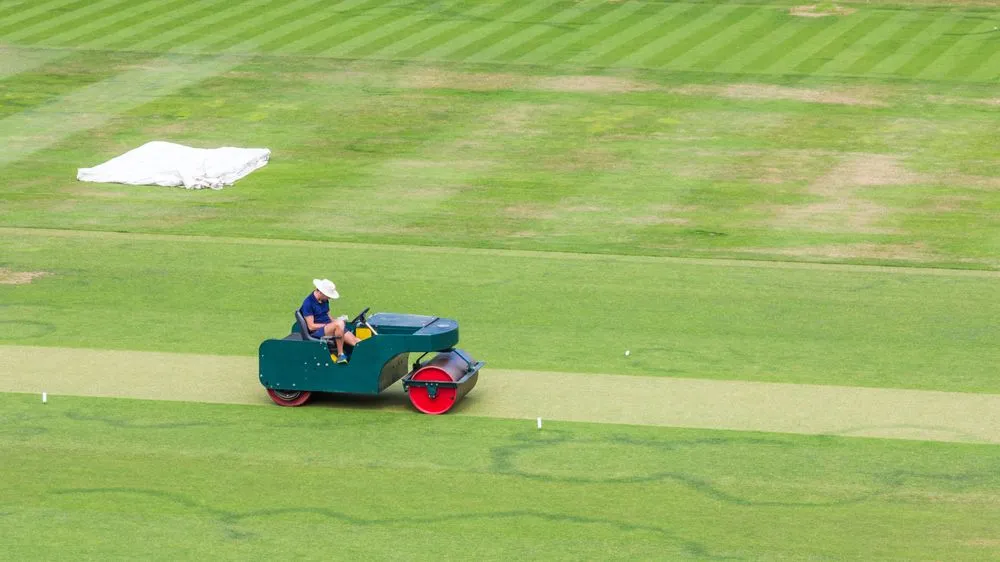
- Compaction: Pitch compaction is the ability of soil particles to bind together. This is enhanced by moving heavy rollers over the pitch. Higher compaction will make the pitch bouncier and faster.
Different Types Of Cricket Pitches
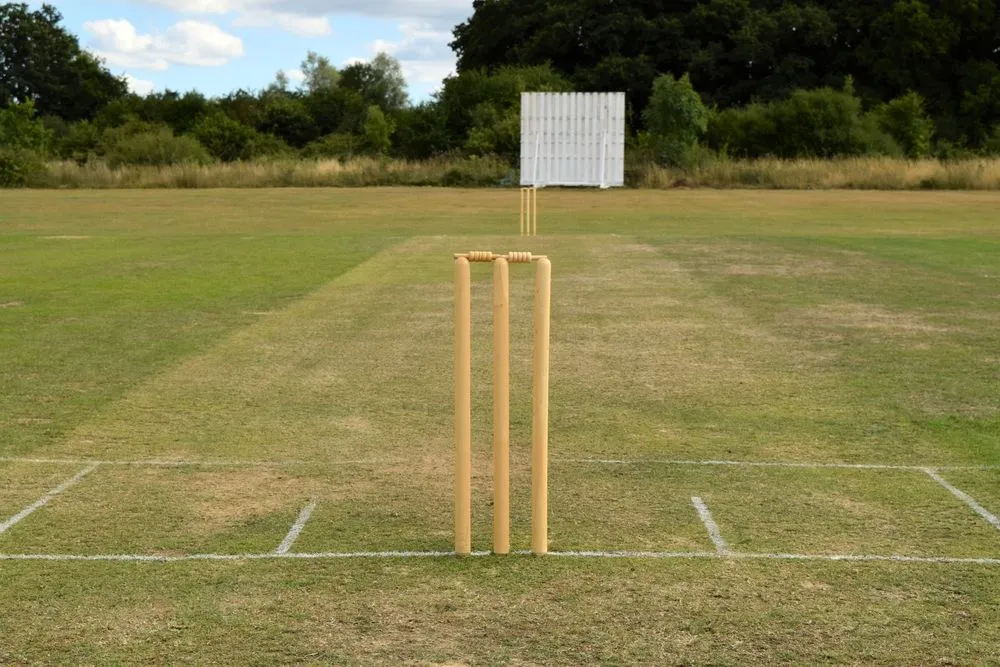
Cricket pitches can be broadly classified into three types.
- Green pitch: A green pitch is one that has a light covering of grass measuring 6-10mm. The ball does not grip the surface well on such a pitch, meaning that it retains speed and bounce. This makes it ideal for fast bowlers. The grass also helps retain moisture, which prevents cracks from forming in the pitch. Green pitches are common in Australia, New Zealand, England, and other countries.
- Dusty pitch: This type of pitch has a lot of sand on it because it isn’t rolled very well. The ball grips the surface when you hit it, which is good for spinners, as they can make the ball turn more. However, the bounce isn’t as good as on pitches that are kept in better condition. You will find this kind of pitch in India and other countries in that region.
- Dead pitch: A dead pitch is one that offers little assistance to bowlers, with neither their desired bounce nor tricky turns once the ball hits the surface. This is caused by continuous rolling, which eliminates grass or moisture on the pitch. Such pitches are usually prepared for shorter formats of the game, like 20 or 50 over matches, making them high scoring, as they favor batsmen. Dead pitches are found in subcontinent countries like India, Pakistan, and Sri Lanka.
Logic Behind The Behavior Of A Cricket Ball Upon Impact With The Pitch
Let’s try to understand two basic physics terms that will help explain the ball’s behavior when it hits the ground.
Coefficient of friction: This is a measurement of the amount of friction between two surfaces. The lower the coefficient of friction, the easier it will be for one object to slide against or over another. In terms of a cricket pitch, if there is less friction between the ball and the pitch, the ball will easily slide over the surface, maintaining its speed and bounce, which would assist faster bowlers. However, if there is more friction (a higher coefficient), then this would make the ball grip the surface more, thus assisting spinners to turn it.
Coefficient of restitution: The coefficient of restitution is the measurement of how much speed an object retains after hitting a surface. A high coefficient means that the object will retain most of its speed upon impact, which is beneficial for faster bowlers.
How Does A Cricket Pitch Change During A Match?
A pitch is not a fixed surface. It is more like a living strip of soil that keeps changing ball after ball and, in the longer formats, day after day. This is why a Test match can stretch across five days on the exact same 22-yard (20.1-metre) strip, yet feel like three completely different games.
On the opening day, the pitch is usually at its freshest. If some grass and moisture are still present, the ball can seam and swing, which is why a captain who wins the toss on a green, damp surface will often choose to bowl first and cash in before conditions ease. As the match wears on, the grass thins out under the constant pounding of the bowlers' run-ups and the batsmen's footwork. Crucially, the pitch cannot be watered once a game has started, so the surface only dries out further with every session.
On pitches with a high clay content, that drying causes the soil to shrink, and the cracks we looked at earlier begin to widen. By the fourth and fifth days, these cracks, along with the rough, scuffed patches (called footmarks) left by the bowlers' feet as they follow through, hand spinners plenty of grip. The ball starts to turn sharply and bounce unevenly, so a surface that offered fast bowlers movement on Day 1 can crumble into what commentators call a "turner", where batting last becomes a real struggle. This is exactly why a healthy first-innings lead is prized so highly, and why traditional spin nations like India and Sri Lanka are so tough to beat once a pitch begins to break up.
How Do Overhead Conditions And Dew Affect Play?
The soil is only half the story. What happens in the air above the pitch matters too, and this is where a lot of cricket folklore creeps in.

Take swing bowling. Players and commentators have long insisted that a humid, muggy day helps the ball swing. The science, though, does not back that up. A 2012 study by researchers at Sheffield Hallam University modelled ball trajectories and even laser-scanned the balls, and, in line with earlier work, found that humidity has no measurable effect on how much a cricket ball swings. What seems to matter more is cloud cover. An overcast sky reduces the heating of the ground, which calms the air and lowers the small-scale turbulence above the pitch. That still, low-turbulence air makes it easier for a bowler to hold on to the uneven airflow around the ball that produces swing. So it is most likely the calm air beneath the clouds, and not the moisture in it, that does the trick.
Then there is the dew factor, the headline talking point of almost every day-night limited-overs match. After sunset, the temperature can fall to the "dew point", the temperature at which the air can no longer hold all of its water vapour, and moisture condenses onto the grass, the outfield and the ball. A wet ball is slippery and hard to grip, and spinners feel it worst of all, because their craft depends on the fingers gripping the seam. Instead of biting into the surface and turning, the ball skids straight on, which makes life much easier for the batting side. Because chasing gets easier once the dew arrives, captains increasingly choose to bowl first when heavy dew is forecast, and ground staff even spray anti-dew agents on the outfield to keep it playable.
What Is The Perfect Pitch Recipe?
There are several factors that affect the quality of a pitch and how it will behave during a game. However, based on the information we have read, we can make some predictions.
A pitch that is high in clay content, with some grass coverage, and is dry with high compaction, will be suitable for fast bowlers. This type of pitch will have a high coefficient of restitution and a low coefficient of friction.
A pitch that is good for spin bowlers will have more silt, loose sand particles, and be dry with less compaction. This type of pitch has a low coefficient of restitution and a high coefficient of friction.
Now, the next time cricket commentators discuss a pitch before a game, you can try to predict the playing XI and whether fast bowlers or spinners will be included based purely on how the pitch behaves!
References (click to expand)
- James, D. M., Carré, M. J., & Haake, S. J. (2005, December). Predicting the playing character of cricket pitches. Sports Engineering. Springer Science and Business Media LLC.
- Pandey, A., & Rao, C. L. (2020, June). Numerical simulation of ball-pitch impact in cricket. International Journal of Advances in Engineering Sciences and Applied Mathematics. Springer Science and Business Media LLC.
- Improvement of Geotechnical Properties of Cricket Pitches. hilarispublisher.com
- E Ekwue —. Engineering Properties of Major Soils Used in Cricket Pitches .... The University of the West Indies
- James, D., Macdonald, D. C., & Hart, J. (2012). The effect of atmospheric conditions on the swing of a cricket ball. Procedia Engineering (SHURA, Sheffield Hallam University).
- Cricket: Humidity has no effect on swing bowling – study. NZ Herald.
- Cricket pitch. Wikipedia.
- Forecasts indicate dew is unlikely to affect World Cup final chase. Wisden.