Almost certainly not. While the underlying physics is sound (concentrated sunlight can burn small objects), a peer-reviewed analysis by Mills and Clift in the European Journal of Physics estimated it would take roughly 440 men holding 1 m2 mirrors just to scorch a 1 × 0.5 m patch of a wooden hull from 50 m away. Once you factor in moving Roman warships, damp timber, and a chaotic battle, the legend collapses. Mythbusters busted it three separate times.
I’m sure that many of us must have burnt a piece of paper at least once in our lives by focusing sunlight through a lens on a specific spot. The feeling of seeing the first hints of a black spot appear on the paper is bizarre, but very satisfying! After succeeding in burning a small piece of paper, many people have even tried to burn comparatively larger things by using the same principle, but found little or no success.
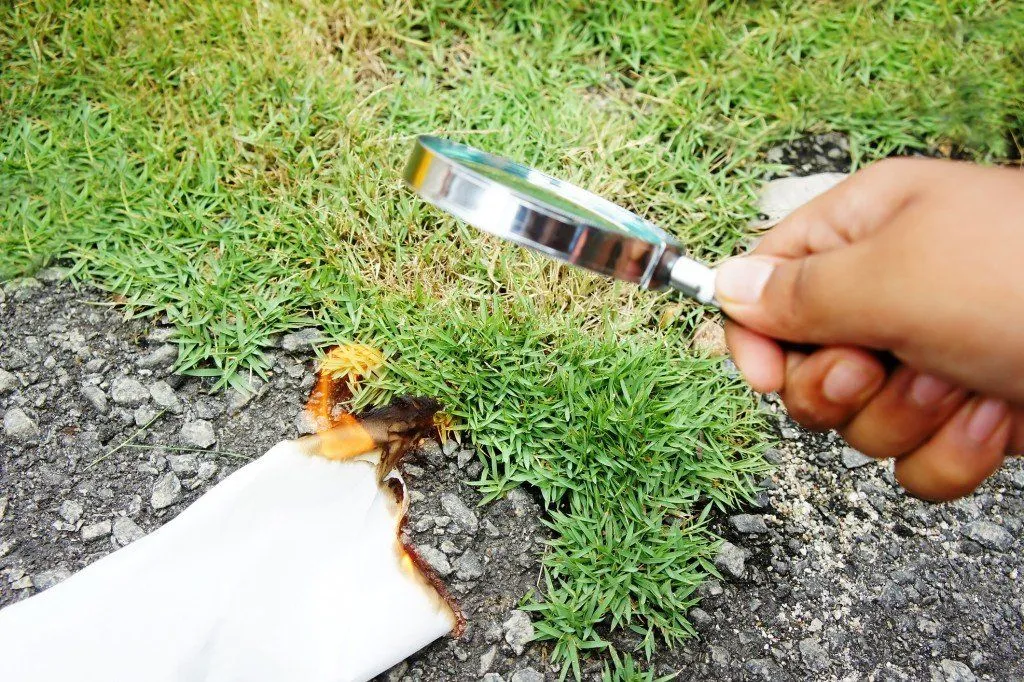
However, rest assured, many others have tried to do the exact same thing. In fact, legend has it that Archimedes, the famous Greek scientist and mathematician, also thought of causing destruction using the same principle, only on an exponentially bigger scale. It’s said that he created a ‘death ray’ by focusing sunlight through a large number of mirrors (or a single enormous mirror) onto the Roman fleet besieging his home city of Syracuse during the Second Punic War (around 214 to 212 BCE). Legend has it that he burnt down those enemy ships and sent the Roman attackers into complete disarray.
However, for this post, we’re not particularly interested in the latter part of the legend; rather, we would like to know if Archimedes ever actually built such a formidable ‘death ray’. More importantly, is it actually possible to burn ships by focusing sunlight on them through mirror(s)?
A Mirror’s ‘Burning’ Potential
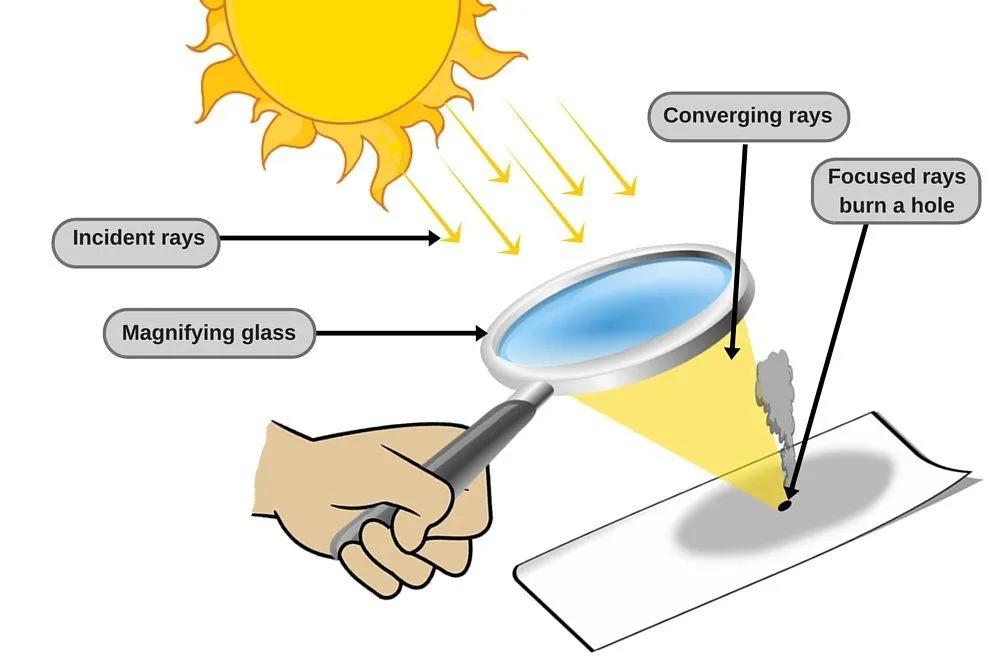
Let’s return to our little ‘paper-burning’ experiment using a small lens. Sunlight, or light rays coming from the sun, carry a specific amount of energy. Under normal conditions, sunlight doesn’t cause paper to light on fire because the light rays are diffused, or too far away from each other to be able to make any significant visible impact on the paper.
However, when you position a magnifying glass between the piece of paper and the light rays coming toward it, you essentially cause those rays to come closer together and converge onto a specific spot (called a ‘focal point’), which first turns black, and then, sometimes quite dramatically, bursts into flames!
Can The Same Principle Be Used To Burn Something Bigger, Say, A Ship?
Theoretically, yes… you CAN burn larger stuff (only things that can be burned, that is) using this principle, which means that there is some theoretical basis to Archimedes’ ship-burning legend.
That being said, in a real-life situation, it’s difficult enough to smolder a piece of wood, let alone set a huge ship ablaze! There are some practically insurmountable difficulties in burning a ship using this technique. Let’s take a look at a few:
Size Of The Mirror
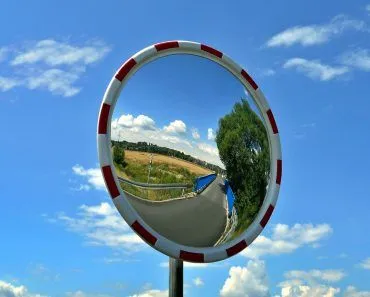
The first thing that would have upset Archimedes must have been the need to have a mirror; and a huge one at that! You see, it’s easy to burn a hole in a flimsy piece of paper with a small magnifying glass, but when it comes to burning a life-sized ship from a considerable distance, or even cause the tiniest of flames, you would need an impractically huge mirror.

Let’s suppose, for the sake of argument, that Archimedes had access to such a huge mirror. He would then have to figure out a way to transport, maneuver and point it precisely at the target without significant difficulty and as swiftly as possible. On top of that, Archimedes surely wouldn’t want to crack or dent the mirror even a little bit while moving it, would he?
Using A Cluster Of Mirrors?
Let’s assume that Archimedes used a cluster of smaller mirrors, rather than using one giant mirror. Now, is there anything wrong with that?
Yes… a lot of things, actually.

Scientists A. A. Mills and R. Clift investigated this historical legend and published a study called ‘Reflections of the Burning Mirrors of Archimedes’ in the European Journal of Physics. They found that it took 440 men, each holding a 1m2 mirror, to just begin to ignite a tiny area of 1*0.5 m of a wooden hull placed at a distance of 50 meters. This means that if you don’t want to try a giant mirror, you would need at least 440 mirrors and just as many men to aim them precisely at the target.
Even after all that effort, you would be far from obtaining the desired result. Supposing you get those 440 men to aim at a spot with surgical precision, you would still only be able to create a minor smolder, which could be easily quenched by saltwater (which is readily available to soldiers onboard a ship). Also, do you think that the enemy ship would be stationary and simply wait for your array of mirrors to inflict any serious damage on it?
Mythbusters, a popular Discovery Channel show, also tested if a ship could be burnt just by using mirrors, and concluded that first, it’s an uphill task to focus multiple mirrors’ reflected beams at a single spot. While you could achieve a temperature of a couple hundred degrees, it still won’t be as hot and as powerful as to be able to burn an entire ship down.
All in all, it’s practically impossible to burn a ship down by focusing sunlight on it through the use of mirrors. However, you can certainly blind, puzzle or inflict some burns on the skin of certain crew members onboard the enemy ship.
Turns out that Archimedes’ idea for this sort of assault on an enemy doesn’t hold much water, but history is always told by the victors!
What Do Historians Actually Say About The Legend?
Here’s the strangest part of this whole story: not a single historian alive during the Siege of Syracuse ever wrote about a death ray. Polybius, the Greek historian who described that siege in painstaking detail, talks at length about Archimedes’ war machines (cranes that yanked Roman ships clean out of the water, catapults that hurled stones, that sort of thing), but he never mentions a mirror. Neither does Livy, writing later from Roman sources, nor does Plutarch in his biography of the Roman general Marcellus.
The mirror version of the story only surfaces centuries after the fact. Lucian of Samosata, writing around 200 CE (about 400 years too late to be a witness), mentions Roman ships being set on fire by ‘artificial means’ without specifying what those means actually were. The first writer to explicitly describe Archimedes using a parabolic mirror is Anthemius of Tralles in the 6th century CE, in a treatise called On Burning-Glasses. Byzantine scholars like John Tzetzes and John Zonaras then re-told and embellished the tale in the 12th century, by which point Archimedes had been dead for over 1,400 years.
There’s also an inconveniently practical problem. Polybius and Plutarch both record that the decisive Roman attack on Syracuse’s sea walls came at night, which makes a sun-powered weapon spectacularly unhelpful. So the death ray almost certainly grew in the retelling. The Romans really did sack Syracuse, Archimedes really did design ingenious siege defenses, and later writers were happy to credit him with progressively more cinematic weapons.