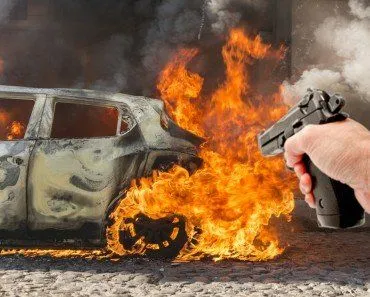
It is very unlikely that you will go up in flames if you toss a cigarette butt in a pool of gasoline. Cigarettes tend to burn at a much lower temperature than gasoline, and the fumes from the gasoline are the main burning agent, not the liquid itself. In addition, cigarette butts are more likely to ignite a lighter than the gasoline itself.
We’ve all seen it done a thousand times… a good (or bad) guy in a movie casually flicks his cigarette through the air, the slow-motion sequence begins, and we see that sparking tip ignite a waiting trail of gasoline, usually leading to a tanker or conveniently placed box of ACME explosives. The cigarette instantly ignites the gasoline, flames race along the surface, and the payoff explosion is as glorious as we’d hope for.
It’s pretty incredible in the movies, but the question is, can it happen in real life?
In short… not really, unless the conditions are absolutely perfect. But maybe we should take a closer look…
Gasoline And Cigarettes Don’t Mix?
Again, the answer to this should be quite simple, a yes or no answer, but in reality, the answer is slightly more complex. A lit cigarette smoulders at roughly 700-800°F (370-430°C) between puffs, and the glowing tip can reach 1300-1650°F (700-900°C) during a hard drag (source). Essentially, you are providing more and more oxygen for the fire to burn faster and hotter, thus eating up the tobacco and releasing smoke into your lungs. Now, the autoignition temperature of gasoline is much lower than that: roughly 475-536°F (246-280°C), with most safety references citing about 495°F (source).
On paper, this means that the gasoline should ignite quite quickly and an explosion is imminent. However, researchers have proven that this is highly unlikely. When a cigarette is not being “dragged”, the temperature drops considerably, making it harder to ignite. Furthermore, gasoline is dangerous due to the flammability of the fumes, not the liquid itself. When gasoline goes up in flames, the fumes from the liquid are the main burning agent. When the liquid isn’t in a contained space, like the open air of a gas station, it would be nearly impossible for the lit cigarette to ignite those fumes.
The variables of gasoline vapor, airflow, and the temperature of the cigarette are all difficult to calculate, but the probability is extremely low that you will go up in flames because you tossed a cigarette butt in a pool of gasoline. The most thorough investigation, a 2013 study by U.S. ATF researchers Marcus and Geiman published in Fire Technology, ran 70 distinct test configurations and exposed 723 cigarettes to gasoline vapors more than 4,500 times. Not a single one of those exposures produced ignition.
Several mechanisms have been proposed to explain why cigarettes refuse to light gasoline vapor. The ash that builds on the burning tip behaves like a tiny flash arrestor, insulating the glowing ember and even reforming after it’s knocked off. The combustion zone inside the ember is also oxygen-poor and rich in CO₂, which quenches any nascent flame. Finally, the hot gases convect upward, so petrol vapor near the puddle is swept away from the hottest part of the cigarette before it can ignite. Whatever the dominant reason, the lab data is consistent: lit cigarettes are remarkably bad at lighting gasoline.
If Cigarettes Are Relatively Safe, What About Lighters?
Interestingly enough, the sparking mechanism in a lighter has been shown to be more receptive to gasoline fumes than a lit cigarette. In other words, you would be much safer walking into a gas station with a lit cigarette, rather than lighting one once you’ve already walked through a few gasoline puddles.
While the probability of your imminent gasoline demise are very small, it’s better to simply avoid these types of situations whenever possible, unless you’re the cool guy from the movie who flicks a cigarette and turns his back on the explosion.

Can You Put A Cigarette Out In A Puddle Of Gasoline?
The internet is full of videos of people stubbing cigarettes out in cups of gasoline and grinning at the camera like they just defused a bomb. Are they lucky, or is the physics on their side?
Mostly the latter. Remember, liquid gasoline doesn’t burn; only the vapor does, and that vapor is only flammable within a narrow window, between 1.4% and 7.6% concentration in air (source). Right at the surface of a puddle, gasoline evaporates so aggressively that the air is far richer than that 7.6% ceiling. The layer where a dropped cigarette actually lands is too saturated with fuel to burn, in the same way that an engine flooded with gasoline refuses to start. The zone where the mixture can ignite floats somewhere above the surface, and as the ATF tests showed, a smoldering ember passing through that zone failed to light it in more than 4,500 attempts.
Before you try impressing anyone at a party, though… don’t. A freshly lit cigarette can carry a brief open flame on its paper, and an actual flame ignites gasoline vapor instantly, every single time. The lab record belongs to controlled laboratory conditions, not to your driveway.

Can A Cigarette Light Diesel?
If gasoline refuses to light from a cigarette, diesel doesn’t even show up for the argument.
The key concept here is the flash point: the lowest temperature at which a liquid fuel gives off enough vapor to flash when an ignition source comes along. Gasoline’s flash point is around -45°F (-43°C) (source), so at any temperature you will ever encounter at a gas station, a gasoline puddle is shedding ignitable vapor. Diesel is the polar opposite. The U.S. specification for diesel fuel (ASTM D975) requires regular No. 2 diesel to have a flash point of at least 125°F (52°C). Unless the fuel itself is hotter than that, a pool of diesel simply isn’t producing enough vapor to form an ignitable mixture. Drop a lit match into cool diesel and the most likely outcome is that the match goes out, as if you had dunked it in cooking oil.
That’s not to say diesel won’t burn. Spray it as a fine mist into hot, compressed air (which is precisely what a diesel engine does thousands of times a minute) and it combusts enthusiastically. But an open puddle on an ordinary day shrugs off a cigarette even harder than gasoline does, because there’s no flammable vapor layer hovering above it in the first place.

What Actually Starts Fires At Gas Stations?
If cigarettes are such hopeless fire-starters, why does every pump in the country wear a NO SMOKING sign? Because gas stations really do catch fire, roughly 4,150 times a year in the United States. Between 2014 and 2018, those fires caused an average of three deaths, 43 injuries and $30 million in property damage annually (source). The causes just aren’t the ones the movies trained you to expect.
More than half of station fires are vehicle fires, and about three-quarters of those trace back to mechanical or electrical failures (think leaking fluids meeting a hot exhaust manifold, or a frayed wire shorting out). Only about 2% of those vehicle fires started at the fuel tank or fuel line, which tells you that the act of refueling itself is rarely to blame. Smoking materials do start roughly a quarter of the outside fires on station properties, but they do it the boring way, by smoldering in mulch, trash or dry vegetation, not by lighting the gasoline.
The refueling fires that do happen usually have a sneakier villain: static electricity. The Petroleum Equipment Institute documented 176 refueling fires attributed to static discharge between 1993 and 2010, and nearly half of them struck in the dry winter months of December through February (source). The classic sequence goes like this: you start the pump, slide back into your seat to escape the cold, build up a charge through friction between your clothes and the seat, and then grab the nozzle again. The spark jumps right at the filler neck, exactly where gasoline vapor sits in its flammable band; in 87 of those 176 reports, the fueler had returned to the vehicle mid-fill and then touched the nozzle. It matters because gasoline vapor is heavier than air. It doesn’t float away; it pools low and can even creep along the ground to an ignition source and flash back (source).

Two myths worth retiring while we’re here: PEI has never documented a single refueling fire started by a cell phone, and gasoline can’t simply ignite itself on a hot day. As we saw earlier, it needs a surface at roughly 495°F (257°C) to autoignite, which no parking lot on Earth manages. So the real safety advice is wonderfully mundane: stay out of the car while you fuel, touch bare metal away from the nozzle if you do get back in, and keep open flames far away, because while the cigarette in your hand probably won’t light the gasoline, the lighter that lit it absolutely can. (And if you’re wondering about the other Hollywood staple, we’ve also covered whether shooting a car’s gas tank makes it explode.)
References (click to expand)
- Marcus, H. A., & Geiman, J. A. (2013, December 24). The Propensity of Lit Cigarettes to Ignite Gasoline Vapors. Fire Technology. Springer Science and Business Media LLC.
- Holleyhead, R. (1996, October). Ignition of flammable gases and liquids by cigarettes: a review. Science & Justice. Elsevier BV.
- Jewell, R. S., Thomas, J. D., & Dodds, R. A. (2011, June). Attempted ignition of petrol vapour by lit cigarettes and lit cannabis resin joints. Science & Justice. Elsevier BV.
- NIOSH Pocket Guide to Chemical Hazards: Gasoline. Centers for Disease Control and Prevention.
- ASTM D975: Standard Specification for Diesel Fuel. ASTM International.
- Ahrens, M. (2020). Service or Gas Station Fires. National Fire Protection Association.
- Renkes, R. N. (2010). Fires at Refueling Sites That Appear To Be Static Related. Petroleum Equipment Institute.
- Gasoline. CAMEO Chemicals. National Oceanic and Atmospheric Administration.