No, humans cannot spontaneously combust. Around 200 cases have been reported over the past three centuries, but none have been witnessed and no internal mechanism has ever been demonstrated. Forensic investigators believe these deaths are explained by the wick effect: an external spark ignites clothing, body fat melts into the cloth, and the fabric burns like a candlewick for hours.
It’s a beautiful day in South Park. The four boys are walking out of a store when, suddenly, Kenny erupts into flames! Oh no! Viewers of South Park will probably recognize this story from Season 3, Episode 2 (aired in 1999).
(Spoilers ahead!)
In this particular episode, the town is faced with people spontaneously combusting. A scientist finds that the cause of this is methane buildup in people who refuse to fart regularly. This leads to the people of South Park farting excessively, which, according to cartoon logic, leads to global warming and ozone depletion. The scientists then come up with the final solution: people need to fart in moderation. Phew! That was a rollercoaster ride from start to finish.
However, on a more serious topic, can humans in the real world spontaneously combust?

Spontaneous Human Combustion
Spontaneous Human Combustion is when a person is found with significant burns, specifically on their torso and abdomen, with little or no damage to their extremities and surroundings, and with no obvious cause for the burns.
Around 200 cases have been cataloged over the past three centuries (Larry Arnold’s 1995 book Ablaze! is the most cited tally). Crucially, not one of them has ever been witnessed by another person. Given the nature of the phenomenon, there are a number of theories that try to explain it.
However, let us first remember that the two basic components for fire are a source of ignition and a source of fuel. Keep these two things in mind as you read on.
Reported Cases Of Spontaneous Human Combustion
The earliest widely cited case is that of Countess Cornelia Bandi of Cesena, found burnt to ashes in her bedroom in 1731; the Royal Society fellow Paul Rolli published the report in 1746, and Jonas Dupont compiled a famous collection of similar cases (De Incendiis Corporis Humani Spontaneis) in 1763. An influential 1823 medical text described most reported victims as elderly women, often with heavy alcohol use and limited mobility, which led many at the time to brand it a supernatural act of punishment.
However, we are a scientific community, so we demand some level of scientific reasoning.
Some of the scientific reasons suggested for this phenomenon include the movement of important body fluids and the presence of flammable compounds. Our body makes certain compounds that can spontaneously combust. Some researchers believe that gases such as methane, which are normally produced in the body, may occasionally be involved in some “freak” internal reaction that causes them to spontaneously combust. However, no such reaction has ever been discovered or described.
Critics of this theory point out that such cases never occur in animals that produce even higher amounts of such gases, such as cows.
A number of researchers suggest that a human body cannot “go up in flames” without some external trigger, no matter how small. The trigger itself may get combusted in the fire, like a matchstick, thus leading to the illusion of spontaneous combustion.
Another factor is that the victims of spontaneous human combustion have mostly been found near chimneys, fireplaces, or other open flames. While on-site investigators often failed to find a clear link between the corpses and these heat sources, researchers believe such proximity could easily have triggered the fire. In most cases the corpse was so badly burned that it was impossible to identify the original spark.
Some people also believe that excessive alcohol consumption can cause alcohol to seep into a person’s clothing, making it more inflammatory, which contributes to the so-called wick effect.
The Wick Effect
The human body essentially has three combustible components. First is the skin, which can burn when dry and dehydrated, but it’s not a very good fuel source. Second, we have bone, which is a decent source of fuel due to the bone marrow, but not very easy to burn otherwise. Finally, there is fat, which is an excellent source of fuel.
Here’s the interesting bit. Human fat itself ignites only at relatively high temperatures, around 250 °C (482 °F). But once it has melted and soaked into cloth, the cloth acts as a wick, and the fat can keep feeding a low, slow flame even though the bulk fat sits at a temperature as low as about 24 °C (75 °F). This is the wick effect.
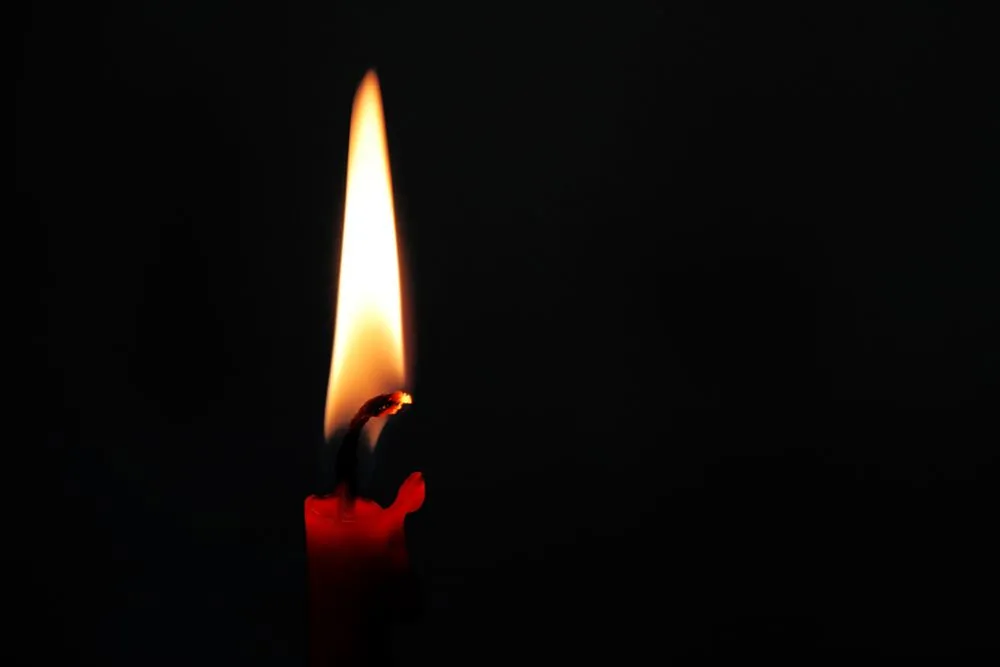
According to this theory, once the clothes catch fire and the fat melts, the body burns due to the wick effect. This is supported by the fact that clothed bodies burn faster in a fire, as compared to unclothed bodies.
The forensic pathologist David Gee recreated this in a Leeds laboratory in 1965. He wrapped a piece of human fat in several layers of thin cloth to form a roll about eight inches long, then applied a Bunsen flame to one end. Thanks to the high water content of human fat, he had to hold the flame on it for over a minute before it caught, but once it did, the “candle” burned slowly along its length for about an hour with a smoky yellow flame and heavy soot, with no external fuel source required.
Forensic scientist Dr. John DeHaan ran a now-famous demonstration of the same idea on a larger scale. A pig’s carcass (chosen because pig fat content is similar to a human’s) was wrapped in a woollen blanket, doused with a small amount of gasoline (about the energy of a dropped cigarette or stray ember), and set alight inside a furnished room. The gasoline burned off within the first few minutes, but the carcass kept smoldering and burning for roughly five hours, fed almost entirely by its own melting fat soaking into the blanket. Damage to the surrounding room was minimal.
The wick effect also explains the pattern of burning in victims of spontaneous human combustion. Since the fat content in our bodies is typically concentrated in our torso, it explains how most victims were found with their legs minimally affected by the fire.
A major criticism of this theory is the burning of bones. Without boring you with too many figures, our bones need relatively high temperatures to burn completely. As it is extremely difficult to replicate actual cases of alleged spontaneous human combustion, it’s not possible to determine whether these fires reached these high temperatures.
The justification for this is that most victims may have suffered from osteoporosis (a condition in which the density of the bones decreases). In such a case, a slightly lower temperature may suffice to burn the bones.
Are Humans Flammable?
Not really, at least not in the way a dry log or a splash of petrol is. The single biggest reason is water. Up to 60% of an adult human body is water, and that water is the main obstacle to combustion. Before any tissue can char, a fire has to boil off all of that moisture, and doing so soaks up a huge amount of energy. It is exactly why a stray spark or a brief brush with a flame usually just singes the skin rather than setting the whole person alight.

The one genuinely fuel-rich part of us is fat. Even a lean person carries several kilograms of it, and fat holds plenty of chemical energy. The catch, as we saw with the wick effect, is that solid human fat does not ignite until it reaches around 250 °C (482 °F). Skin, muscle, and internal organs are far too waterlogged to make good fuel, and bone barely burns at all. So while a body technically contains enough stored energy to burn itself down to ash, it will never do so on its own. It needs a steady external flame first, to dry the tissue out and melt the fat, before the wick effect can take over and keep it going.
A Modern Case: The Michael Faherty Verdict
If most reported cases feel safely locked away in dusty 18th-century records, one modern example keeps the debate alive. In December 2010, 76-year-old Michael Faherty was found badly burned in the sitting room of his home in Ballybane, Galway, in Ireland. The fire damage was strange in the classic way: his body was almost completely destroyed, with scorching on the ceiling above him and the floor beneath him, yet the rest of the room was left largely untouched.
At the inquest in September 2011, forensic experts reported that they had found no trace of an accelerant and no evidence of foul play, and concluded that the fire burning in the room’s fireplace had not caused the blaze. West Galway coroner Dr. Ciarán McLoughlin, who said he had never seen anything like it in 25 years on the job, returned a verdict of “spontaneous human combustion, for which there is no adequate explanation.” According to the BBC, it was the first such verdict ever recorded in Ireland.
Skeptics were quick to push back. As you would expect from everything above, they argue that the wick effect is the far more likely culprit: an elderly person, an open fire in the same room as a ready ignition source, and clothing that could smoulder for hours while the badly burned body simply hid the original spark, be it a stray ember, a match, or a cigarette.
As you can see, the jury is still out on whether this bizarre phenomenon is possible or not. While wick theory remains the most probable cause, it does reiterate that an initial source of fire or a spark is required for the process to begin. However, the occurrence of this event is incredibly rare, so it’s definitely something to wonder about, rather than worry about!
References (click to expand)
- Koljonen, V., & Kluger, N. (2012). Spontaneous Human Combustion in the Light of the 21st Century. Journal of Burn Care & Research, 33(3), e102-e107.
- Christensen, A.M. (2000). Debunking the Spontaneous Human Combustion Myth: Experiments in the Combustibility of the Human Body. M.A. Thesis, University of Tennessee, Knoxville.
- Wick effect. Wikipedia (summary of Gee 1965 Leeds experiment and DeHaan pig demonstration).
- The Water in You: Water and the Human Body. U.S. Geological Survey (USGS) Water Science School.
- Spontaneous human combustion. Wikipedia (scientific consensus that reported cases involve an overlooked external ignition source).
- Court finds pensioner’s death in fire caused by spontaneous combustion. The Irish Times (2011).
- Irishman’s Death Ruled Spontaneous Combustion. ABC News (2011).