No telescope on Earth—including Hubble or the 10.4-meter Gran Telescopio Canarias—has anywhere near enough resolving power to image the Apollo flags, rovers, or lander bases on the Moon. You would need a mirror roughly 200 meters across just to see the flag, and 25 meters to register the lander base as a single pixel. The Apollo landings have instead been confirmed up close by NASA's Lunar Reconnaissance Orbiter, which has photographed every landing site since 2009.
For almost every major event in history, a conspiracy theory seems to be attached, usually consisting of an altogether different explanation of the incident/event, which kicks off numerous controversies and debates as to the original story’s validity. There have been many conspiracy theories throughout history, but one of the most popular ones that many people, communities, and even countries can’t let go of is the authenticity of the Apollo landings (i.e., whether the moon landings were real or fake). Such theories claim that some or all elements of the Apollo program conducted by NASA were hoaxes.
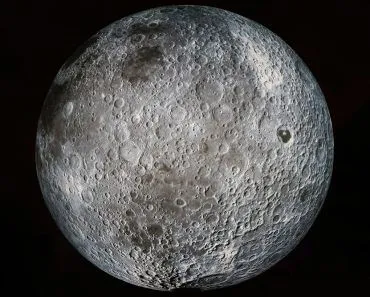
To test the authenticity of the event, or in other words, to test whether or not the Apollo landings did occur, many folks suggest using high-powered telescopes to look for signs of the landings on the lunar surface.
But would that work? In simple words, can high-tech telescopes (say, the Hubble Space Telescope) see signs and artifacts of the Apollo missions on the lunar surface and confirm if the Moon landings were real?
Short answer: No telescope on Earth, including Hubble, can resolve the Apollo flags, rovers, or landers on the Moon—you'd need a mirror ~200 meters across. NASA's Lunar Reconnaissance Orbiter has photographed every landing site instead..
Visual Signs Of The Apollo Landings On The Lunar Surface
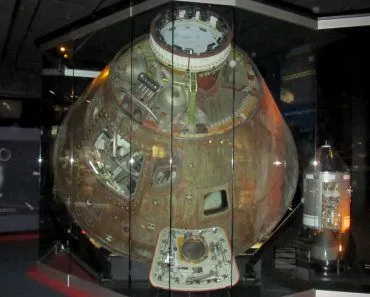
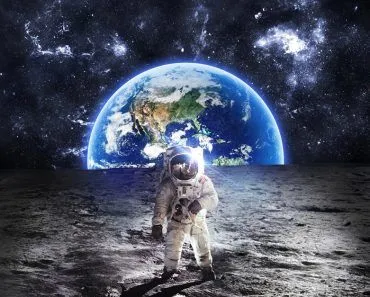
Pick any of the multiple Apollo missions and check its Wikipedia page (here’s the Wikipedia link of Apollo 16). For more in-depth insights, you can also look up the Apollo press kit on NASA’s official website (here’s the press kit of Apollo 16). You can see that the landings left quite a few imprints on the lunar surface in the form of small blast craters and human footprints, as well as multiple artifacts, including the American flag, the base of the lunar modules and moon rovers.
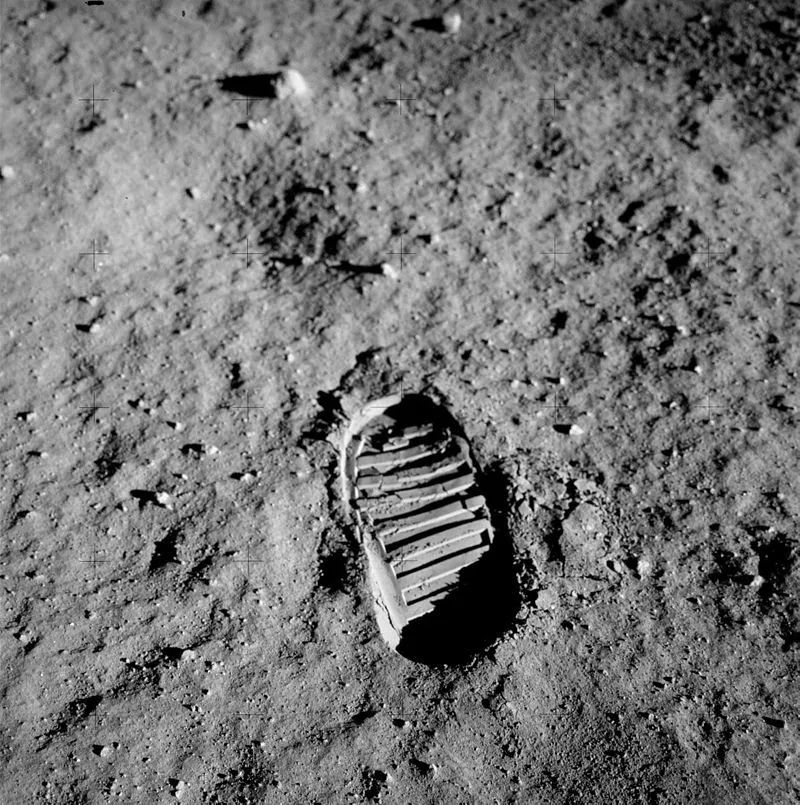
Some of these visual signs, such as human footprints, are obviously too small to be observed from a telescope back on Earth, but the others (like the American flag and the rovers) are comparatively larger and thus more likely to be observed. However, the size of these pieces of evidence is not the issue.
Resolving Power
When you stand next to a person, you can see them clearly without any problems, but seeing the same person from a distance of 1 mile wouldn’t be the same. How about seeing them from a distance of 10 miles? A hundred? Unless you have access to Charles Xavier’s Cerebro from X-Men, you wouldn’t be able to tell if that person is truly there or not.
The same thing is true when it comes to telescopes. The more ‘powerful’ the telescope, the more it easily it can differentiate and produce images of two objects that are close in proximity. In technical terms, we’d say that ‘telescopes have a high resolving power’.
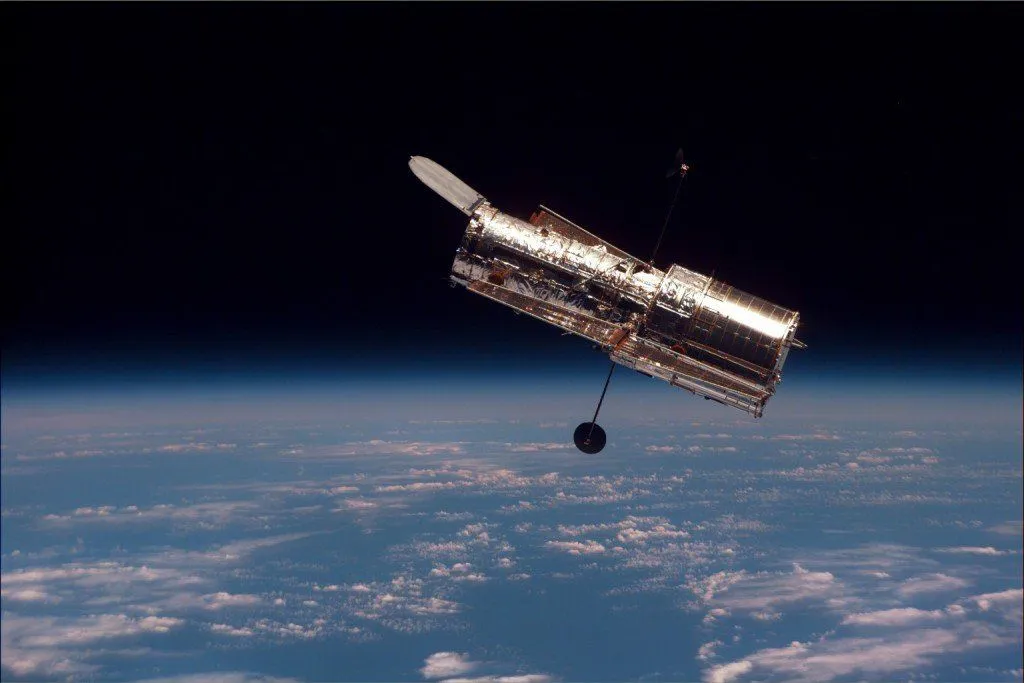
Whether or not an object in space can be seen through a telescope depends largely on its resolving power, which in turn depends heavily on the size of the lens/mirror being used.
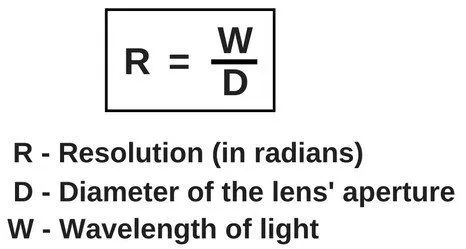
In optics, there’s a simple formula to determine the resolution of any telescope.
The Resolving Power Of The Hubble Telescope
Suppose we try to look for visual signs of the Apollo landings through the Hubble telescope. We know that its diameter is 2.4 meters (7.9 feet). We also know that the wavelength of visible light is in the range of 400-700 nanometers, so let’s call it 600 nanometers for ease of calculation.
Substituting these values in the above formula, the resolution of the Hubble comes out to be 2.5 e-7 radians. Calculations show that the smallest thing the Hubble can see must be at least 96 meters in size!
Now, let’s look at the sizes of the artifacts that were left on the lunar surface during the Apollo landings.
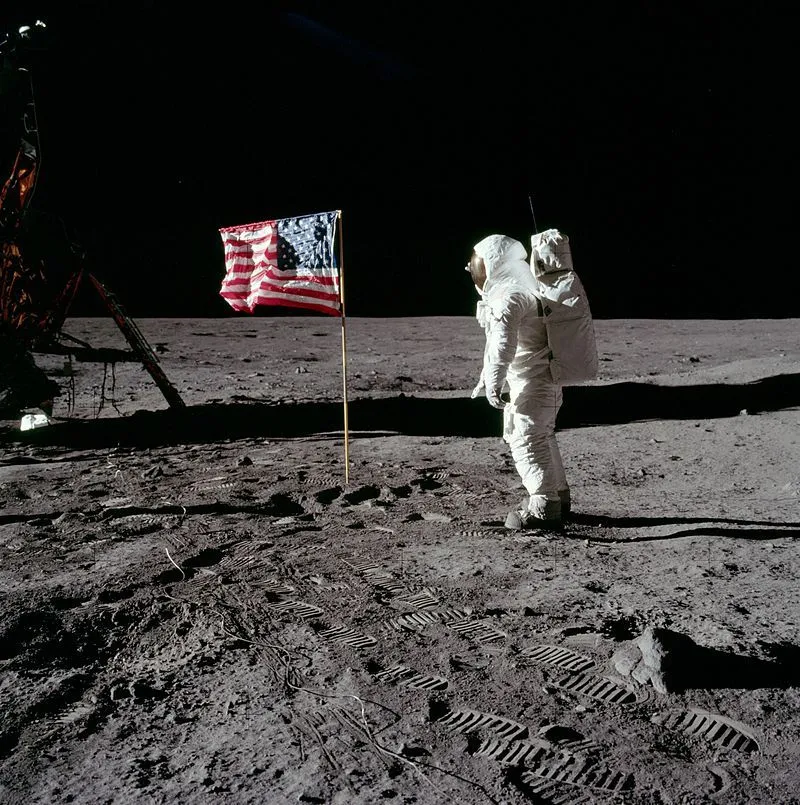
The Apollo lunar flags measured roughly 5 feet long by 3 feet tall (1.52 by 0.91 m). To resolve a feature that small from Earth, you would need a telescope around 200 meters in diameter! The Hubble telescope, with a paltry diameter of 2.4 meters, would be extremely ineffective in resolving the American flag.
Now, let’s look at something that’s bigger than the flag – the lunar Rover. Its length is 3.1 meters, so it would take a telescope 75 meters in diameter to spot it. Another element, the lunar lander base, along with the landing gear (which is 9.5 meters across) would require a telescope nearly 25 meters across to even barely represent it in a single pixel.
Therefore, using the Hubble telescope to view signs of the Apollo landings is totally out of the question. Forget the Hubble, even the biggest optical telescope we have back on Earth—the Gran Telescopio Canarias in Spain, with an effective aperture of 10.4 meters—still falls more than seven times short of resolving even the lunar lander base. The Extremely Large Telescope (ELT) being built in Chile will eventually have a 39-meter primary mirror, but even that giant, expected to see first light around 2029, would barely register the lander base as a fuzzy single-pixel blob, and would still be hopeless on the flag or rover.
So, Did The Apollo Landings Really Occur?
Most definitely!
Many scientists, academics and astronomers all over the world have come forward against the ‘moon landings were hoax’ conspiracy theorists, so there is no shortage of logical arguments that support the authenticity of the moon landings.
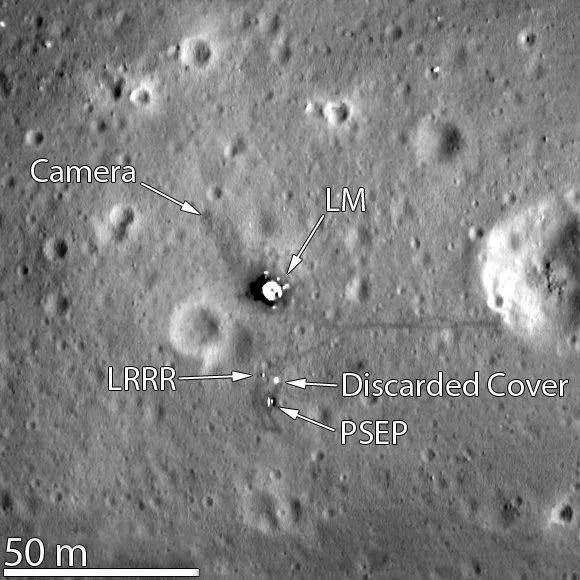
Furthermore, the Lunar Reconnaissance Orbiter (LRO)—a NASA robotic spacecraft that has been orbiting the Moon since 2009—has captured many high-resolution images of every Apollo landing site, complete with the descent stages, scientific instruments, rover tracks, and even the astronauts' footpaths still etched into the regolith. India's Chandrayaan-2 orbiter and Japan's SELENE spacecraft have independently photographed Apollo landing-site features as well, joining a long list of third-party evidence that supports the authenticity of the landings—including the laser retroreflectors left behind by Apollo 11, 14, and 15, which observatories around the world still bounce laser pulses off today. So, yes—the Apollo landings were REAL!
To conclude, yes, it’s theoretically possible to observe visual signs of the moon landings through telescopes, but with the technology we have at our disposal today, all you’d see is a bunch of dots (if that) if you tried looking at the lunar surface for proof (or a lack of proof) of the landings.
References (click to expand)
- Apollo program - Wikipedia. Wikipedia
- Resolving power - Wikipedia. Wikipedia
- Hubble Space Telescope - Wikipedia. Wikipedia
- Third-party evidence for Apollo Moon landings - Wikipedia. Wikipedia
- Are there telescopes that can see the flag and lunar rover on .... Cornell University
- How to Spot Apollo Moon Landing Sites in Telescopes | Space. Space.com