Table of Contents (click to expand)
Apollo 13 was meant to be NASA's third Moon landing, but 56 hours in, an oxygen tank in the service module exploded and the landing was scrapped. Rather than orbit, the crew looped once around the Moon's far side on a free-return trajectory, using its gravity as a slingshot back to Earth. All three men landed safely on April 17, 1970.
“Okay, Houston, we’ve had a problem here.”
These were the words Jack Swigert radioed back to NASA, moments after an oxygen tank ruptured aboard Apollo 13 (Jim Lovell repeated them seconds later, and the line is usually remembered as “Houston, we’ve had a problem”). Apollo 13 was supposed to be NASA’s third Moon landing, a sure-footed success that instead turned into one of the worst spacecraft malfunctions ever, right in the middle of the journey. The 1995 film takes its inspiration from this accident, but what makes this particular spaceflight stand out from every other mishap in the annals of spaceflight?
Astronauts Of Apollo 13
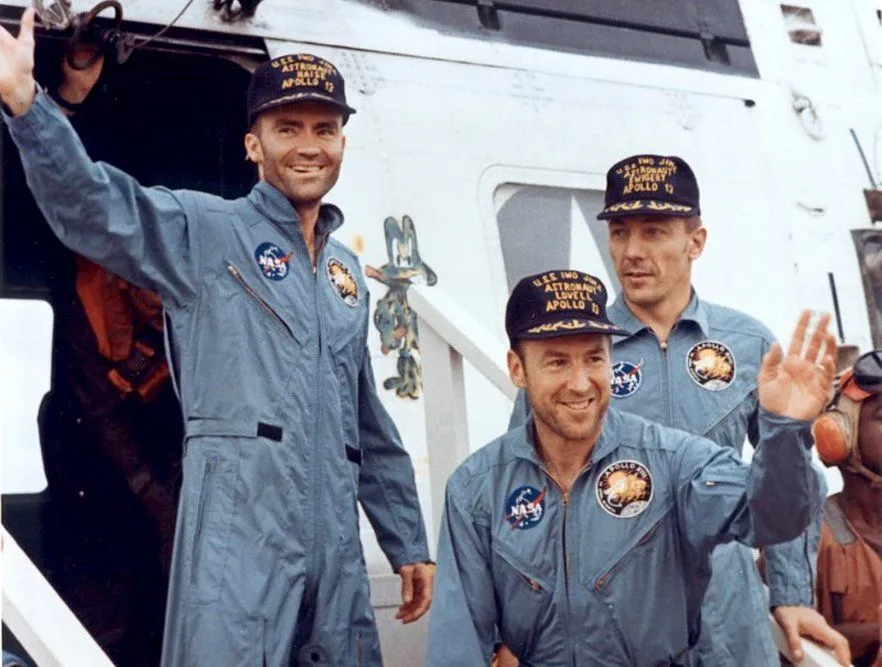
The Apollo 13 spacecraft launched on April 11, 1970, from the Kennedy Space Center in Florida. The crew was composed of a three-person team.
First was James Arthur Lovell Jr., more popularly referred to as Jim Lovell, the commander of the Apollo 13. He was first designated as a Naval Aviator on February 1, 1954. In 1962, when NASA was looking for a second group of Astronauts for the Gemini and Apollo programs, Lovell applied and was selected. However, another fun fact is that it was the second time he applied and got picked. Lovell had been the backup commander for Apollo 11 and was originally slated to command Apollo 14. His crew was moved up to Apollo 13 in a swap with Alan Shepard’s crew, who needed more training time.
Next, we have Jack Swigert, an American test pilot, as well as a mechanical and aerospace engineer, United States Air Force pilot, and NASA astronaut. He was the Command Module Pilot for the Apollo 13 mission. The funniest thing is that Jack was not even commissioned to fly on Apollo 13. However, the backup crew had been exposed to German measles (rubella), and a blood test showed that Ken Mattingly lacked immunity to it. To avoid the risk of him falling ill mid-mission, NASA grounded Mattingly just two days before launch and brought Jack in as a last-minute replacement. (As it turned out, Mattingly never came down with the disease.)
Finally, we have Fred Wallace Haise Jr., who was a former American fighter pilot with the U.S Marine Corps and a test pilot before joining NASA. He was inducted in the NASA Astronaut Group 5 in 1966. His role was to be the lunar module pilot aboard the Apollo 13 space mission.
STRUCTURE OF APOLLO 13
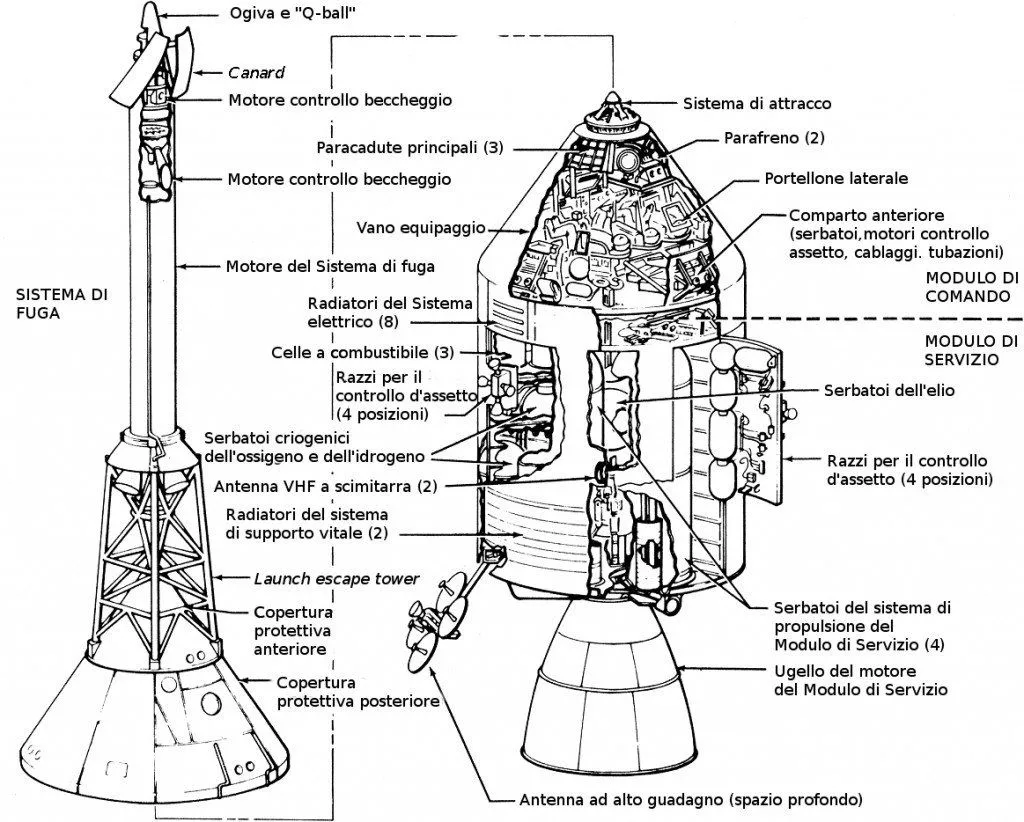 The spacecraft had three main modules, all of which had various responsibilities in their contribution towards the success of the mission.
The first is the Service Module, which was designed to provide consumables, such as oxygen, water, and power for the mission. It was also the primary propulsion stage of the spacecraft. It was in this module that the first fault occurred. On a normal flight it stayed attached until shortly before re-entry, partly to shield the command module’s heat shield from the prolonged cold of space.
Naturally, the next part of the spacecraft is the Command Module, which was equipped with couches, and served as the crew compartment and control center. The main purpose of this module was to bring the astronauts safely back upon re-entry.
The final module was the Lunar Module, which was designed for landing on the moon and would serve as an operation base and living quarters for the astronauts. It played a critical role in the survival of the astronauts and acted somewhat like a lifeboat.
A Crucial Fault Occurs
The Apollo 13 mission is aptly dubbed a ‘successful failure’ by NASA. The objective of the mission was to land on the moon, but 56 hours into the flight, there was a loss of cryogenic oxygen from the service module, and an electrical fault occurred.

The exact sequence of events occurred after 55:53:18 of ground elapsed time (GET). All spacecraft systems were in nominal condition until the fans in the cryogenic oxygen tank were turned on. When the fans switched on, a short circuit occurred in the fan wiring inside the no. 2 cryogenic oxygen tank in the service module. Within seconds, further short circuits followed.
The electrical short circuit that had occurred in the fan of the cryogenic oxygen tank resulted in the melting of the wire insulation, resulting in an increase of pressure within the cryogenic oxygen tank. This drove the pressure within the cryogenic oxygen tank up to about 1008 psi (roughly 6950 kPa). Although a relief valve was present, this helped in reducing the pressure for only 9 seconds, after which the relief valve failed and closed, causing the pressure to rise again.
This led to several other faults occurring within a matter of seconds, including a tank line bursting open due to severe heat generated by the short-circuiting of the cryogenic oxygen tank.
The Survival
Severe heat buildup in the service module had led to the power failure. This led to the malfunction of all vital life-supporting functions. The power failure led the crew to evacuate the command module immediately. With only one alternative place to survive, the team shifted to the lunar module, which was intended to help them survive on the surface of the moon.
With careful coordination between ground control and the astronauts, they were able to devise an economic return plan, taking into consideration the shortage of amenities and fuel. The method they devised was to use the moon’s gravity as a gravitational slingshot.
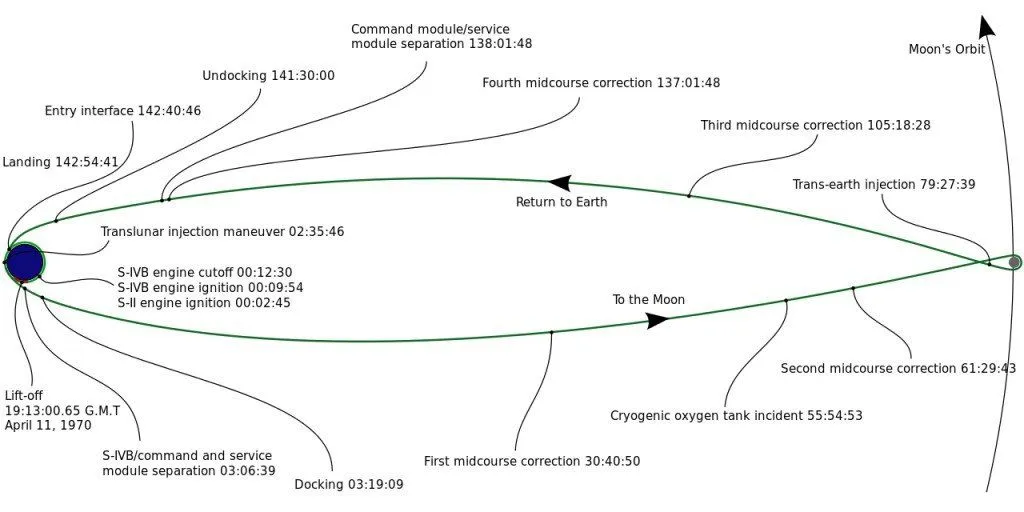
Contrary to a common misconception, Apollo 13 never went into orbit around the Moon. Instead, it was put on a free-return trajectory: a path that swings close enough to the Moon to be bent around by its gravity, but not so close that the spacecraft is captured into orbit. Apollo 13 looped once around the far side of the Moon, letting lunar gravity sling it back toward home, and a short engine burn after the flyby refined that course. Because the spacecraft passed behind the Moon rather than orbiting it, the crew swung out to 400,171 km (248,655 mi) from Earth, a record for the farthest humans had ever traveled that stood for 56 years, until NASA’s Artemis II crew edged past it in April 2026.
This truly is a remarkable feat, not only considering the age in which it was done, but also the level of nerves both the astronauts and ground control had to show. Also, considering the ingenuity of both parties at critical moments, this story is one that people will continue to tell for generations to come.