We answer the phone with ‘hello’ because Thomas Edison championed it. On August 15, 1877, he wrote to T.B.A. David that ‘Hello! can be heard 10 to 20 feet away’, beating out Alexander Graham Bell’s preferred ‘Ahoy’. The first telephone manual, published in New Haven in 1878, made ‘Hulloa’ the recommended greeting, and ‘hello’ stuck.
(telephone line ringing….)
– “Ahoy!”
(pause)
– “I’m sorry?”
– “Why?”
– “I’m sorry. I must have dialed the wrong number. Goodbye.”
When you call someone on the phone, how do you expect them to answer? With a ‘hello’, right? Can you picture yourself calling someone and being greeted by ‘Ahoy’? Wouldn’t the (very short-lived) conversation play out somewhat like the dialogue above if it began with such a seemingly bizarre salutation? ‘Hello’, on the other hand, is so ubiquitous that you’d never stop to wonder why it is so standardized, despite the hullabaloo of other words we experience every day.
We can thank Mr. Edison for pushing the non-nautical word “hello” into the world of telephone conversations.
Setting Sail From ‘Ahoy’
A gusty call of ‘ahoy’ brings to mind a grubby-looking sailor calling for the attention of one of his mates. This nautical interjection is widely linked to the Dutch greeting ‘hoi’ and the older English ‘hoy’. It surfaced in English nautical writing by the mid-1700s (Tobias Smollett used it in his 1751 novel The Adventures of Peregrine Pickle) and served to hail another ship or attract its attention, often in the longer phrase ‘Ho, the ship ahoy!’. It was on the shortlist of phrases that could kick off a telephone conversation, but generally stayed within the nautical realm.
‘Hello’: The Humble Beginnings Of A Conversation Starter
At a mere 5 letters, “hello” is a short word, but it’s definitely not small.
As a ubiquitous part of daily conversation, ‘hello’ needs no introduction. You pick up any phone, and the knee-jerk reaction is to say ‘hello’. This opens the door for all further chatting. A cheery ‘hello’ acts as the perfect prelude to a stimulating discussion.
So, where did hello come from?
It turns out, hello can be traced back to the early 19th century. It stemmed from variations like ‘hallo’, ‘hullo’, ‘hollo’ and ‘holla’, salutations that had been in use to hail someone since the late Middle Ages (the Oxford English Dictionary links them to Old High German halôn, ‘to fetch’, used in calling a ferryman). ‘Halloo’ was traditionally a shout used to urge hounds in the chase. The British variant ‘hullo’ served as an expression of surprise. The earliest known printed use of hello itself dates to 1826, in the Norwich Courier of Connecticut, where it originally functioned as an expression of surprise and a call to attention rather than a greeting.
How does a plain-old hailing greeting turn into a conversational Messiah around the world?
‘Hello’ Trumps ‘Ahoy’
The year was 1876. Alexander Graham Bell had just introduced the telephone, a device that would go on to revolutionize the world of communication. ‘Ahoy’ was slated to become the salutation that greeted every caller when the telephone was picked up. However, in an Edisonian turn of events, ‘hello’ trounced its competitors as the chosen greeting.
When Thomas Alva Edison was tinkering with sound-recording machines in 1877, ‘halloo’ was already on his lips as a default call-to-attention. One frequently cited account has him bellowing ‘halloo’ into the phonograph mouthpiece, although the canonical first phonograph recording was Edison’s recitation of ‘Mary had a little lamb’ later that same year. Either way, the same word would soon follow him from the lab into the realm of telephonics.
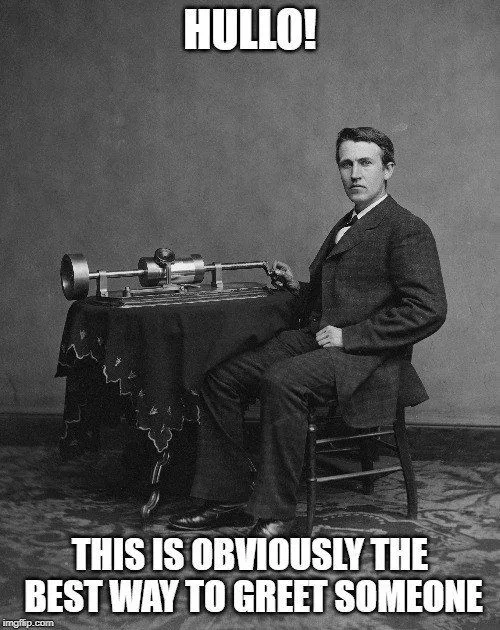 On August 15, 1877, Edison wrote a letter to T.B.A. David, president of the ‘Central District and Printing Telegraph Company’ of Pittsburgh. In this letter, retrieved later from the American Telephone and Telegraph Company archives, he explained the perks of using ‘hello’ when speaking on the telephone. This was a time when the addressee was planning on introducing the device to the city. Edison envisaged a permanently open line of communication between businesses, allowing people to speak to each other at the simple click of a finger, but how would you catch a particular person’s attention?
“Friend David, I don’t think we shall need a call bell, as hello! can be heard 10 to 20 feet away. What do you think? EDISON”, he wrote.
The time between the phonograph experiment and the above letter had clearly led to a modified version of his earlier ‘halloo’.
In 1878, the first set of telephone exchanges began to be equipped with operating manuals. Telephone books came with detailed ‘How to’ guides. They set down prescribed caller guidelines, including the most appropriate salutations and closures. Incidentally, ‘that is all’ was considered to be the best way to say goodbye.
The first commercial telephone exchange, the ‘District Telephone Company of New Haven’, opened in Connecticut on January 28, 1878. It began with just 21 subscribers, and by February 21 of the same year it published the first ever telephone directory, a single-page flyer listing 50 names. The numbers stayed low because most users preferred to be connected through an operator rather than pay for a private line.
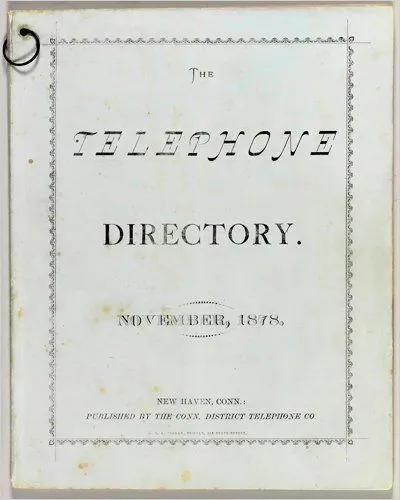
This manual vouched for ‘hulloa’ as the conversation starter, as opposed to contenders like ‘What is wanted?’, ‘Are you there?’, and ‘Are you ready to talk?’.
These glorious references jump-started an illustrious career that would solidify the place of ‘hello’ in a dynamic world with fluctuating trends.
The Course Of A New And Improved ‘Hello’:
Our favorite salutation climbed its way up the conversational ladder rapidly after 1878.
Mark Twain’s 1880 sketch ‘A Telephonic Conversation’, published in The Atlantic Monthly, gave us the first recorded use of ‘hello’ in literature as a telephone greeting. An 1880 convention of telephone companies held in Niagara Falls, New York, saw widespread positive reception for the organizational president’s speech, which consisted of a single word: “Hello”. Soon after, ‘Hello’ was the accepted call used to signal that telephone communication had been established.
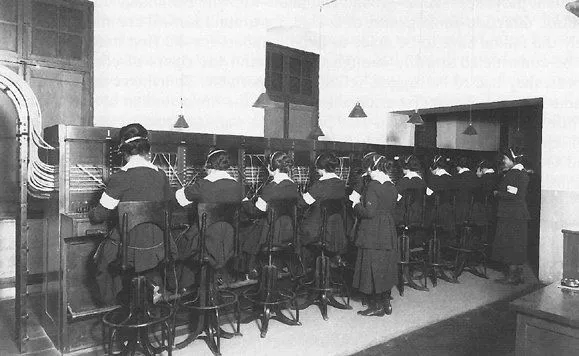
Female telephone operators, preferred over their male counterparts because they lent a pleasant air to phone calls, were nicknamed ‘hello girls’. Mark Twain’s 1889 novel A Connecticut Yankee in King Arthur’s Court nodded to them directly, with the protagonist even naming his daughter ‘Hello-Central’. Three decades later, bilingual ‘hello girls’ (French and English) served as switchboard operators with the U.S. Army Signal Corps in World War I, dramatically speeding up communications on the Western Front.
Did Bell Ever Give Up On ‘Ahoy’?
Here is the delicious irony of the whole saga: the one man who never surrendered to ‘hello’ was the telephone’s own inventor. Alexander Graham Bell had championed ‘ahoy’ (often doubled up as ‘ahoy, ahoy’), the salty hail he had borrowed straight from the decks of ships, and he was in no hurry to let his rival Edison rewrite his etiquette. There is no real evidence that Bell’s nautical greeting ever caught on with the wider public.

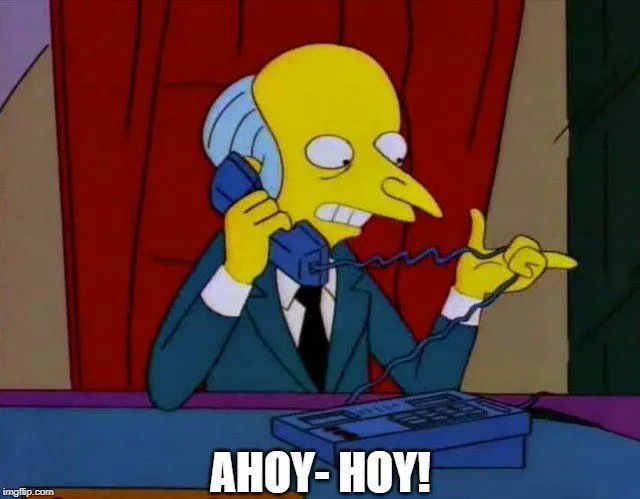
Bell, however, was stubborn. According to language writer Ammon Shea’s book The Phone Book, as recounted by NPR, Bell reportedly kept answering his own telephone with a hearty ‘ahoy’ for the rest of his life, quietly refusing to concede the point to Edison’s ‘hello’. The greeting was never fully forgotten, either: fans of The Simpsons will recognize ‘Ahoy-hoy’ as the endearingly out-of-date way the elderly Mr. Burns picks up his phone, a knowing wink at the salutation that time left behind.
How Does The Rest Of The World Answer The Phone?
‘Hello’ may have conquered the English-speaking world, but travel a little and you will find that other languages settled on entirely different words to break the ice, and most of them are less about greeting and more about a practical question: can you hear me?

In Italy, callers answer with ‘Pronto’, meaning ‘ready’ (from the Latin promptus), a brisk way of saying ‘I’m here and I can hear you’. Japan went one better with ‘Moshi moshi’. It grew out of the humble verb mōsu (申す, ‘to say’), which early operators repeated over crackly, low-quality lines to make sure they were getting through, so it lands somewhere close to ‘speaking, speaking’, the spoken equivalent of tapping a microphone. China’s ‘Wéi’ (喂) has a similar backstory: it began life not as a greeting but as a quick check to find out whether the person on the other end could hear anything at all, and it is still reserved almost exclusively for the phone.
Elsewhere the logic repeats. In Spain, people answer with ‘¿Diga?’ or ‘Dígame’ (‘speak’ / ‘tell me’), while in Mexico the standard is ‘Bueno’, literally ‘good’, used here to mean something closer to ‘well?’. Germans often skip the pleasantries altogether and simply announce their surname. Different words, same instinct: before you can properly chat, you first need to know the line is working.
Hello, Is It Me You’re Looking For?
More than a century after ‘hello’ first gained prominence, it continues to be used tens of millions of times every day. The simplest questioning ‘hello’ wields enough power to lead complete strangers into a dialogue. ‘Good-bye’, leading to a single, dismissive end, cannot compete against the many potential spins that ‘hello’ can take. Informal and short, the latter packs quite a punch for facilitating easier communication between billions of people!
References (click to expand)
- Ahoy Definition & Meaning - Dictionary.com. Dictionary.com
- HELLO | Meaning & Definition for UK English | Lexico.com - www.lexico.com
- A (Shockingly) Short History Of 'Hello' - NPR. National Public Radio
- Great 'Hello' Mystery Is Solved - The New York Times. The New York Times
- U.S. Army Signal Museum, Fort Gordon, Ga - www.signal.army.mil
- A Telephonic Conversation - Mark Twain (1880). MIT OpenCourseWare
- Hello. Wikipedia
- Hello - Etymology, Origin & Meaning. Etymonline
- On this date in 1877, inventor Thomas Edison suggested ‘Hello’ to the president of the Central District and Printing Telegraph Co. Hagley Museum and Library
- Hello Girls. Wikipedia
- How to Answer the Phone in Different Languages. Portable Press
- Why Moshi Moshi Doesn’t Actually Mean Hello. Busuu Blog
- Answering the Phone: How to Greet Them the Right ‘Wei’. eChineseLearning