Mayday is a distress signal used by sailors and pilots when their ship or aircraft is in danger. It is derived from the French term ‘m’aidez’, which means ‘help me’. The word became popular after it was used by a radio officer at Croydon Airport in London in 1923. It is now a standard distress call used by many countries.
Unless you’ve been living under a rock for years, you’ve likely heard the term Mayday, especially in critical situations involving ships and aircraft. Have you ever wondered what the story is behind this unusual word? I mean, it’s not even a proper English word, right?
Why do sailors/pilots use this word when their ship is about to sink or when their aircraft has experienced a critical technical snag that could bring them down? What’s wrong with using English words like ‘help’ or ‘danger’ instead? Does it have anything to do with a day in the month of May, or is it just another term in aviation/maritime jargon without a definite meaning that just stuck?
Short answer: The term Mayday is derived from a French term ‘m’aidez‘, which basically means ‘help me’.
What Is ‘Mayday’?
Mayday is a special word used as a distress signal in radio communication by mariners and aviators all over the world. If a ship/aircraft faces immediate danger that could be life-threatening to the crew and passengers, the radio operators onboard will broadcast a Mayday signal to request help.
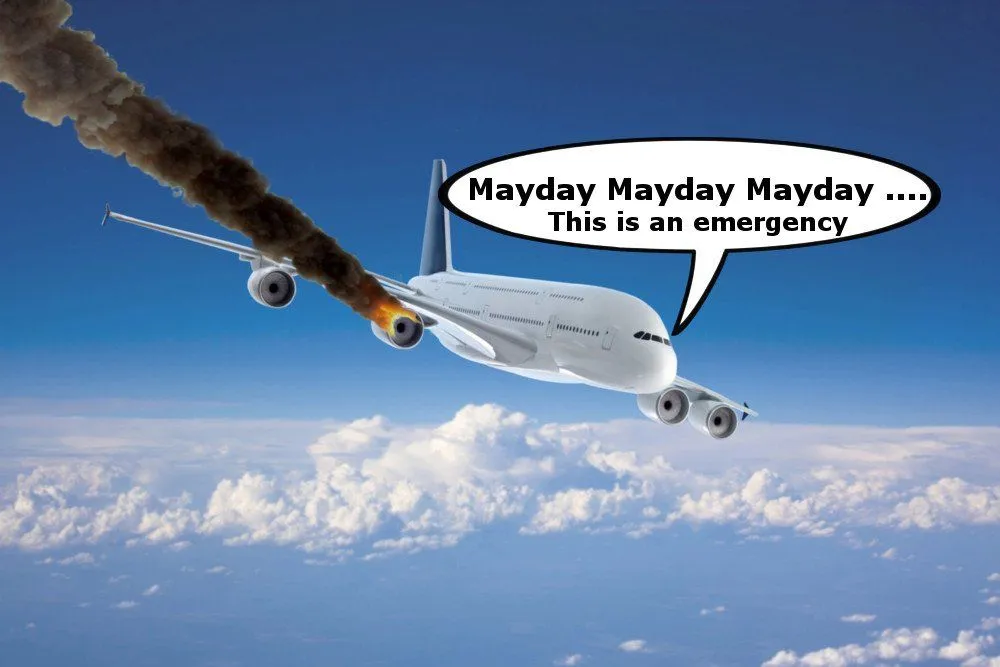
Although it’s typically known to be used by the crew of ships and aircraft, there are some countries whose local government organizations, such as police, fire safety department, and transportation authorities also use Mayday as a distress signal to express an imminent threat to life.
What’s The Story Behind The Word ‘Mayday’?
The word ‘Mayday’ might, quite understandably, lead one to believe that it has something to do with a particular day in the month of May, but let me assure you that it’s not even distantly related to springtime.

The word Mayday is actually an anglicization, or in simple words, the English approximation of a French phrase “m’aidez” or “m’aider”, which literally means ‘help me’. It’s said to have originated with a senior radio officer at Croydon Airport in London named Frederick Stanley Mockford in 1923. He was asked to come up with a word that could be used in distress signals that could easily be understood by all pilots and support staff at airports. Since much of the air traffic at that point was between Croydon and Le Bourget Airport in Paris, he proposed the word “m’aider”, which is actually a shortened version of “venez m’aider”.
The term was well-received by users and was consequently adopted as the standard voice (radiotelephone) distress call by the International Radiotelegraph Convention of Washington in 1927. Note that Mayday did not replace SOS; the older Morse code signal SOS stayed in use for radiotelegraph, while Mayday took over for voice transmissions, because the letter ‘S’ is hard to make out clearly over a crackly radio. Today, the term ‘Mayday’ has become synonymous with imminent peril or a life-threatening situation.
How Is A Mayday Call Transmitted Over Radio?
Have you ever noticed in movies/TV shows depicting a ‘Mayday situation’ in a ship or plane that they never just say “Mayday, our ship has developed a major leak” or “Mayday, both our main engines have failed”? This is because there’s a particular, predefined way in which a Mayday signal needs to be transmitted.
The word ‘Mayday’ must be said loud and clear three times in a row, followed by the call sign and type of ship/aircraft, location details, type of emergency and its severity, the number of persons onboard and any other vital piece of information that the transmitter considers to be important enough to be relayed. For more clarification, here is a distress message format released by the US Coast Guard.
Note that it’s necessary to repeat the word Mayday three times in a row so that it cannot be confused with a similar-sounding phrase by the receiver. Also, it helps any potential receivers to confidently know that it’s an actual Mayday call and not a message about a Mayday call. If a ship cannot send a Mayday signal due to problems with its radio system, a Mayday relay can also be transmitted by another ship on its behalf.
Here’s a real-life example of a mayday call made by MV Summit Venture when it collided with the Sunshine Skyway Bridge in 1980, resulting in its collapse.
A very important thing to remember about making a Mayday call is that it could land you in prison and burn a large hole in your pockets if it’s not a legitimate emergency!
Yes, that’s right. Making a false distress call to the Coast Guard is a federal crime in the US (14 U.S.C. § 521(c), the renumbered successor to the older § 88), a Class D felony punishable by up to six years in prison, a civil penalty of up to $10,000, and liability for every dollar the Coast Guard spends responding. In other words, don’t radio a Mayday signal just because a tap in the kitchenette onboard your boat stopped working; doing that might land you in some real trouble!
What’s The Difference Between Mayday, Pan-Pan And Sécurité?
Here’s something the movies almost never tell you: Mayday isn’t the only word a pilot or skipper can reach for. It sits at the top of a three-rung ladder of radio calls, each one signaling a different level of trouble, and each one telling everyone else on the frequency exactly how seriously to take you.

Mayday is the top rung: the distress call. The US Federal Aviation Administration defines a distress condition as one “of being threatened by serious and/or imminent danger and requiring immediate assistance”, so think fire onboard, a sinking hull, or engine failure with the ground rushing up. A Mayday outranks every other transmission on the frequency and effectively commands radio silence so the rescue can be coordinated.
Pan-Pan (said “pahn-pahn”) is the rung below, the urgency call. Like Mayday, it comes from French, but the parent word here is panne, meaning a breakdown or mechanical failure. The FAA defines urgency as “a condition of being concerned about safety and of requiring timely but not immediate assistance; a potential distress condition.” A fishing boat with a dead engine and a fair-weather forecast, or a plane with a sick passenger but no immediate danger, would use Pan-Pan. It tells other stations to clear the channel and stand by, while still yielding to any genuine Mayday. Just like Mayday, it’s spoken three times in a row: “Pan-Pan, Pan-Pan, Pan-Pan.”
Sécurité (“say-cure-ee-tay”, French for ‘safety’) is the bottom rung. It isn’t about your own emergency at all; it flags a message “concerning the safety of navigation or giving important meteorological warnings”, such as a drifting container, a buoy that’s gone dark, or a storm warning. It too is repeated three times before the message. So the next time you hear one of these on a radio, the very first word already tells you whether someone is fighting for their life, dealing with a serious-but-survivable problem, or simply warning the rest of us to watch out. The same logic lets mobile phones place emergency calls even with no signal of their own.
References (click to expand)
- Mayday - Wikipedia. Wikipedia
- Emergency Procedures - 1st Coast Guard District - www.uscg.mil
- 47 CFR § 80.5 - Definitions. - www.law.cornell.edu
- Communications Instructions Distress And Rescue Procedures - CiteSeerX
- The origins of SOS and Mayday | OxfordWords blog - blog.oxforddictionaries.com
- Aeronautical Information Manual, Chapter 6, Section 3: Distress and Urgency Procedures. Federal Aviation Administration
- Pilot/Controller Glossary: Distress. Federal Aviation Administration
- Pilot/Controller Glossary: Urgency. Federal Aviation Administration
- 47 CFR § 80.327 - Urgency signals and messages. Legal Information Institute, Cornell Law School
- 47 CFR § 80.329 - Safety signals and messages. Legal Information Institute, Cornell Law School
- 14 U.S. Code § 521 - Saving life and property. Legal Information Institute, Cornell Law School