Table of Contents (click to expand)
Faxes have faded since the internet arrived, yet they are still used routinely in healthcare and by law enforcement. Fax persists because of perceived security, easy interoperability between mismatched systems, familiar regulatory rules, and plain old resistance to change. In US healthcare especially, fax remained the default for sharing records long after email became common.
If someone asks you to ‘fax’ them a copy of a document for college or work, you’d probably reply back incredulously. Why, in the age of the Internet, should anyone be faxing something?
Hold on to your horses, as fax isn’t dead yet. Granted, their usage is nothing like it used to be in the 1980s or 90s, but thousands of fax machines are still sold every year in the US alone. So, according to technology historian Jonathan Coopersmith, it’s still way too early to regard fax as a relic of the past. In fact, a fax is probably being sent somewhere for some reason at this very instant!
Where Is Fax Still Used?
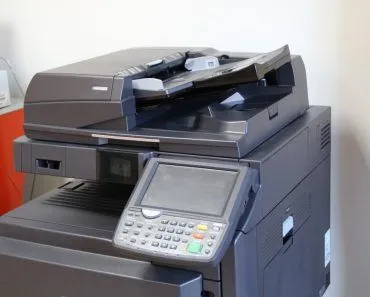
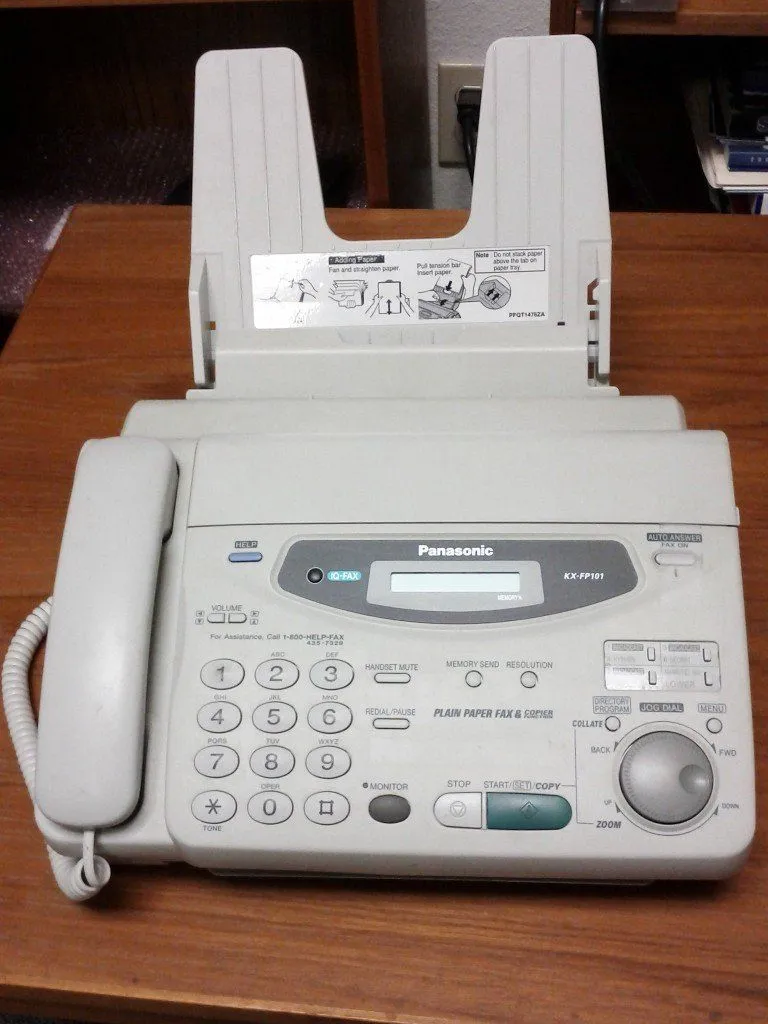
Surprisingly, fax machines are still used routinely in many places. In fact, faxes were once at the forefront of communication technologies. Even today, it is regularly used by law enforcement agencies for bail postings or the delivery of public records. Similarly, the healthcare industry still largely uses fax machines. There were numerous attempts to upgrade them with better alternatives, but thanks to the regulatory confusion, the phobia of online security, and stubbornness to change, fax machines are still churning and working all across the globe.
History Of Fax Machines
Although the use of fax machines peaked in the 1980s and 1990s, very few people know that fax machines have actually been around since the 19th century. In fact, fax technology was well ahead of its time, considering that the next widespread method to send scanned images/documents electronically, i.e., email came nearly 100 years after the first device that could send a facsimile message.
Scottish inventor Alexander Bain patented the basic idea of the fax way back in 1843, decades before the telephone. His design used synchronized pendulums to scan a message line by line and reproduce it remotely on chemically treated paper. Bain’s machine was never a practical, working system, so it is still debated whether he truly built the “first fax”. The Englishman Frederick Bakewell demonstrated an improved version in 1851, and Italy’s Giovanni Caselli ran the first commercial facsimile service between Lyon and Paris in the 1860s. Around that same period, other inventors, including Thomas Edison and Alexander Graham Bell, were also chasing facsimile technology that had the power to be the next big thing in the communication industry. By then, telegraphs had carried messages across great distances, albeit with a limitation: one letter at a time. However, the people wanted a technology that could allow them to send copies not just of text, but also of images/documents, and be able to do it at higher speeds. This was one of the biggest motivations for eminent inventors of that era to strive for a facsimile technology. French novelist Jules Verne prognosticated Paris of the 1960s to be brimming with fax machines, making such a prediction in his writing in the 1860s!
Adoption Of Fax Machines
Fax technology turned out to be one of the most important revolutions in communication technology. Americans first came to know about fax machines during the famous New York World’s Fair of 1939 where a fax machine sent images for newspapers at the rate of 18 minutes per page, a remarkable speed for that time.
 However, it was only after a few decades that the use of fax picked up in offices around the world. Fax machines brought about major improvements in the speed of business transactions, allowing companies and individuals to disseminate documents quickly and broadly. Someone in an office in China could, in a matter of minutes, send an important business document to an office in the US.
Even so, its reign was short-lived. The invention of the internet diminished the utility of fax machines. In fact, in 1995, MIT Media Lab founder Nicholas Negroponte said that fax machines would no longer be relevant in the modern technology landscape. Several years later, his prediction turned true as the demand for fax machines began to wane.
Although the sales of fax machines are on the decline, sectors like law enforcement and healthcare still rely on fax machines for day-to-day activity. This is due to rigid regulatory frameworks, concerns over the security of digital systems, and plain old resistance to change.
Why Is Fax Still Used?
Faxes are used in both routine and high-stake situations by doctors. In fact, according to one estimate, nearly 3/4 of medical communications occur via fax!
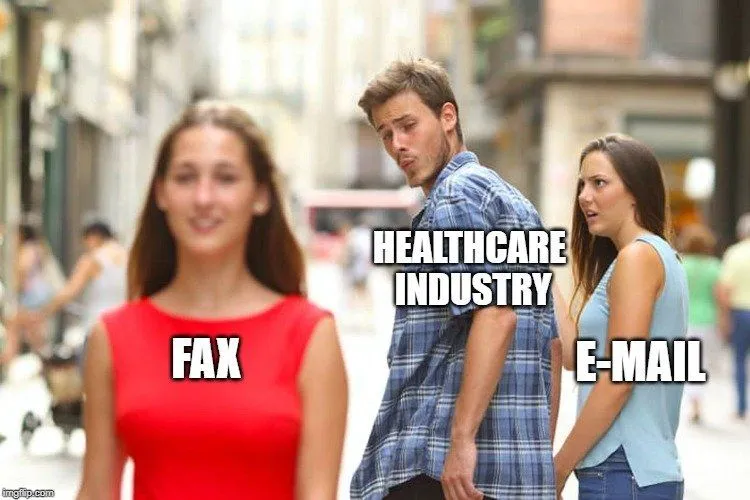
Many millennials taking up medical studies are flummoxed by the use of fax machines in the age of the Internet. Some have vehemently expressed their discontent over the use of what they call “an ancient technology”. Despite the confusion and outrage, fax use hasn’t abated much in the healthcare realm. Around the time this article was first written, the US Office of the National Coordinator for Health IT estimated that about 7 in 10 hospitals still relied on fax to transfer patient records, and various surveys have pegged roughly three-quarters of all medical communication as fax-based. Much of this is blamed on US health privacy law, HIPAA, which requires providers to take stringent steps to safeguard patient information. Contrary to a popular myth, HIPAA does not mandate fax or forbid email; both are allowed as long as proper safeguards are in place. The catch is that a direct-dialed fax meets those safeguards almost by default, whereas email has to be carefully encrypted and configured first. So rather than risk a privacy slip, many providers simply kept faxing.
Another major deterrent for hospitals to switch over from fax to a more advanced electronic medium is the fear that hacking computers is easy. They feel that a fax machine is more robust when it comes to being attacked by perpetrators. That perception is part of why a start-up called PatientBank, which tried to let patients share and receive medical records digitally instead of relying on an anachronistic technology like fax, shut down in 2018, having found hospitals too hard to wean off fax.
Some experienced medical practitioners also vouch for fax because of its interoperability: people on completely different (and often incompatible) software platforms can still send each other a document over one uniform, universally understood technology.
Law enforcement is another area that remains loyal to fax machines. In fact, data entry protocols in law enforcement departments have remained widely analog. Despite having access to the most advanced technologies, law enforcement departments in the US rely on fairly low-tech tools, including fax machines, for daily chores. One detail that highlights this sluggishness: the FBI dropped email for Freedom of Information Act requests and now accepts them only by fax, standard mail, or its online portal.
This stubbornness is not unique to the US. In the UK, the National Health Service was so dependent on fax that in 2018 it ran an estimated 8,000 machines, prompting then health secretary Matt Hancock to ban new purchases and set a deadline to “axe the fax” by March 2020, a target many trusts struggled to hit. Japan offers an even starker example. Fax remained so embedded in offices and hospitals that, during the COVID-19 pandemic, staff had to tally new coronavirus cases by hand and fax them to public health centers, creating a reporting bottleneck that finally pushed the government toward an online system. Wherever fax survives, the pattern is the same: it is wired into rules, habits, and partner organizations, so no single hospital or agency can drop it alone.
Let’s Upgrade!
Obviously, faxing gives a certain joy because of its retro functionality, but at the institutional level, it’s time that fax machines are replaced with more advanced and better systems. Doctors need to have immediate access to medical records, police shouldn’t have to wait several minutes to get photos of suspects via fax for rapid action, and the FBI shouldn’t be stuck routing public records through fax and mail! Fax machines can still play a role in offices as a backup, in the case of the failure of digital/electronic systems, but it shouldn’t be the end-to-end communication method. We have developed much more efficient communication technologies since the advent of the internet, and we should be applying them more widely to the betterment of all!
References (click to expand)
- Medical Record FAQs for Healthcare Providers | Information Management & Technology |SUNY Upstate Medical University - www.upstate.edu:80
- Fax | Definition, History, & Facts. Encyclopaedia Britannica
- 47 U.S. Code § 227 - Restrictions on use of telephone .... The Legal Information Institute
- Medical students flummoxed by fax machines. studyinternational.com
- A Unique Way to Axe the Fax Through Using Business Automation Workflow to Expedite eReferral Adoption. JMIR Medical Informatics. NCBI PMC
- NHS banned from buying new fax machines as Hancock orders phase-out. Digital Health