Table of Contents (click to expand)
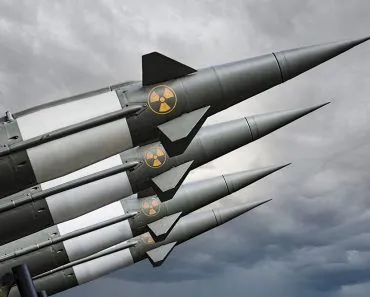
A nuke exploded in space produces no shockwave (there's no air to carry one), but it still releases a brilliant spherical flash of gamma rays, X-rays, and heat. Charged particles trapped in Earth's magnetic field can trigger auroras visible for thousands of miles, while the resulting electromagnetic pulse (EMP) can damage satellites, power grids, and electronics across a continent.
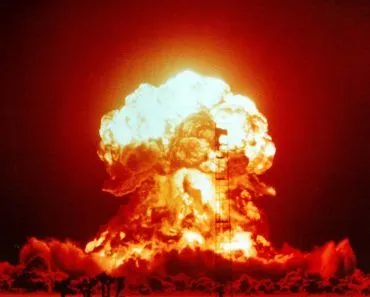
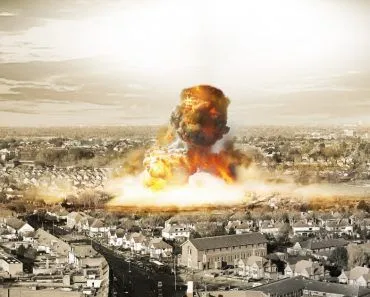
The image of a mushroom cloud is one of the most recognizable sights in the world and one of the most terrifying. Although many of our nuclear threats have lessened in the past few decades, there was a time in the 20th century when the fascination and fear of nukes made everyone around the world do some rather crazy things.
Nuclear nations around the world (primarily Russia and the US) tested nuclear weapons underwater, in the mountains, in the atmosphere, and even in space!
We can probably imagine what most of those explosions would look like and the repercussions, but what about that final one?
What would happen if a nuclear bomb went off in space?
Nuclear Bomb In Space – Bomb Testing
During the height of the Cold War, both the United States and Russia tested nuclear bombs extensively. Due to concerns about a long-range nuclear missile or satellite delivery system for a nuclear warhead, both nations focused on the skies. The US conducted a series of tests known as Operation Fishbowl, consisting of high-altitude nuclear weapon tests. The most notable and historic test in this project was Starfish Prime. On July 9th, 1962, a 1.4 megaton nuclear bomb was detonated about 250 miles above Earth’s surface.
Although this may seem ridiculous today, those were tumultuous times, and the resulting explosion and its after-effects were truly extraordinary.
What Would Happen If A Nuclear Bomb Went Off In Space?
In space, a nuclear explosion looks different than it does on Earth. Without an atmosphere interrupting its path, the explosion produces intense outpourings of heat, light, and high-intensity radiation in gamma and X-rays. The blast appears roughly spherical, and the radiation and light expand to light up the sky.
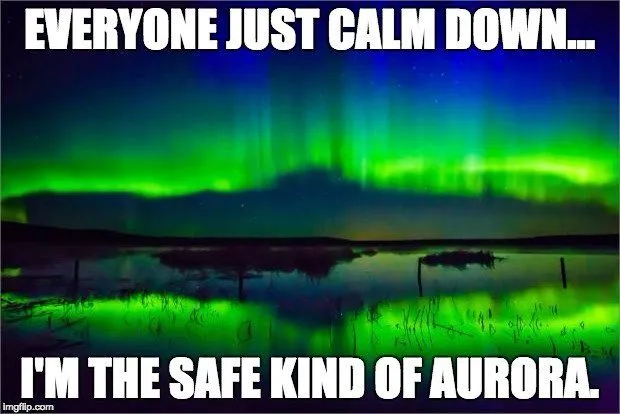
On Earth’s surface, the blast would cause vivid auroras of light, visible for thousands of miles within minutes of the explosion. This is because the charged particles from the blast would immediately interact with Earth’s magnetic field, creating a visual spectacle similar to the aurora borealis. These ribbons of light and charged particle streams would continue to be seen for hours or even days after the blast, depending on the size of the explosion.
In a nuclear explosion, debris would burn up in the Earth’s upper atmosphere, and the atmospheric molecules would absorb heavy ions. These extra radioactive molecules are actually useful in certain ways, which will be explained in the next section.
Are There Any Other Effects Of A Nuclear Explosion In Space?
Perhaps even more worrying than the huge amount of radiation being dropped into Earth’s atmosphere is the impact of detonation on electromagnetic signals in a massive area beneath the blast. Essentially, those highly charged, rapidly moving electrons will create a small and incredibly powerful magnetic field called an EMP (electromagnetic pulse). You’ve probably seen this in sci-fi movies often; an EMP bomb cuts off all electronic power within a given area (most famously, perhaps, in The Matrix Trilogy).
In the case of Starfish Prime, that meant about 300 streetlights extinguished in Honolulu (roughly 900 miles from the blast), burglar alarms tripping, damaged microwave links, and disruptions to radar and navigation. The EMP also crippled satellites in low orbit. Of the 24 satellites operating in 1962, at least a third were damaged or knocked out within months, including Telstar 1 (launched a day after Starfish Prime) and the British satellite Ariel 1. It showed scientists the true power that a nuke in space could have: it could effectively cripple a nation’s infrastructure without physically destroying any of it!
Now, consider the size of the bomb used in Starfish Prime (1.4 megatons). Some of the largest nuclear warheads ever created were 50-megaton hydrogen bombs, more than 35x more powerful. Imagine the auroras you’d be able to see if a bomb like that went off in space and think of the widespread technological devastation from an EMP big enough to shut down Texas!
Finally, regarding the long-term effects of a nuclear weapon detonating in space, that radioactive material falling into the atmosphere isn’t going anywhere. In fact, it dissipates and spreads around the entire planet. Those extra molecules imparted by that nuclear blast can now be accurately measured as a means of dating things, such as trees, wine, and animals. While that may be one useful thing about nuclear testing in space, that certainly doesn’t make the whole process any more sensible.
There were only a handful of high-altitude nuclear detonation tests in the 1950s and 1960s, but in total, more than 2,000 nuclear detonations were conducted on Earth between 1945 and 1998.
Clearly, whether they happen on Earth or in space, nuclear detonations are never good news!
Would A Nuclear Bomb Actually Work In Space?
Here's a question that trips up a lot of people: if there's no air in space, can a bomb even go off out there? For an ordinary explosive, like the TNT in a stick of dynamite or the gunpowder in a firework, that instinct is partly right. Conventional explosives rely on a chemical reaction, and many of them depend on oxygen to burn. Strip away the surrounding air and a lot of that violent, fiery behavior simply fizzles.

A nuclear weapon is a completely different animal. It doesn't burn anything in the chemical sense. Instead, it runs on nuclear fission: when the nucleus of a heavy atom like uranium-235 or plutonium-239 is struck by a stray neutron, it splits into lighter pieces and flings out more neutrons. Those neutrons slam into neighboring nuclei and split them too, releasing yet more neutrons, and the whole thing snowballs into a self-sustaining chain reaction in a fraction of a second. A thermonuclear (hydrogen) bomb takes it a step further, using that fission spark to fuse hydrogen isotopes together for an even bigger release.
The crucial point is that none of this needs oxygen, or any surrounding medium at all. The reaction lives entirely inside the weapon's own core, so the vacuum of space changes nothing about whether the bomb detonates. In fact, the largest nuclear test ever carried out at high altitude, Starfish Prime, went off about 400 km (250 miles) up, well above the breathable atmosphere, and released its full 1.4-megaton yield without a hitch. So yes, a nuke absolutely works in space. What changes dramatically is not whether it explodes, but what that explosion looks like.
What Would A Nuclear Explosion Look Like In Space?
On Earth, the iconic image is the rolling orange fireball and the rising mushroom cloud. Both of those are products of the atmosphere, not the bomb itself. A ground or air burst dumps a huge slug of X-rays into the air around it, which is absorbed within a few yards, superheating that air into the glowing fireball. The rising column of hot gas and debris is what curls over into the familiar mushroom shape. In the vacuum of space, there is no air to absorb the X-rays and no atmosphere to billow upward, so neither the classic fireball nor the mushroom cloud forms.

Instead, almost all the energy escapes as a blinding pulse of X-rays, gamma rays, and visible light radiating outward at the speed of light. The only matter that physically expands is the vaporized remains of the bomb itself, racing outward as a thin shell of superheated plasma rather than a churning ball of flame. To an observer at a safe distance, a true deep-space detonation would register as an intensely bright, roughly spherical flash that swells and fades in an instant, with no lingering smoke and no shockwave (there's no air to carry a sound or pressure wave at all).
The Starfish Prime test sits between true space and the lower atmosphere, and its glow was unforgettable. Detonated over the Pacific in 1962, it lit up the sky for thousands of miles, painting Hawaii's horizon with eerie reds and greens as charged particles funneled into Earth's magnetic field and triggered an aurora-like display. That is closer to what a high-altitude nuclear flash actually looks like: less Hollywood fireball, more a sudden, ghostly, sky-wide shimmer.
What Would Happen If You Nuked The Sun?
One of the most common follow-up questions is gloriously ambitious: what if we just launched our biggest bomb straight into the Sun? It feels like it should do something dramatic. The honest answer is that it would do essentially nothing, and the reason comes down to a staggering mismatch in scale.

The Sun is a fusion reactor on a scale we can barely picture. According to NASA, it pours out roughly 3.8 × 1026 watts of power, the result of converting about 4 million tonnes of its own mass into pure energy every single second. Now compare that to the largest device humanity has ever detonated: the Soviet Tsar Bomba, which yielded around 50 megatons of TNT. Even that monster releases its energy just once, in a single burst. The Sun radiates more energy in about a second than a billion Tsar Bombas combined.
So a nuclear bomb arriving at the Sun would be like tossing a lit match into a raging wildfire and expecting it to make a difference. The bomb's energy would be utterly swamped, vaporized and absorbed without leaving so much as a measurable flicker in the Sun's output. The Sun's own routine outbursts, the solar flares it throws off regularly, already release energy on a scale that dwarfs our entire nuclear arsenal. Nuking the Sun is one of those ideas that sounds apocalyptic but is, in practice, completely beneath the Sun's notice.
Last Updated By: Ashish Tiwari
References (click to expand)
- The STARFISH Exo-atmospheric, High-altitude Nuclear ....
- Johnson, M. H., & Lippmann, B. A. (1960, August 1). Electromagnetic Signals from Nuclear Explosions in Outer Space. Physical Review. American Physical Society (APS).
- Karzas, W. J., & Latter, R. (1962, June 15). Electromagnetic Radiation from a Nuclear Explosion in Space. Physical Review. American Physical Society (APS).
- Latter, R., Herbst, R. F., & Watson, K. M. (1961, December). Detection of Nuclear Explosions. Annual Review of Nuclear Science. Annual Reviews.
- How Nuclear Weapons Work. Union of Concerned Scientists.
- Glasstone, S., & Dolan, P. J. The Effects of Nuclear Weapons, Ch. II. U.S. Department of Defense / Department of Energy.
- Cosmicopia: Ask Us (The Sun). NASA Goddard Space Flight Center.
- Tsar Bomba. Encyclopaedia Britannica.
- Solar Storms and Flares. NASA Science.