Table of Contents (click to expand)
An atomic (A) bomb is a pure fission weapon that splits uranium or plutonium nuclei. A hydrogen (H) bomb is a fusion weapon that uses a fission bomb as a trigger to compress and ignite hydrogen fuel. Because fusion can be fed almost unlimited fuel, H-bombs can be hundreds to thousands of times more powerful than atomic bombs.
Humans have always tried to harness different forces in the natural world to fit their wants and needs. From the energy of the winds to the energy binding all particles at a molecular level, the human mind keeps exploring ways to control the greatest sources of power we find.
Today, several nations get their electricity from uranium fission. Nuclear plants will become a major source of power when every nation comes to an understanding of how to prevent its misuse.
A nuclear bomb releases its energy in the blink of an eye, producing a strong concentration of heat in just picoseconds.
In nuclear power plants, however, the nuclear fuels progressively burn up to generate power. A city could be destroyed with just a few kilos of that same nuclear fuel.
New possibilities come up when we study nuclear reactions by bombarding a nucleus with other nuclear particles, like neutrons, protons etc. These possibilities give birth to nuclear fission and fusion reactions. Fission splits a heavy nucleus into lighter pieces, while fusion joins light nuclei into a heavier one, and both release energy in the process.
Nuclear fission is the energy source in nuclear reactors that generate electricity.
To understand the explosive nature of an H-bomb, we first have to look into the basics of an atomic bomb.
How Do Atomic Bombs Work?
Atomic bombs function on the principle of nuclear fission. They produce a tremendous amount of energy due to uncontrolled nuclear fission. It is a nuclear reaction that splits an atom’s heavy nucleus into two lighter nuclei.
When a free neutron clashes with an atom of a fissionable material, like uranium or plutonium, two to three more neutrons are emitted. The neutrons leave the nucleus and release a lot of energy. The neutrons that have been released then strike other uranium (or plutonium) nuclei, splitting them similarly, and then releasing additional energy and neutrons. This domino effect spreads immediately.
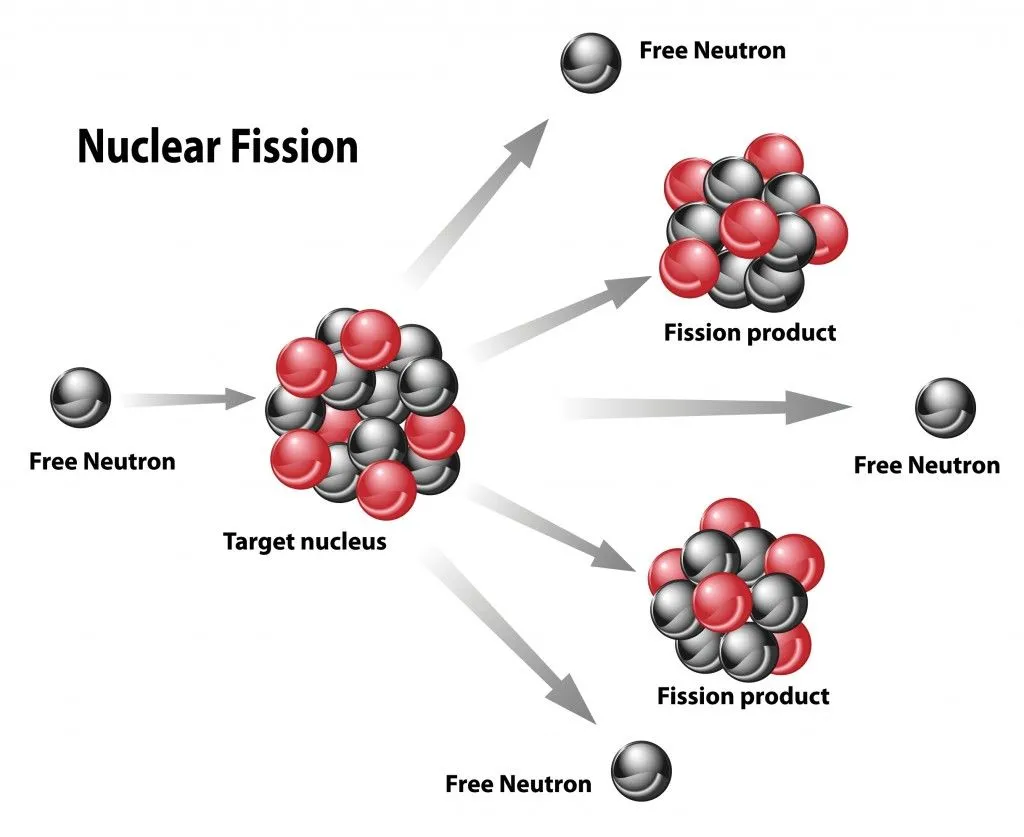
A critical thing to understand here is that a chain reaction cannot occur in a small amount of uranium-235. This is because the fission’s neutrons might escape without hitting another nucleus and causing another fission reaction. The probability that one of the discharged neutrons will start another nuclear fission increases only if more uranium-235 is added to the mixture. The smallest quantity of the nuclear element required to start a self-sustaining fission chain reaction under specified circumstances is referred to as the “critical mass”. A bare sphere of uranium-235 has a critical mass of about 52 kg (115 lb), though a neutron reflector around the core can cut that to roughly 15 kg (33 lb).
It is necessary to assemble the “critical mass” of nuclear fuel quickly and compress it into a smaller volume to have enough of it to react before the resulting heat blows everything up… BOOM!
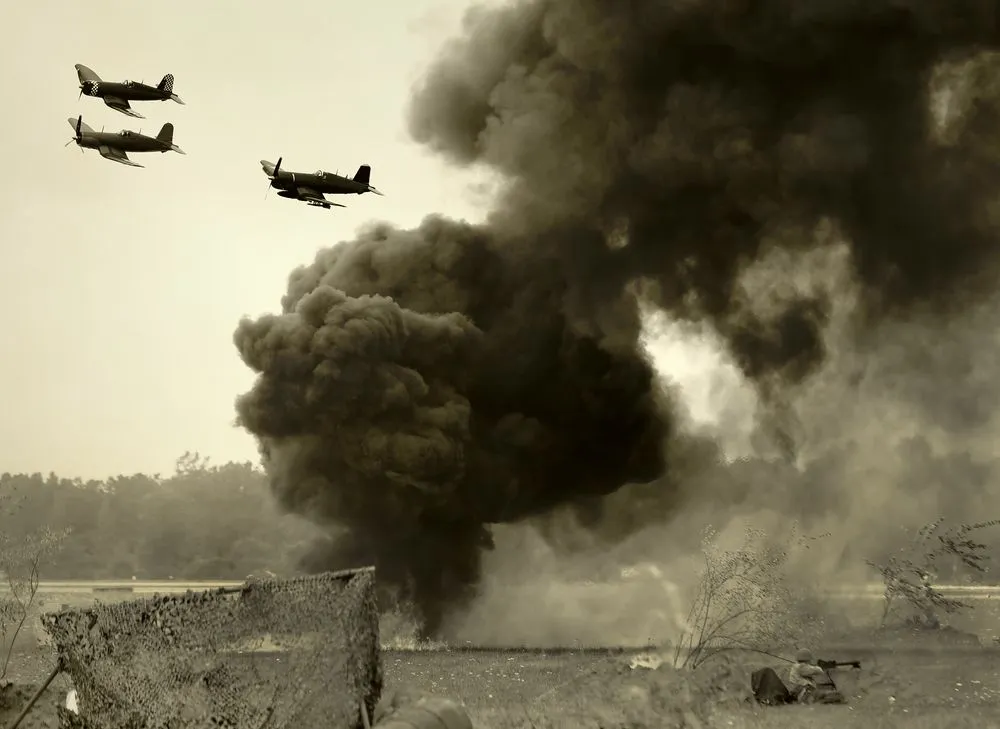
During World War II, in 1945, the United States detonated the world’s first atomic bomb named “Little Boy” on Hiroshima, and the second named “Fat Man” on Nagasaki, killing more than 200,000 people in Japan. The explosions instantaneously killed a large number of individuals, while others eventually died from radiation and burns. You can read more about the differences between Little Boy and Fat Man by visiting this article.
However, compared to an atomic bomb, a hydrogen bomb has the ability to be much more potent. This is because hydrogen bombs explode more powerfully than atomic bombs. Their shock waves blast heat and radiation across a wider field of effect. Each H-bomb carries the potential to wipe out any modern city.
How Is An H-Bomb Different From An Atomic Bomb?
Weapons that work on the principle of fusion are called hydrogen bombs or thermonuclear bombs. The most advantageous nuclear fusion process occurs when a deuterium nucleus and a tritium nucleus (both isotopes of hydrogen) fuse. They combine to form a helium nucleus (two protons and two neutrons) plus a single free neutron that flies off. This releases an enormous amount of energy, which explodes the weapon.
To understand why nuclear fusion is difficult to sustain, you might want to visit this article. It explains why nuclear fusion is not employed to generate power… yet.
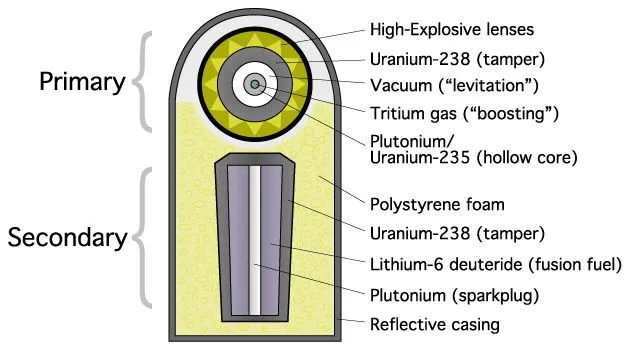
The above diagram explains the functioning of an H-bomb. The secondary fusion reaction is started by the “primary,” which is essentially an implosion fission weapon.
What Makes A Hydrogen Bomb More Lethal?
When an atomic bomb using U-235 is activated, a lot of U-235 remains. Simply said, it is too sparsely distributed to support a chain reaction. The number of neutrons absorbed by other U-235 atoms is insufficient to keep the chain reaction going. The majority of the U-235 gets scattered by the explosion of the weapon, preventing it from capturing a neutron and triggering a chain reaction again.
The Hiroshima bomb, “Little Boy,” carried about 64 kg (141 lb) of uranium and exploded with a yield of roughly 15 kilotons of TNT. Yet only about 1.4% of that uranium actually fissioned; the rest was blown apart before it could react. Had the fuel fissioned completely, the blast would have been many times larger. Thus, atomic weapons have a practical limit to their strength, but hydrogen bombs surpass all such limits.
A hydrogen bomb utilizes the energy of an atomic bomb as its trigger. Its fuel compresses more quickly, entirely resolving the issue of blowing apart before the reaction has advanced very far. Thus, a greater explosion can be produced by using more fuel.
An H-bomb has never been deployed in battle by any nation, but they carry the potential to kill significantly more people than the already deadly atomic bomb.
People often assume that because fusion is the “clean” reaction, a hydrogen bomb leaves less radioactive fallout than an atomic bomb. In practice, the opposite is usually true. Fusion itself produces almost no long-lived radioactive debris, but every H-bomb still needs a fission bomb to set it off, and most designs wrap the fusion fuel in a heavy uranium casing that the fusion neutrons split as well. This fission-fusion-fission arrangement boosts the yield, but it also scatters large amounts of radioactive fission products. So yes, hydrogen bombs are radioactive and they do produce fallout, typically more of it than a simple atomic bomb, simply because they are so much larger.
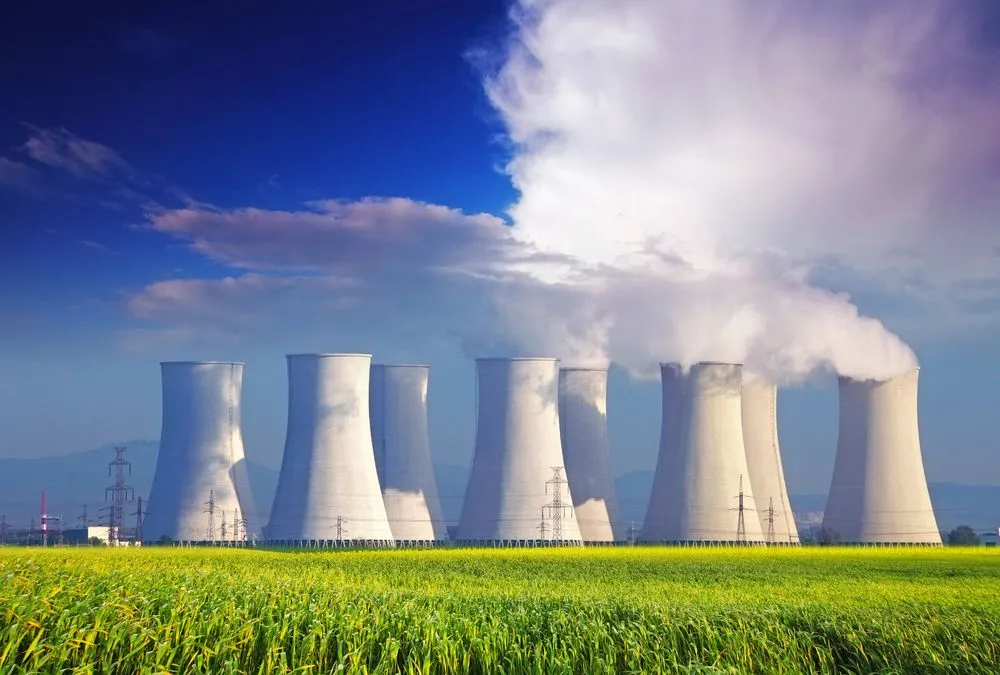
Future generations may have access to a limitless supply of energy once we are able to harness fusion technology, but it also poses a great threat to humanity itself if it falls into the wrong hands. Thus, its safety becomes a huge challenge.
Controlling these forces is overwhelmingly powerful, as nuclear technology holds the strength to change the destiny of entire nations.
References (click to expand)
- (S-9) Nuclear Weapons. The Goddard Space Flight Center
- DOE Explains...Nuclear Fusion Reactions. U.S. Department of Energy, Office of Science
- Nuclear weapon - Fission, Fusion, Yield. Encyclopaedia Britannica
- Truman Breakout Box Activity. Harry S. Truman Presidential Library and Museum
- The Story of the Atomic Bomb - eHISTORY. The Ohio State University
- How do nuclear weapons work? -. The Campaign for Nuclear Disarmament
- The Atomic Bombs That Ended the Second World War. Imperial War Museums