Table of Contents (click to expand)
Spaceships are sterilized using dry heat, chemicals, radiation and low-temperature plasma, then assembled in cleanrooms that strictly limit microbial life. The goal is planetary protection: keeping Earth microbes off other worlds so they cannot mistakenly be counted as alien life or harm those environments.
Whether it is to send people to the moon or restock a space station, launch satellites in Earth’s orbit or simply explore the solar system, our tryst with space shows no sign of stopping. One of the big-picture missions for humanity’s space travel is the search for extraterrestrial life; NASA is doing their best to find an answer.
To satiate this curiosity, it is important that the spaceships we send out into the universe are germ-free. Why? Because we have a duty to planetary protection. Planets must be protected from other planetary life. Try to imagine the consequences if a flesh-eating germ from Jupiter hitched a ride to Earth on a returning spaceship!
That is why scientists do their best to make sure spaceships are germ-free. The main question is… how do they accomplish that?
How Are Spaceships Sterilized?
Heat
In the early days of space travel, spaceship parts were baked at scorching temperatures of 110-200°C (230-392°F) inside dry ovens with carefully controlled humidity. They were also held in those hot-air ovens for hours or even days to ensure maximum sterilization. This technique is called dry-heat microbial reduction, and it remains a NASA standard today. In 1975, it was used on the two Viking landers headed for Mars: once sealed inside their protective bioshields, the whole spacecraft were heated to around 112°C (234°F) for roughly 30 hours, cutting the number of surviving microbes by a factor of about 10,000.
However, heat sterilization isn’t an option all the time.
Radiation
First of all, spaceship assembly is challenging. Heat-sterilizing complex electronic parts like sensitive temperature sensors will destroy the part. The alternate approach employs ultraviolet (UV) or gamma radiation. Spaceship parts and their equipment are exposed to these high-powered rays that damage the microbes’ DNA and kill them. As an extra measure, the assembled parts are also wiped down with 70% alcohol or hydrogen peroxide to kill any remaining survivors.
However, these chemicals can’t be used everywhere, as they can damage the epoxy or silver coatings on the spaceship parts or equipment.
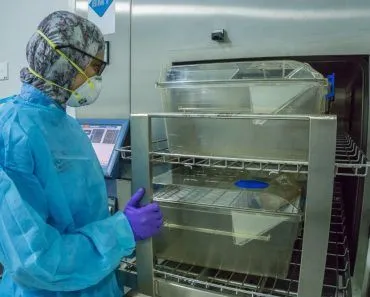
So, heat, radiation, and chemicals are all used to keep spaceships and equipment germ-free, but that’s not the end of the precautions. The spaceships are also assembled in cleanrooms that meet strict international air-cleanliness standards (the ISO 14644 series, which replaced the older U.S. Federal Standard 209E in 2001). These rooms cap the number of airborne particles, and technicians work in full-body coveralls, gloves and masks to keep their own microbes off the hardware.
Even with all that forethought, these methods aren’t foolproof. Some bacteria can adapt and are heat-resistant, like bacillus species. Bacillus spores are also very tough and can withstand high temperatures, pressure and radiation exposure. They can survive at high temperatures for a few minutes. Cleanrooms can even breed their own hardy specialists: in 2013, scientists described Tersicoccus phoenicis, a microbe found on the floors of two spacecraft cleanrooms thousands of kilometers apart (at NASA’s Kennedy Space Center and an ESA facility in French Guiana) and nowhere else, that shrugs off the usual drying, chemical and UV cleaning. Chemical usage isn’t 100% effective either. Furthermore, due to our new and physically sensitive modern technological instruments, complete sterilization isn’t possible using the above methods.
What’s the alternate safer method? Plasma sterilization!
What Is Plasma Sterilization?
You may know plasma as the 4th state of matter. Plasma is essentially charged or ionized gas. Examples of natural plasma include lightning during a storm and the Northern Lights. Plasma is made by energizing gas molecules until their electrons break free from the nucleus orbit. As these electrons release their energy, the bright characteristic plasma color is seen.
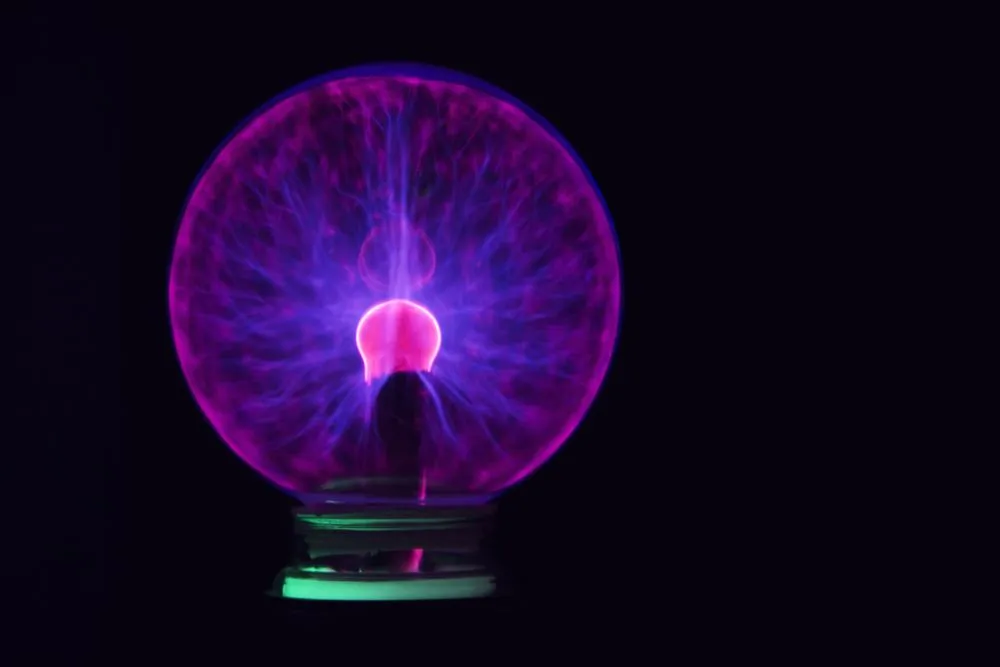
This sterilization technology was first commercialized by Johnson & Johnson (as the Sterrad system) to sterilize moisture- and heat-sensitive medical equipment. Researchers have since adapted low-temperature plasma for spacecraft hardware.
A sealed chamber with electrodes is filled with a reactive gas, often vaporized hydrogen peroxide, and an electric field ionizes it into plasma. This generates a soup of charged particles and reactive species, such as ozone (O3) and hydroxyl radicals, that bombard the germs, disrupt their biological processes and shred their DNA, essentially killing them.
Plasma one-ups other sterilization methods in several ways. The gases can be charged using electric currents at temperatures as low as 40°C (104°F). This makes it safer to use on heat-sensitive materials and equipment.
It also prevents direct chemical contact with the equipment, so it’s safer to use on different spaceship materials.
Plasma sterilization also has a higher sterilization efficiency than heat or radiation sterilization. It even kills heat-resistant bacterial spores.
By this point, you might be wondering why we go through so much trouble to kill germs on spaceships in the first place… After all, a few germs can’t be that bad, right?.
Why Is It Important To Keep Spacecraft Germ-free?
At the beginning of this article, we mentioned the term planetary protection, remember? It’s an internationally recognized practice to protect other planets and solar system bodies from Earth life. It actually has roots in space law: Article IX of the 1967 Outer Space Treaty commits nations to avoid the “harmful contamination” of other worlds and adverse changes to Earth. The practical rules come from the Committee on Space Research (COSPAR), which sorts missions into categories of increasing strictness depending on the destination, and at NASA they are enforced by the Office of Planetary Protection. It works both ways: scientists guard against forward contamination (Earth microbes hitching a ride to another world) and backward contamination (anything we might bring home from a sample-return mission).
That’s where planetary protection comes in. Let’s assume another rover lands on Mars in search of alien life. However, the ship wasn’t properly sterilized and it carried a bacterial species from Earth all the way to Mars. As soon as the rover lands on Mars and drives around the red planet, the Earth bacteria from the rover will land on the planet. At that point, it could mutate and adapt to the Martian environment.
Now, the rover starts taking soil samples and eventually picks up this modified bacteria to study. Scientists on Earth will think they discovered life on Mars, but the ugly truth is that this life is actually from Earth. Such mistakes can ruin the search for foreign life. Space travel isn’t cheap, so such mistakes will waste billions of dollars and destroy the integrity of space exploration.
Bacteria can mutate and adapt in space, so it’s theoretically possible in our exaggerated hypothetical scenario that the duration of the space mission would be long enough to “discover” and mistake the Earthly bacteria for a Martian variety.
Additionally, bacteria not only mutate and survive space, but they can also potentially transform into something dangerous. One study found that E. coli grown in space had different physical properties because of the effects of microgravity. These physical changes make it difficult for antibiotic drug molecules to penetrate their cell membranes, meaning that E. coli grown in space are antibiotic-resistant.
What other dangerous changes bacteria may face in space can only be speculated, but none of us want to find out the answer the hard way.

Additionally, it’s a health risk to the astronauts to have germ-infested spaceships. An astronaut’s immune system is already weakened in space. If an astronaut picks up a terrible disease or infection, it will be very difficult to treat without a proper hospital or enough medical resources, which are still Earth-bound luxuries.
These rules are about to be tested like never before. Robotic landers can be baked and scrubbed to a strict spore limit, but a crewed Mars mission cannot: astronauts shed microbes constantly, so there is no clean “at launch” threshold to design around. NASA and COSPAR are actively rewriting the guidelines for human missions, and the rise of commercial spaceflight raises a thorny question of who enforces planetary protection when the spacecraft isn’t government-owned.
Conclusion
There are already strict quality control measures in place when it comes to building spaceships. Planetary requirements seem minor, but they should not be taken lightly. The consequences that alien life could have on Earth’s ecosystem and balance are incalculable. That is also why, if any object from space crashes into Earth, the surrounding crash site is sealed off and decontaminated.
Plasma sterilization makes it easier to sterilize spaceships uniformly without damaging the sensitive equipment or delicate materials on board. It’s necessary to ensure that spaceships are kept germ-free, because if a large amount make their way onboard, they can be quite hazardous to the integrity and safety of the mission.
It’s also necessary for astronauts to maintain good hygiene, as their skin or gut bacteria can also make their way into the spaceship’s air circulation and spread all over. When it comes to space travel, cleanliness is king!
References (click to expand)
- Müller, M. (2019). Characterisation of cold atmospheric plasma afterglow for decontamination. Ludwig-Maximilians-Universität München. Retrieved from
- Shimizu, S., Barczyk, S., Rettberg, P., Shimizu, T., Klaempfl, T., Zimmermann, J. L., … Thomas, H. M. (2014, January). Cold atmospheric plasma – A new technology for spacecraft component decontamination. Planetary and Space Science. Elsevier BV.
- Pillinger, J. M., Pillinger, C. T., Sancisi-Frey, S., & Spry, J. A. (2006, January). The microbiology of spacecraft hardware: Lessons learned from the planetary protection activities on the Beagle 2 spacecraft. Research in Microbiology. Elsevier BV.
- DEBUS, A., RUNAVOT✠, J., ROGOVSKY, G., BOGOMOLOV, V., KHAMIDULLINA, N., & TROFIMOV, V. (2002, March). Landers Sterile Integration Implementations: Example Of Mars 96 Mission. Acta Astronautica. Elsevier BV.
- Office of Planetary Protection. NASA Jet Propulsion Laboratory.
- COSPAR Policy on Planetary Protection (June 2020). Committee on Space Research.
- Rare New Microbe Found in Two Distant Clean Rooms. NASA Jet Propulsion Laboratory.
- Zea, L., et al. (2017). Phenotypic Changes Exhibited by E. coli Cultured in Space. Frontiers in Microbiology.
- NASA’s Planetary Protection Team Conducts Vital Research for Deep Space Missions. NASA.