Table of Contents (click to expand)
Mirrors look silver because behind the glass is a thin, well-polished coating of metal, usually silver or aluminum, and that shiny metal lends the mirror its color. The faint green tinge you sometimes notice (especially in tunnel-like reflections between two mirrors) comes from tiny iron impurities in the soda-lime glass itself, not from the metal backing.
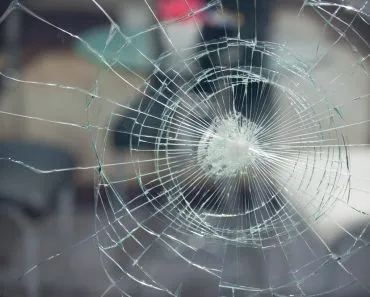
If you stare into a mirror long enough, trying to see what ‘color’ it is, you’ll probably come up with an answer of silver. Of course, mirrors are intrinsically supposed to reflect an image, so having their own color seems quite counter-intuitive. However, if you look at a mirror from an angle, from the side, or when it’s cracked, it will give your eyes the impression that the entire mirror is silver. Why is that? Well, first of all, let’s find out precisely how mirrors reflect the light we see.
What Are Mirrors, Exactly?
When you look at an object, what you are essentially seeing is the light that is either emitted from the object, or reflected off the object, entering your eye. So, what you’re not seeing is the light being absorbed by an object. If an object is green, like the leaves on a tree, it’s because all the colors on the visible spectrum have been absorbed except green, which has been reflected. If something is white, it means that all the colors of the visible spectrum are reflected and none are absorbed. Now, wait a minute, isn’t that what a mirror is? Just a surface that reflects all colors of the visible spectrum? So perfect mirrors are technically white, right?

It is practically impossible to create a mirror that reflects 100% of its light. Some light will always be absorbed by the mirror itself. Roughly 5–10% of the light hitting a common bedroom mirror is absorbed (silver coatings sit near the top of that range at about 95% reflectivity, aluminum a touch lower at 88–92%), which trims the intensity of the reflection. A perfect mirror, one that does not absorb any light at all, cannot be realistically created, as some energy is always going to be lost in the process of reflection.
What Color Is A Mirror, Really?
So if a flawless mirror would bounce back every color equally, you could fairly call it a kind of white, just a very smart white that hands the light straight back as a sharp image instead of scattering it everywhere. A bedroom mirror is honestly the closest thing most of us own to that ideal. But it isn’t perfect, and the imperfections give it a faint color of its own. So if you press the question “what color is a mirror?”, the honest scientific answer is that a real mirror is the tiniest bit green.
This isn’t hand-waving. Physicists Raymond L. Lee Jr. and Javier Hernández-Andrés measured the reflectance of ordinary household mirrors for a 2004 paper in the American Journal of Physics, and found that the clear soda-lime glass over the metal transmits light best at about 510 nm, right in the green, while the finished mirror reflects most strongly around 545 nm, a yellowish green. In plain terms, the glass nudges the light it passes ever so slightly toward green, so the image that comes back at you is faintly green-biased. The shift is far too small to spot in a single glance, which is why nobody thinks of their bathroom mirror as “green.”

Where the green stops hiding is the “infinite tunnel” you get when two mirrors face each other. Each bounce trims a little more of the non-green light, and because the effect compounds with every reflection (the same study showed the tunnel’s reflectance after N bounces is just the single-bounce value raised to the power N), the deepest images in the tunnel turn unmistakably green and dark. The mirror was always slightly green; the tunnel just stacks the evidence dozens of times over until your eye can’t miss it.
What Is A Mirror Made Of?
The mirror in your bedroom is probably a uniform flat surface, which means that the glass in it is probably float glass. Float glass is the most common type of glass, found in everything from windowpanes to beer bottles, and it’s a soda-lime silicate that picks up a faint greenish tint from tiny iron impurities in the sand it’s made from. A single sheet looks clear enough, but the color stacks up the more glass the light has to pass through. If you’ve ever stared at two mirrors placed in front of each other, you’ll have seen an “endless reflection”. However, before the endless reflections fade into tiny blackness, you’ll notice a stark green hue, which comes from the glass. Does that mean that mirrors are actually green? Well… not quite.

The mirrors we commonly find around our house aren’t perfect mirrors, but they’re good enough to do the job. Mirrors are made from either silver or aluminum, with a sheet of glass on top to protect the metal. Household mirrors, especially the one over your bathroom sink, are usually silvered using a chemistry trick perfected by Justus von Liebig in the 1830s, in which silver nitrate is reduced onto glass to leave a wafer-thin metallic film. Aluminum is the cheaper option and shows up in everything from mass-produced bedroom mirrors to the side mirrors on your car. Older mirrors were instead made through mercury silvering (brushing a tin–mercury amalgam onto the glass), a process the Venetians turned into an art form until it was banned in the late 1800s because mercury is, well, extremely toxic. There’s an even stranger variant called the “liquid mirror”, first demonstrated by Henry Skey in 1872: a dish of mercury is spun on its vertical axis, and centrifugal force pulls the liquid into a perfect parabolic shape, no polishing required. Only one such telescope is currently doing science, the 4-metre International Liquid Mirror Telescope (ILMT) that came online in the Himalayas in 2022, and NASA ran a smaller 3-metre liquid-mirror telescope from 1994 to 2002 to scan for orbital debris. They’re wonderfully cheap to build, but the dish has to point straight up, which is why they never replaced conventional mirrors. Closer to home, the door mirror on your car and the mirror above your sink are still nothing more exotic than a thin film of aluminum or silver behind a slab of glass.
Can You Make A Mirror Out Of Gallium?
If mercury makes such an unpleasant mirror metal, is there a friendlier liquid that does the same job? There is, and its name is gallium. Gallium is a soft, silvery metal that melts at just 29.76 °C (85.58 °F), so a solid lump turns to liquid in the warmth of your hand. In that molten state it has a bright, mirror-like sheen, and (unlike mercury) it actually wets glass: smear a little onto a clean slide and it spreads into a thin, reflective film instead of beading up. That is exactly why “gallium mirror” is something people search for, because painting gallium onto glass really does leave behind a glossy, mirror-bright coating.

Gallium is also the leading candidate to replace mercury in liquid-mirror telescopes. Metallic gallium is essentially non-toxic, it has a very low vapor pressure (so it doesn’t breathe poisonous fumes into the room the way mercury does), and it reflects light a touch better than mercury too. Astronomers usually work not with pure gallium but with eutectic alloys such as galinstan, a gallium–indium–tin mix that stays liquid all the way down to about −19 °C (−2 °F). The one stubborn headache is oxidation: a freshly exposed gallium surface quickly grows a dull skin of gallium oxide in air, which is handy for making it stick to glass but bad for keeping a telescope mirror optically clean. Solve that, and a spinning dish of gallium could one day give us the cheap, giant mirrors that mercury never safely could.
So basically, a mirror is just a lot of shiny metal with some glass on top and a frame to make it look pretty.

That’s what gives a mirror its silver color. Aside from the glass, a mirror is essentially just a well-polished metal surface. In many ways, it’s just like a well-polished plate or a shiny car. If you’re ever looking at a mirror and are unable to place why it appears silver to your eyes, just remind yourself that the metal used underneath is shiny. Now, determining why metals are shiny? Well, that’s an article for another day!
References (click to expand)
- Silvering. Encyclopaedia Britannica.
- Surdej, J. et al. The 4 m International Liquid Mirror Telescope: construction, operation and science. Astronomy & Astrophysics (2025).
- Liquid-mirror telescope. Wikipedia.
- Mirror. Wikipedia.
- How mirrors work. Explain that Stuff.
- Lee, R. L. Jr. & Hernández-Andrés, J. Virtual tunnels and green glass: The colors of common mirrors. American Journal of Physics 72(1), 53–59 (2004).
- Borra, E. F. et al. Gallium Liquid Mirrors: Basic Technology, Optical-Shop Tests, and Observations. Publications of the Astronomical Society of the Pacific (1997).
- Gallium. Wikipedia.