A transparent object (like glass or water) does not let all the light pass straight through. A small fraction of every ray is reflected off its surfaces, another fraction is refracted (bent) as the light enters and leaves the object, and a tiny bit is absorbed. Your brain detects those bent and reflected rays, and the way the scene behind the object looks distorted, and uses them to reconstruct the object's shape, which is why a transparent object is still visible.
Transparent objects let light pass through them, whereas opaque objects don’t.
This simple concept may be taught, projected, reprinted, reproduced or otherwise disguised with a painfully high amount of jargon and technical details, depending on the place and setting you’re in, but the fact remains the same.
What Are Transparent Objects?
Transparent objects let the light pass through them, without scattering it or altering its path. One can clearly see through these objects. Examples of such substances can be water and glass.
While many sources and materials discuss this fundamental characteristic of light, there remains a question that befuddles many curious minds. It goes something like this: we know that light passes through transparent objects, so objects that allow light to pass through them are invisible, right? Isn’t that the principle behind invisibility cloaks?
Given that, how can a transparent object – like glass – be transparent and visible at the same time?
What's The Difference Between Transparent, Translucent And Opaque?
Physicists sort materials into three buckets based on what happens to the light that hits them: transparent, translucent and opaque.
A transparent material lets light pass through with almost no scattering, so you can clearly see whatever sits behind it. Clean glass, water and air are the textbook examples. An opaque material is the opposite extreme: it transmits no light at all, and instead reflects, scatters or absorbs every ray that lands on it. Wood, metal and stone all belong here, which is why you can't see through a door.
The interesting one is the middle child. A translucent material does let light through, but it scatters that light along the way, so the glow gets in even though a sharp image does not. Hold a sheet of frosted glass, some wax paper or a milky plastic lid up to a window and you'll see plenty of brightness but only fuzzy blobs of whatever is on the far side. This is exactly the "light passes through but I still can't see clearly" situation that puzzles so many people.

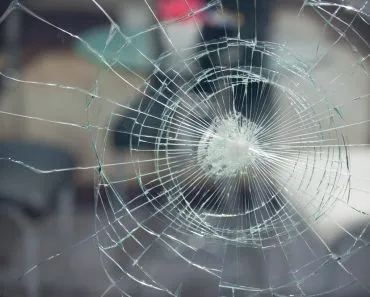
So why does one pane of glass show you the garden while another turns it into a smear? It comes down to how uniform the material is on the inside. A transparent substance has a single, uniform refractive index throughout, so light sails straight across it. A translucent one is built from regions with different refractive indices, or carries a roughened surface, and light gets scattered every time it crosses one of those boundaries, leaving in a spray of directions instead of a straight line. Frosted glass is simply ordinary clear glass whose surface has been sandblasted or acid-etched into a pitted texture; that rough face scatters the transmitted light and blurs the picture without actually blocking it. The same rule turns up all over the place: it is why a grease stain changes how see-through a sheet of paper is, and why the cracks in a clear glass pane look cloudy, since the fractured surfaces scatter light just like frosting does.
Different Ways Of Interacting With Light Rays
In real life, every object interacts with light rays in four basic ways. These are specular reflection, diffuse reflection, refraction and absorption.
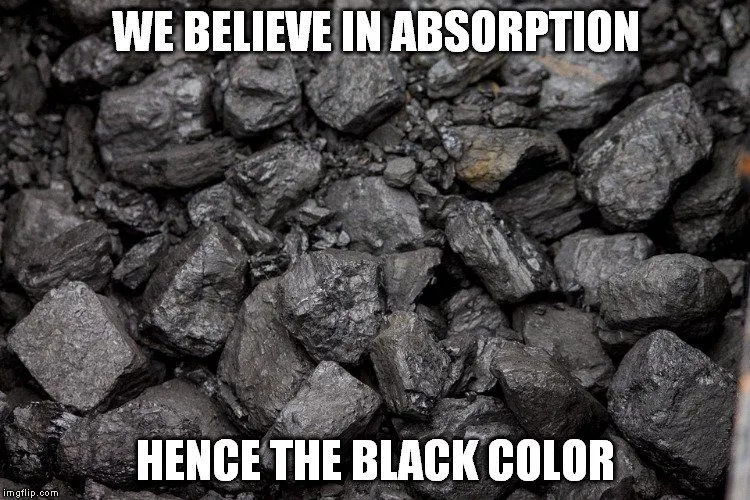
In specular reflection, more simply known as reflection, light rays fall on a surface and most are then reflected in one direction (plain mirrors are the most common example of this). However, when light rays are reflected in more than one direction, it’s called diffuse reflection (light bouncing off non-glossy painted surfaces falls in this category). Absorption involves most of the light rays being absorbed by the material itself (think of a pitch-black piece of coal).
Finally, refraction is the bending of light rays as they pass from one transparent medium into another with a different optical density (water and glass are classic examples).
Almost all materials react with light in all four of the ways mentioned above. It’s just that, for most materials, there is always one way that is dominant over the other ways of light interaction. For example, let’s consider a plain mirror (that’s silver coated on one side).
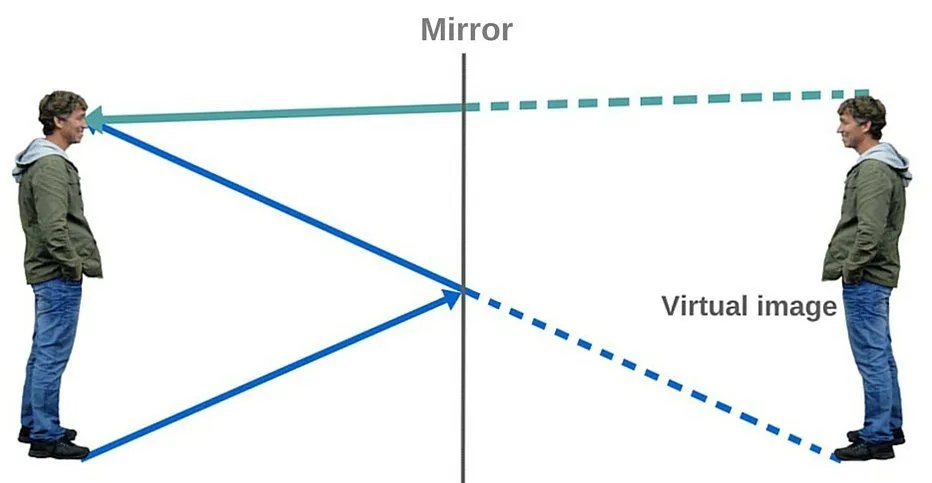
The mirror certainly reflects a lot of light, so specular reflection is the most dominant form of its interaction with light rays. However, it should be noted that the mirror doesn’t reflect all the light that strikes it. There is always some light that’s absorbed; a very small part of the light rays even get refracted in regular mirrors.
When Does An Object Become Visible To Us?
Here is a question worth pausing on before we head back to glass: when, exactly, does something become visible? A handful of objects are luminous, meaning they generate their own light (the Sun, a candle flame, a light bulb), and we see those directly. But almost everything else in your field of view (this page, your desk, the walls of the room) makes no light of its own. The only reason you can see any of it is that it bounces light from some source into your eyes.

The quiet hero here is diffuse reflection. Everyday surfaces are microscopically rough, so when light lands on them it scatters off at a whole range of angles rather than a single one. That scattering is what lets you read a sheet of paper from anywhere in the room; wherever you stand, some of the scattered light is heading straight for your eye. The vast majority of objects you notice in a day are visible for exactly this reason. Put simply, an object becomes visible the instant light reflected or scattered from it reaches your retina.
And that is precisely why a transparent object is such a riddle. It barely reflects and mostly transmits, so it sends very little light back your way. But "barely" is not the same as "not at all." At each boundary between air and glass, roughly 4% of the light is reflected straight back (about 8% for the two faces of a windowpane, since glass has a refractive index close to 1.5), while the rest is bent as it crosses. Those faint surface glints, together with the distorted view of whatever lies behind the glass, are the crumbs of information your eye and brain use to work out that something is actually there.
What Does This Have To Do With Transparent Objects And Invisibility?
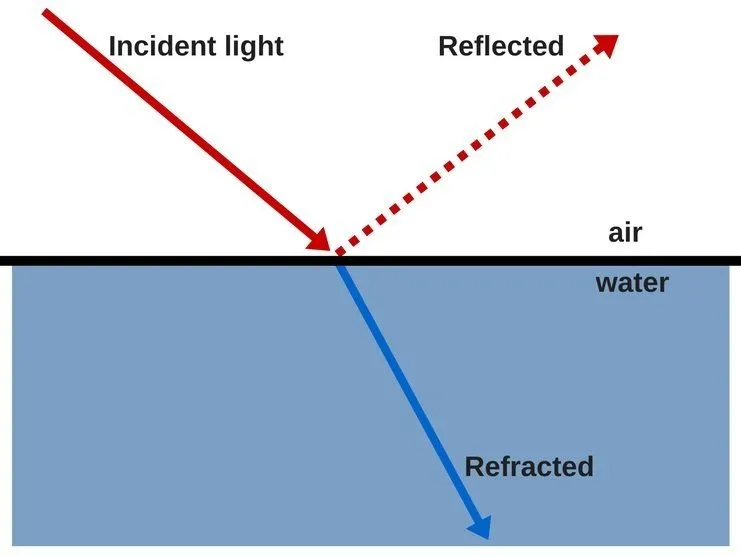
The one interesting thing about these different types of material interactions is that they alter the light rays that are striking them in a certain way. Consider a glass of water, for instance. When light rays fall on it, some rays are reflected, some are absorbed and some are transmitted. Therefore, the path of those light rays is clearly altered.
The image below will help you better understand this visually:
So, how do we see objects that allow light to pass through them? Shouldn’t those objects be invisible to human eyes?
Well, they should. And they would be too, if not for one small thing, weighing less than 1400 grams, that sits in the topmost compartment of the human skull – the brain. It helps us ‘detect’ this alteration of light rays and identify the presence of something transparent. To understand this better; take a pen and look at it. Really look at it. What do you see? A normal, shiny, shapely pen, right?
Now, place a glass of water between the pen and your eyes and look at the pen again. Is it the same shapely pen?

It can’t be. The path of the light rays passing through the glass becomes altered, which is why the pen appears to be imported from some alien planet.
You see, we never ‘see’ an object, per se; we see the light rays that are altered by that object. Our brain does all the complex calculations in the head and ultimately presents us with the perception of the specific object we’re looking at.
This is precisely the reason that we can see transparent objects. Light rays transmit through, and bend around the object according to its shape. Therefore, when you look at a transparent object, you look at how things around it appear to be distorted somehow, and the rest is taken care of by the brain. Our brains are clever enough to realize and subsequently perceive the shape of the transparent object, thus making it visible.
This tricky behavior of light rays brings us to yet another interesting phenomenon: invisibility. If it’s the bending and shifting of the path of light rays that make us see things, then what would happen if light could pass through an object without any reflection, absorption, or refraction at all? Would the object become genuinely invisible? In principle, yes, which is precisely the idea behind modern metamaterial cloaks, which try to steer light around an object so smoothly that the rays leave on the other side as if the object weren’t there at all.
References (click to expand)
- Transparency and translucency - Wikipedia. Wikipedia
- How can a clear object be transparent and visible at the same time? | Science Questions with Surprising Answers - sciencequestionswithsurprisinganswers.org
- RW Wood. The Invisibility of Transparent Objects - NASA/ADS. The SAO/NASA Astrophysics Data System
- Opacity (optics) - Wikipedia
- Frosted glass - Wikipedia
- Diffuse reflection - Wikipedia
- Reflection, Refraction, and Dispersion - Physics LibreTexts
- Fresnel equations - Wikipedia