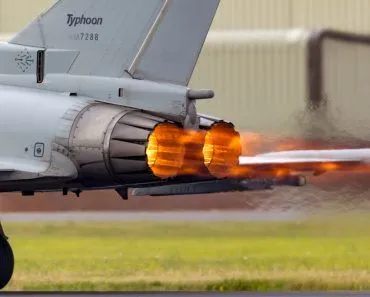
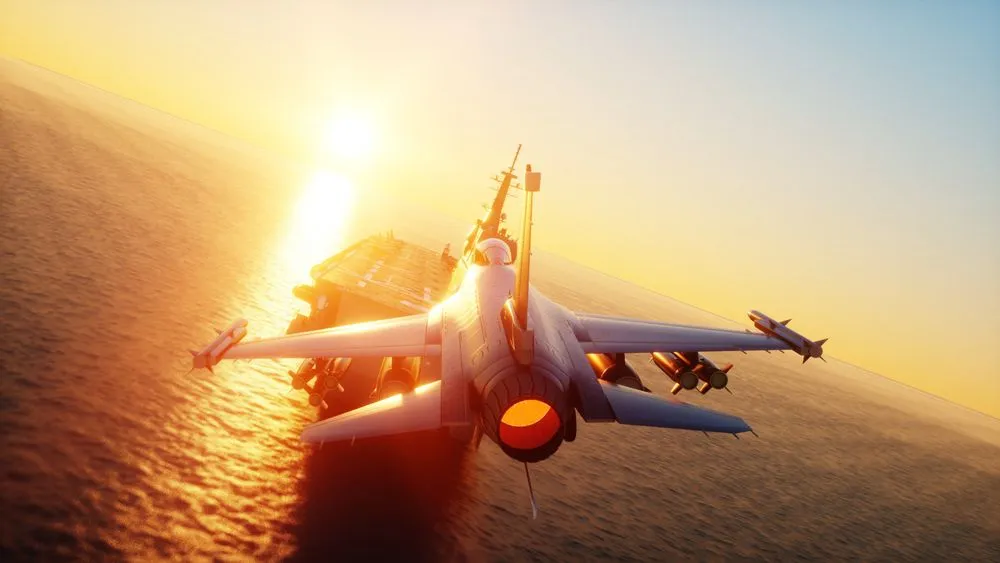
An aircraft carrier's flight deck is far too short for a normal takeoff, so it cheats. A catapult (a steam piston, or an electromagnetic EMALS on the newest carriers) or an angled ski-jump ramp flings the jet airborne in about 90 meters (300 feet), while the carrier steams into the wind for extra lift. To land, the jet's tailhook snags one of several arrestor cables.
The sight of aircraft taking off and landing has always mesmerized me, as both a child and an adult. If you have ever had the opportunity to board an aircraft by stairs, instead of air bridges, the sheer length of the runway you had to walk might amaze you.
Obviously, this is because airplanes need lots of space to take off and land!
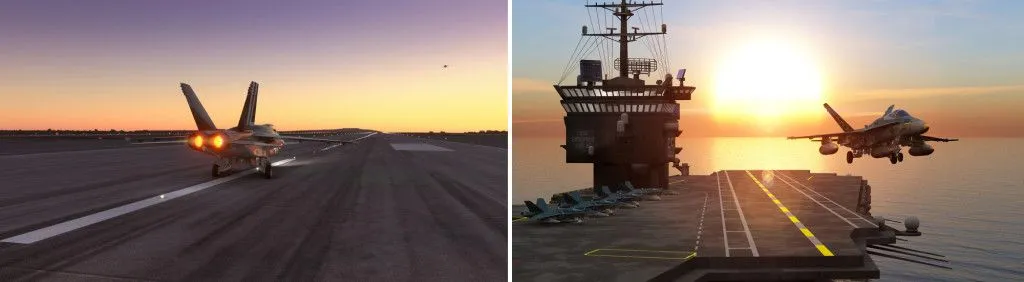
However, fighter aircraft, owing to the critical nature of their operations, might not always have this long-distance luxury. To extend their reach, they are based at sea on specially built ships called aircraft carriers.
However large these carriers may be, they can never be as long as a land runway. A US Navy carrier's flight deck runs only about 333 meters (1,090 feet), and the takeoff stretch is far shorter than that. So how can fighter pilots take off and land in the absence of adequate real estate? The secret lies in one of our toys from childhood!
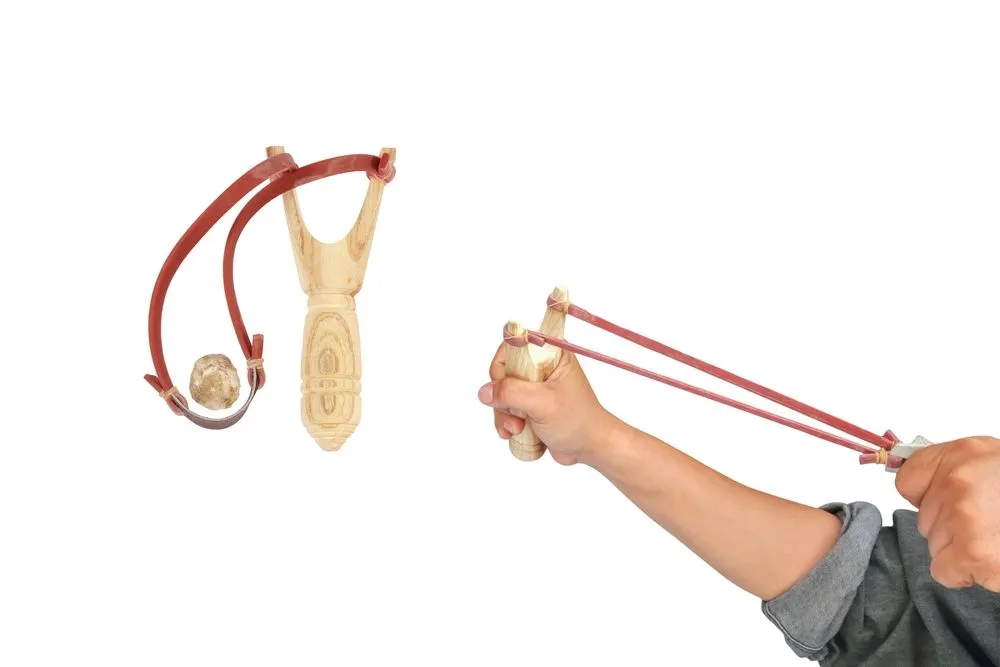
Catapulting Aircraft Into The Sky
Using a slingshot or catapult makes easy work of throwing objects long distances. The principle behind them is the conversion of the stretched rubber sling’s potential energy into kinetic energy for the projectile.
As to how effective this is, it can shrink the take-off distance to a mere 90 meters (300 feet), as compared to the 600 meters (2,000 feet) or more a fighter would need for an unassisted ground roll!
This simple principle also drives aircraft carriers that must launch jets into the skies without a full runway. Here’s a glimpse.
Instead of using rubber slings, aircraft carriers use a steam-powered catapult to send planes airborne. The steam-powered catapult comprises equipment under the deck working in tandem with the aircraft’s front wheel landing apparatus.
Under The Deck
Below the deck is a storage unit or accumulator containing steam from the ship’s internal machinery. The steam is fed into a multi-cylinder piston arrangement, with the pistons locked in place, causing a buildup of pressure. Each piston has a lug that extends from underneath through a gap in the deck. These lugs are connected to a shuttle that will eventually carry the plane to its takeoff speeds.
The steam catapult comprises a pressurized cylinder piston arrangement that attaches to the front landing gear of the aircraft
Over The Deck
When the plane is in position for takeoff, a ‘launch bar’ built into the nose landing gear drops down and hooks into the shuttle. Once released, the shuttle drags the plane forward to the end of the deck. At the same time, a second fitting called the holdback links the rear of the nose gear to the deck. When the pilot spools the engines up to full power, the aircraft is still pinned to the catapult, and the holdback stops it from rolling off prematurely.
Take Off
After conducting pre-flight checks, ground crew check for pressure in the pistons and raise the jet blast deflector (JBD). The JBD is an inclined platform placed directly behind the jet’s exhaust to prevent its wind blast from damaging other equipment on board. Upon takeoff, the pilot cranks the engines to full capacity and the catapult operator releases the locked pistons.
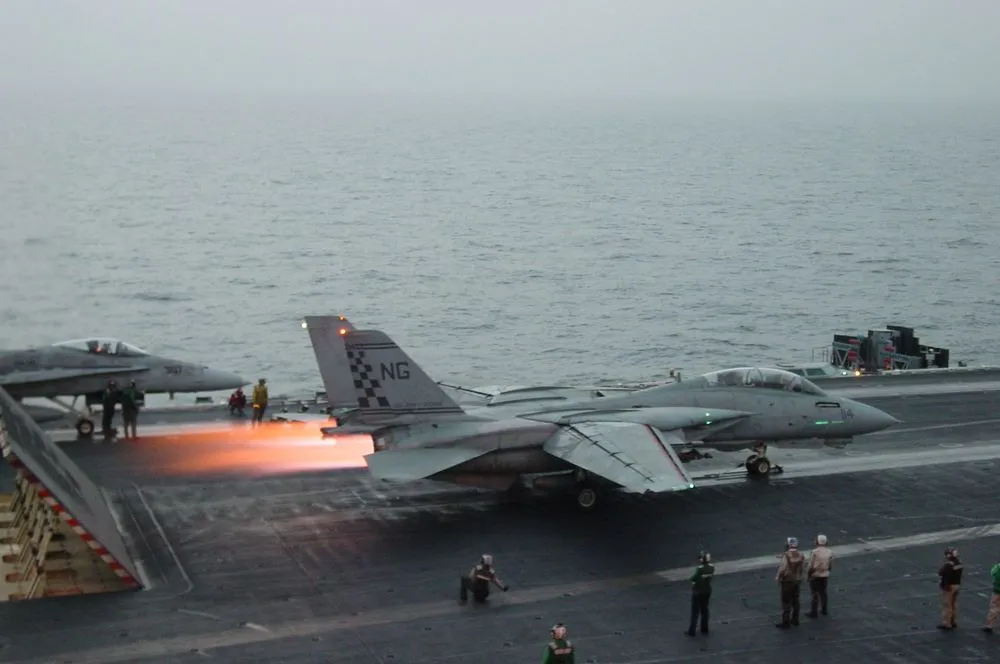
The energy built up by the accumulated steam snaps the holdback and slams the aircraft forward. When the end of the deck is reached, the launch bar slips free of the shuttle and the plane goes airborne. The shuttle can then be retracted and the process repeated, all over again.
Steam catapults are capable of accelerating an aircraft from rest to about 280 km/h (170 mph, or roughly 150 knots) in a mere 2 seconds, over a distance of under 90 meters (300 feet)! The launch is further assisted by the carrier itself, which steams hard into the wind. This adds 20 to 30 knots of wind over the deck, giving the wings extra lift right at the moment of release.
Electromagnetic Catapults (EMALS)
Steam is on its way out. The newest US carriers, beginning with the USS Gerald R. Ford (commissioned in 2017), swap the steam piston for an Electromagnetic Aircraft Launch System (EMALS). Instead of a blast of steam, a linear induction motor (essentially a flat, straightened-out electric motor) generates a moving magnetic field that pulls the shuttle and the jet down the track. Because the acceleration can be tuned electronically, EMALS launches both heavy strike fighters and light drones with far less jolt to the airframe, and it can be recharged for the next launch much faster than a steam catapult.
Landing Aircraft On To The Aircraft Carrier
The beauty of aircraft taking off and landing on aircraft carriers lies in the simplicity of their operating principles. For instance, if a catapult can explain takeoffs, then a hook and loop arrangement can explain how fighter planes land on carriers.
If a hook gets caught in a loop, any further progress of the hook away from the loop is restrained. Similarly, the landing gear of the aircraft is deliberately entangled in steel cables upon touchdown to bring it to a halt. Let’s understand how this process works.
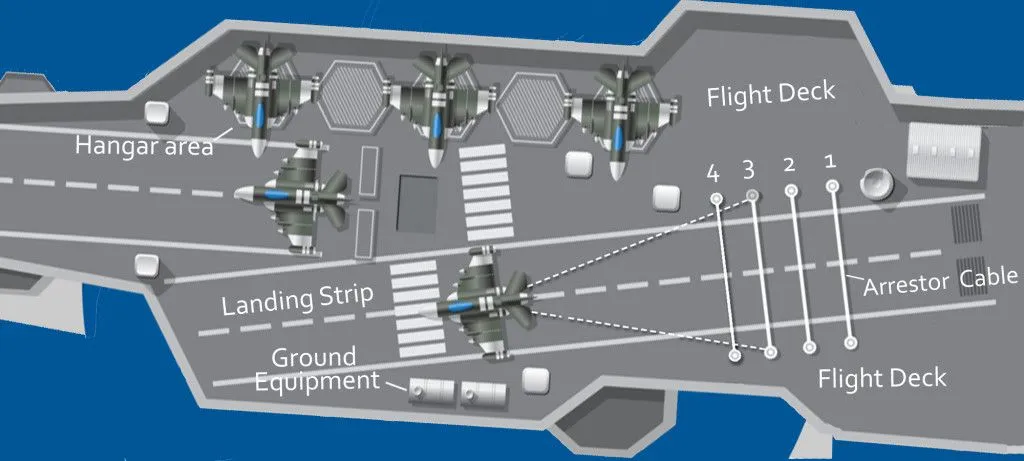
All aircraft landing on carriers must be equipped with a tailhook, which must catch on to steel arrestor cables stretched across the deck. These steel cables have high tensile strength and are connected to an energy-absorbing system below the deck. To give the pilot several chances to snag a wire, the cables are laid out one behind the other. Most older Nimitz-class carriers used four, but newer ships (including the latest Nimitz units and the Ford class) carry three, since the fourth wire was almost never the one caught.
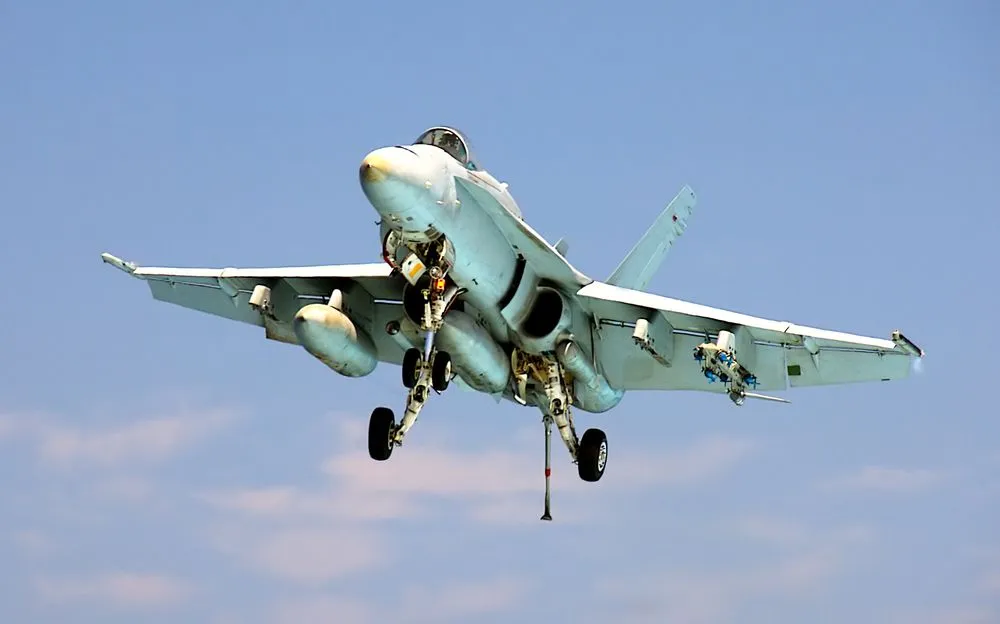
A descending aircraft will lower its tailhook in an attempt to catch one of those cables, the ideal choice being the second or third wire. When the cable snags the tailhook, it pays out from under the deck while loading the arresting engine below. On steam-era carriers this is a hydraulic system, in which pistons connected to the arrestor cable push fluid against a piston and braking valve. This has a damping effect that rapidly bleeds off the aircraft's energy. It brings the plane to a halt in a very short distance, as little as 100 meters (around 320 feet). The newest Ford-class carriers replace this with the Advanced Arresting Gear (AAG), which uses water turbines and an electric motor to absorb the landing more gently and across a wider range of aircraft.
To put the arresting gear’s capability into perspective, here’s an interesting fact. The instant the wheels touch the deck, the pilot pushes the engines to full blast! This is done to ensure that the plane has enough power to take off again, should the tailhook miss every wire (a maneuver pilots call a "bolter"). So the arrestor cables are strong enough to bring an aircraft (engines roaring at full power) to a complete halt in seconds.
Ski-Jump Ramps And Jump Jets
Not every navy uses catapults. They are heavy, complex, and expensive, so many carriers skip them entirely and use a ski-jump ramp instead. This is simply the front of the flight deck, curved upward like a giant skateboard ramp. As a jet races up the ramp at full thrust, the curve flings it into the air at an upward angle. That extra height buys a few crucial seconds for the wings to build up enough lift, letting the plane take off heavier and slower than it could from a flat deck.
Russia's, China's, and India's carriers all launch conventional fighters off ski-jumps in this way, an arrangement known as STOBAR (Short Take-Off But Arrested Recovery), where the jets still land using a tailhook and arrestor cables.
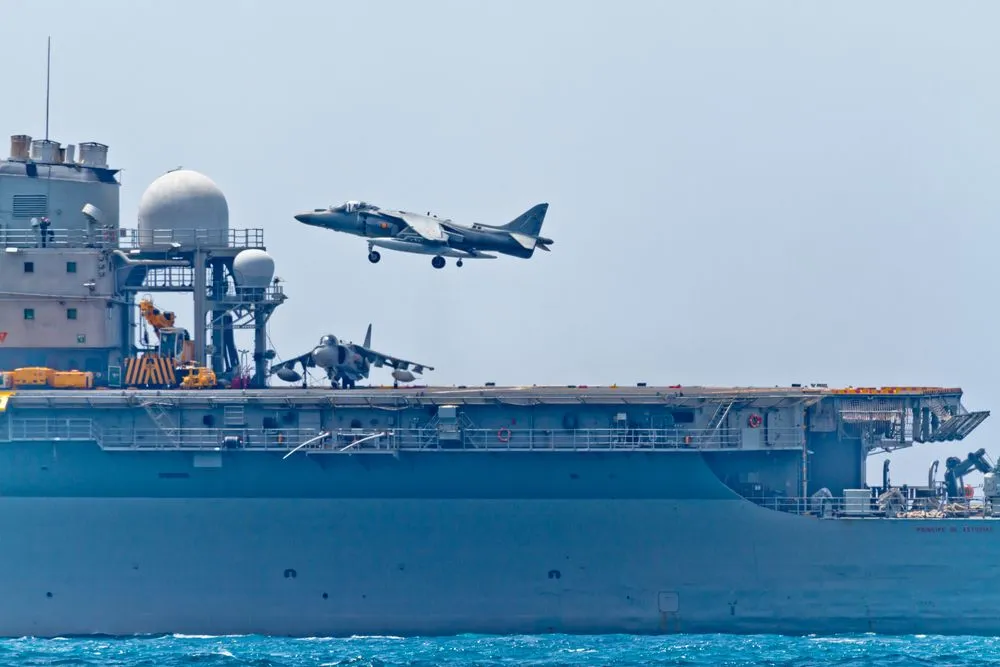
The British Royal Navy's HMS Queen Elizabeth and HMS Prince of Wales take a different route. They fly the F-35B Lightning II, a STOVL (Short Take-Off, Vertical Landing) jump jet. Its engine nozzle swivels downward and a lift fan behind the cockpit blasts air straight down, so the F-35B can make a short rolling takeoff up a 12.5-degree ski-jump and then land vertically, like a helicopter, with no cables needed at all. The older AV-8B Harrier pictured above worked on the same vectored-thrust principle.
How Long Is An Aircraft Carrier's Runway?
Given how much trouble a carrier goes to just to fling a jet off its bow, you might expect its deck to at least resemble a proper runway. It does not come close. The flight deck of a Nimitz-class supercarrier, one of the largest warships ever built, measures about 333 meters (1,092 feet) from bow to stern and roughly 77 meters (252 feet) at its widest point. A major airport runway, by contrast, typically stretches 3,000 meters (about 10,000 feet) or more. In other words, a carrier does the same job in barely a tenth of the length, and the usable takeoff run is shorter still, since the catapult stroke that does the launching is only about 90 meters (300 feet) long.

So how does a single ship squeeze in both a launch strip and a landing strip? The trick is the angled flight deck, and it is one of the cleverest ideas in naval aviation. Instead of a single straight runway down the middle, the landing area is canted roughly 9 degrees to the left of the ship's centerline. That gives a carrier what are effectively two overlapping runways: jets are catapulted straight off the bow while other aircraft touch down on the angled strip, so launching and recovery can go on at the same time rather than one after the other.
The angled deck also solves a dangerous problem. On the old straight-deck carriers, a plane that missed the arrestor cables risked plowing into the aircraft parked at the front. With the landing strip angled off to one side, a jet that fails to snag a wire simply runs off the open edge of the deck, guns its engines, and flies away to come around and try again. The design was worked out by Royal Navy officer Dennis Cambell and first trialed in 1952. It proved so obviously superior that the US Navy adopted it almost at once, and every modern supercarrier, from the Nimitz class to the newest USS Gerald R. Ford, still relies on it today.
A Final Word
As simple as taking off and landing on an aircraft carrier is in theory, the execution is incredibly complex. One may think that if all aircraft could be catapulted and landed like this, we could potentially reduce the huge areas occupied by airfields. However, both of these maneuvers are fraught with extreme risk of failure, and are best suited for light aircraft only.
Another important thing to note is the extreme G forces that act on pilots during takeoff and landing. Fighter pilots are consistently trained to withstand such environments, whereas civilians are not. Many of the technologies once considered futuristic are already at sea, with electromagnetic catapults (EMALS) and vertical-landing jump jets (the F-35B) both in active service. Unmanned carrier aircraft, such as the MQ-25 refueling drone now in testing, are the next frontier to watch in the years to come!
References (click to expand)
- Taking Off and Landing on an Aircraft Carrier. The University of Southern California
- Electromagnetic Aircraft Launch System (EMALS). Naval Air Systems Command (NAVAIR)
- USS Gerald R. Ford. Encyclopaedia Britannica
- Ski-jump (aviation). Wikipedia
- Nimitz-class aircraft carrier. Wikipedia
- Flight deck. Wikipedia