Table of Contents (click to expand)
Stealth fighter aircraft are designed to avoid detection by radar. They achieve this in two main ways: by absorbing radar signals with radar-absorbent materials (RAM) like iron-ball paint, and by deflecting incoming signals away from the radar source using sharply faceted or carefully curved surfaces. The F-117 Nighthawk, B-2 Spirit, F-22 Raptor, F-35 Lightning II, and the new B-21 Raider all combine both methods.
When it comes to any form of combat, stealth is always key if you want to gain the upper hand. From the age of ninja assassins to the modern fighter aircraft, the most important element has always been the ability to be invisible to your enemy.
In the last century, stealth technology has proven to be one of the most effective approaches as far as hiding from radar systems is concerned. Especially for military aircraft, “stealth” or “low observable” technology has become ubiquitous: all new aircraft types are designed based on low observable principles and techniques, while existing jet fighters are often modified in order to reduce their radar signature.
Background
This transition started when radar technology was implemented during World War II. Fighter planes were heavily exposed to the enemy due to their reflections on radar. Since radar technology was developed during the Second World War, it shouldn’t be surprising to learn that the first attempts at stealth technology also occurred during this period. In fact, it was the Germans, not the Allies, who worked on this project. They were responding to the success that the Allies were having with their early radar sets, which proved very effective at spotting incoming enemy bombers and were also extremely important in the battle for the Atlantic. The most often cited German prototype is the Horten Ho 229 (Ho IX), a tailless jet flying wing, although historians remain divided on whether its designers actively pursued radar stealth or simply built a low-drag shape that happened to scatter less.
The United States’ first stealth development was largely accidental. Shortly after WWII, Northrop developed an experimental jet-powered bomber called the YB-49 Flying Wing. As the name implies, the aircraft had no body or tail; it was simply a large flying wing. During 1947–48 testing, pilots and engineers noted that pointing the wing’s slim leading edge at a tracking radar produced a much weaker return than a conventional bomber would. The phenomenon was filed away as a curiosity at the time, and the same insight would resurface decades later in the Northrop B-2 Spirit.
How Does Radar Work?
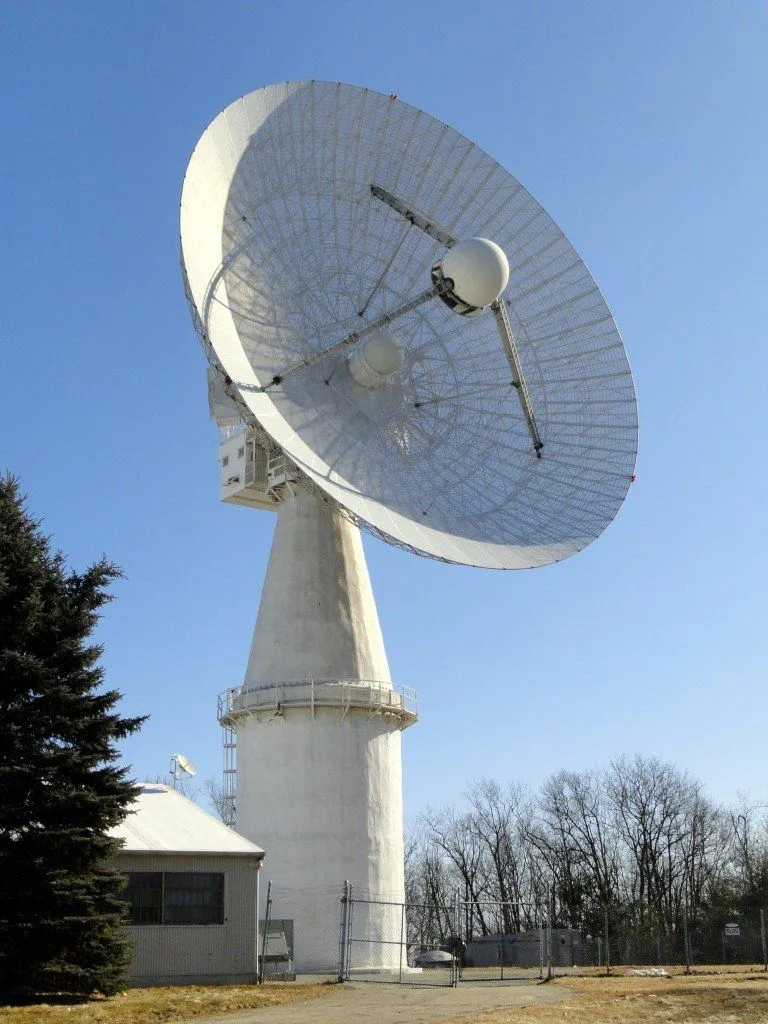
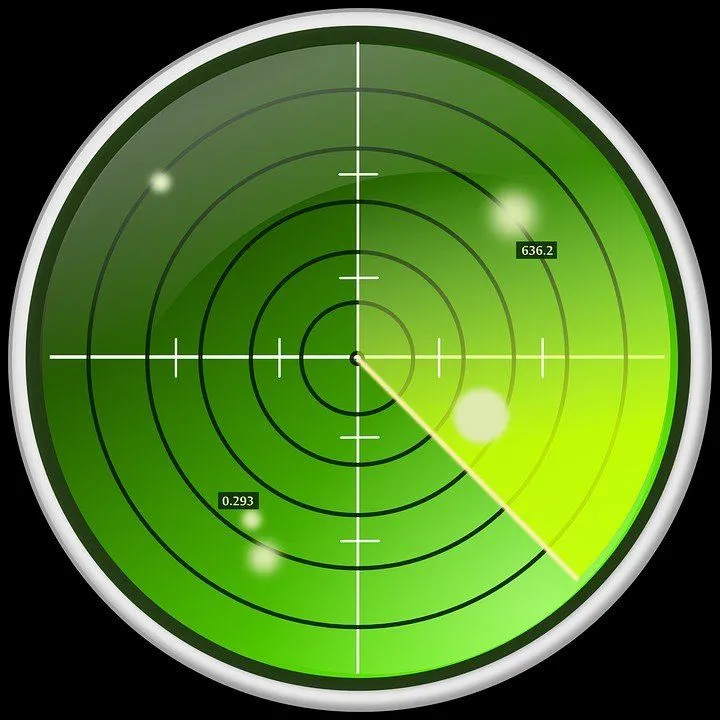
A radar transmitter sends out electromagnetic waves in all directions, which reflect on any obstruction and return to the point from which the waves were transmitted. This signal is processed in order to determine the exact position, size and direction of target. This spoils the element of surprise of the attacking party.
RCS, or radar cross-section, played a major role in the development of this vital technology. RCS is measured in square meters (or dBsm) and represents the equivalent area of a perfect sphere that would produce the same radar echo as the target. The bigger the RCS, the stronger the radar echo and the farther away the aircraft can be picked up. A typical fighter like the F-16 has an RCS around 1 to 5 m², while an F-22 Raptor or B-2 Spirit is closer to 0.0001 m² (comparable to the radar return of an insect).
What Is Stealth?
Imagine a hawk flying about 15 meters away from you. You can see it with ease, but if there’s a bee at the same distance, it would be nearly impossible to spot it, since the human eye isn’t able to resolve such small objects at a distance.
The hawk at 15 meters can be compared to a conventional aircraft, which appears as a large dot on the radar screen, while a bee at that distance can be compared to a stealth aircraft, which doesn’t appear on the radar screen because it can’t resolve the image of the aircraft at that distance.
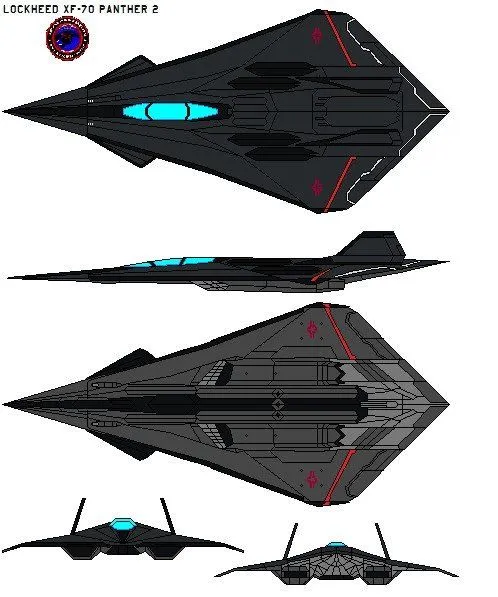
Stealth technology doesn’t make an object totally invisible, but it does delay the object’s detection, giving the enemy enough time to cause serious damage.
The basic principle under which stealth technology works is by preventing radar reflections from reaching the source of the radar signal.
Modern aircraft implement stealth technology in two ways:
1) Absorption of radio waves
This is actually a very clever way of tackling radar. Radar absorbing materials capable of absorbing electromagnetic waves are coated onto the surface of the aircraft, These coatings are made of composites, which absorb the radio waves that fall on them. Common materials used to make RAM materials have good electrical and magnetic properties, such as iron ball paints.

Inside each tiny iron particle, the incoming radar wave forces the magnetic domains to flip back and forth rapidly. That flipping is not free: the energy gets dissipated as heat inside the paint, so the wave exits with a much weaker signal, if it exits at all. (The dramatic pyramid-shaped foam tiles you sometimes see in pictures of stealth labs are a different thing entirely; those are anechoic chamber linings used to test aircraft, not coatings on the aircraft itself.) This makes it practically impossible for the original wave to reflect all the way back to the radar source.
2) Deflecting radio waves
Do you ever wonder why fighter jets have pointy designs, whereas commercial planes have a general roundness to it?
This is primarily to be stealthy by designing the aircraft’s surface in a way that it deflects the incoming waves and scatters them in different directions.
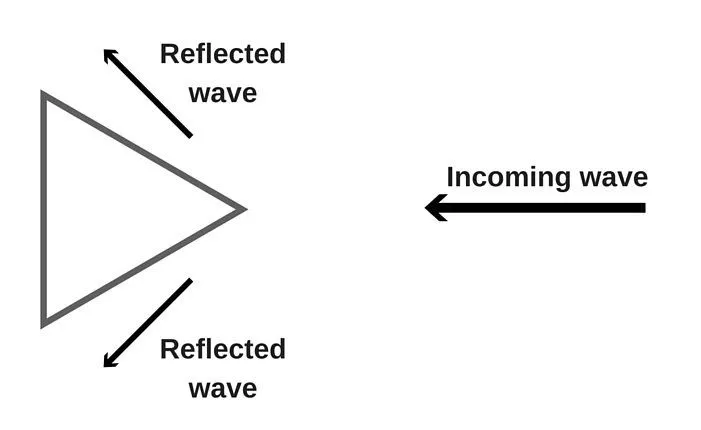
This is achieved by using sharply angled flat surfaces or special curved surfaces at irregular angles, which enable the object or aircraft to conduct the radio waves along its surface, thus preventing any sort of reflections.
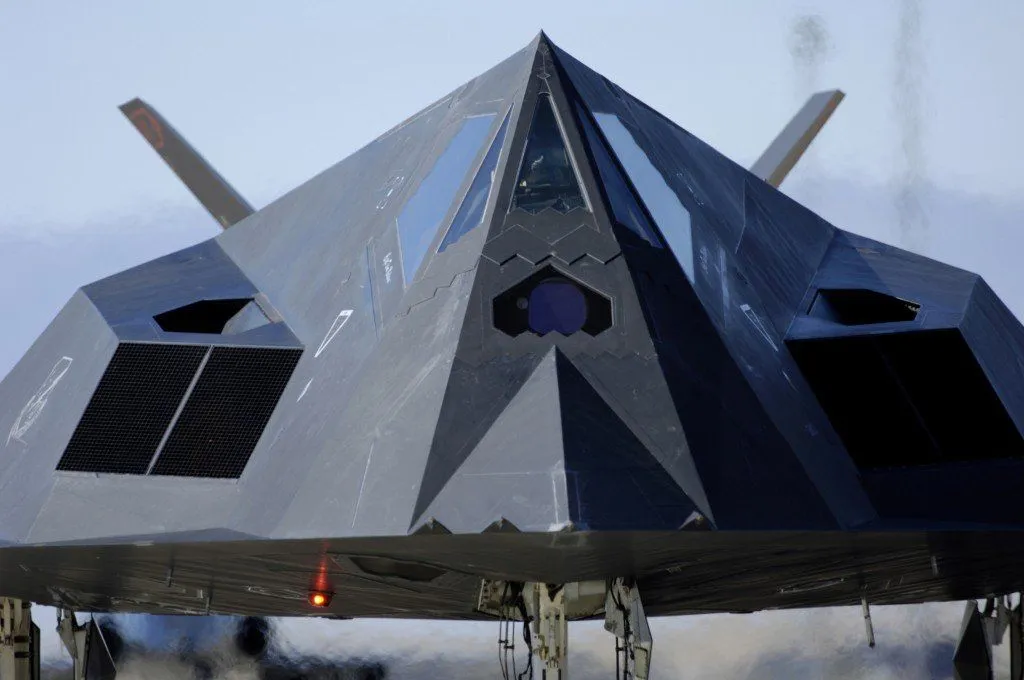
The best way to achieve perfect stealth is to combine the two methods, i.e. RAM coatings + deflectors. This requires a greater amount of research and effort… and is also quite expensive.
The development of stealth technology has completely changed the face of modern warfare. The Lockheed F-117 Nighthawk, which entered service in 1983, was the first true stealth fighter; the Northrop Grumman B-2 Spirit (1989) brought stealth to strategic bombers; the F-22 Raptor (operational 2005) and F-35 Lightning II (operational 2015) became the backbone of US air power; and the new Northrop Grumman B-21 Raider, which took its first flight in November 2023, is expected to enter service later this decade. China’s J-20 Mighty Dragon and Russia’s Su-57 Felon are the most prominent non-US stealth aircraft.
The gigantic aircraft used in the Avengers movie used a different kind of stealth mode, where the aircraft can neither be detected by radar nor visual devices. That’s the perfect level of stealth, but it’s almost impossible to achieve.

The next time you want to sneak out of the house in the middle of the night without being caught, then this modern technology might come in handy (but probably not).