Hot water helps to remove a metal lid from a glass jar by causing the metal lid to expand at a faster rate than the glass jar. This creates a gap between the metal lid and the glass jar, which eventually causes the lid to pop open.
The metal lid expands at a faster rate than the glass jar, which forms a gap between the metal lid and the glass jar. This gap grows as the metal lid expands, until the lid pops open from the jar.
Use a dish towel. Use a knife. Bang it on the counter. Use your hands! The Internet is full of tips on how to open a stubborn glass jar with a metal lid. However, a little science and some hot water can save you the effort of doing anything special at all. The lid just pops open. Voila!
Thermal expansion is what happens when you run a jar under hot water. But how does the process work?
Thermal Expansion
Most materials expand at high temperatures and contract at low temperatures. The phenomenon by which materials expand when exposed to heat is known as thermal expansion.

Inside The Material
All materials are composed of basic building blocks known as atoms. Millions of atoms make up a molecule, and a material is made up of many such molecules. In solids, these molecules are arranged in a specific pattern, known as a crystal structure. They are held tightly together within the structure as a result of strong attractive forces, known as intermolecular forces of attraction. Within the crystal structure, the molecules are continuously vibrating within their fixed positions.
Effect Of Heating
Heat is the internal energy that is transferred from a body at a high temperature to a body at a low temperature. This process is also known as thermal energy transfer. When a material is heated, or receives heat from a source like hot water, the molecules in the material absorb this thermal energy.
The thermal energy does to the molecules what caffeine does to humans – it gives them an energetic boost. The molecules, which were previously just vibrating about their fixed positions, will now start bouncing up and down with this additional energy. Thus, every molecule now takes up more space than it did before to accommodate these energetic vibrations, which causes the material to expand.
Effect Of Crystal Structure
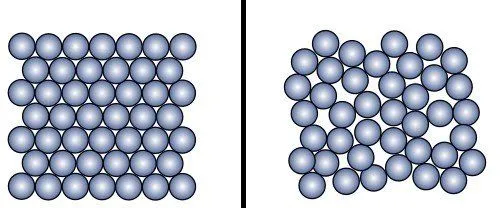
Metals have an organized crystal structure, meaning that the atoms in a metal sit in a neat, repeating lattice. Free electrons can move through this lattice with ease, so heat travels quickly and the metal warms up evenly throughout. Glass is different. Its atoms are locked into a jumbled, disordered arrangement known as an amorphous structure, with no neat lattice and no free electrons to carry heat along. That disorder acts like an obstacle course, so glass conducts heat poorly and warms up slowly. As we will see, this difference in how readily each material takes up heat, along with how much each one stretches per degree, is exactly why the lid loosens before the jar does.
Metal Lid Vs. Glass Jar
Two things make the metal lid and the glass jar expand by different amounts. First, metals are good conductors of heat, so the lid soaks up thermal energy from the hot water quickly and climbs to a higher temperature. Glass is a poor conductor, so the jar warms up far more slowly. Second, and more importantly, metal stretches more than glass for every degree of warming. Put those two factors together and the lid expands a great deal more than the jar.
Thermal energy transfer does not necessarily involve the transfer of matter. Although hot water is flowing over the jar, neither the metal lid nor the glass jar absorb any of the water. They only absorb the heat energy that the water carries along with it.
The quantity that indicates the extent to which a material can expand upon heating is known as the coefficient of thermal expansion. Aluminum, which is normally used to make jar lids, has a thermal expansion coefficient of about 23 × 10-6 per degree Celsius. This means that aluminum expands by 0.000023 times its original dimensions every time the temperature is raised by one degree Celsius! On the contrary, glass has a thermal expansion coefficient of only 9 × 10⁻⁶ per degree Celsius, which is much lower than aluminum.
As expected, the metal lid expands at a faster rate than the glass jar, which forms a gap between the metal lid and the glass jar. This gap grows as the metal lid expands, until the lid pops open from the jar.
Why Is The Lid Stuck In The First Place?
Thermal expansion explains how hot water frees the lid, but it does not explain why the lid was clamped down so hard to begin with. The answer is a partial vacuum. Most store-bought jars of jam, sauce or pickles are sealed while hot. As the contents are filled and heated, air is driven out of the jar. When the jar cools, the food and the leftover air shrink, and the pressure inside drops below the pressure of the air outside, pulling the lid down tight against the rim (Penn State Extension).

From that moment on, the ordinary air around you does the gripping. Atmospheric pressure is about 101 kilopascals, which works out to roughly 10 tonnes pressing on every square meter. A jar lid is small, but the numbers still add up: if a lid about 7 cm across sat over a perfect vacuum, the atmosphere would push it down with a force of around 40 kg. Real jars hold only a partial vacuum, so the true figure is smaller, yet it is still more than enough to pin the lid firmly in place.
So two separate things fight you when you twist: the threads themselves, and the suction of the vacuum. This is why heating the lid works so well. The hot water expands the metal to open a gap, and that same flexing can break the vacuum seal. It is also why a sharp tap on the lid, or a firm whack on the base of the jar, often loosens things in an instant. You may even hear a faint pop as air rushes back in and the pressures equalize.
How To Open A Stuck Jar Lid, Step By Step
Putting the science to work takes less than a minute. Here is the simplest reliable method:
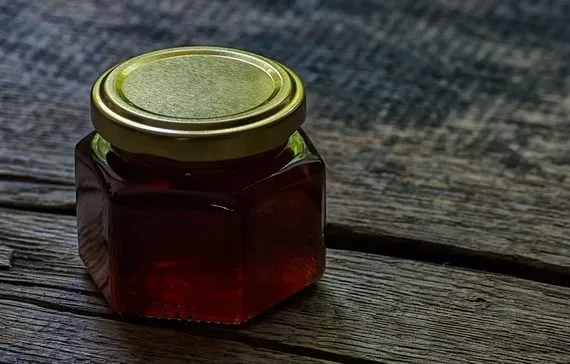
- Warm the lid, not the food. Hold the jar upside down and run hot tap water over the metal lid for 30 to 60 seconds, turning it so every side of the rim heats evenly. You can also stand the jar lid-down in a bowl of hot water for about 30 seconds. Because you are heating only the metal, none of the water gets into the food (Food Republic).
- Dry it and get a grip. Wipe the lid, then wrap it in a dish towel or snap a wide rubber band around it. The extra friction lets you put far more turning force on the lid without your hand slipping.
- Break the seal if it still resists. Tap the edge of the lid against the counter, or give the base of the jar a firm whack with the heel of your hand. That small flex lets air leak back in and cancels the vacuum. Listen for a soft pop, then twist.
The trick is that each step attacks a different part of the problem. The heat expands the metal and weakens the seal, the towel multiplies your grip, and the tap kills the vacuum. Use them together and even a stubborn factory-sealed lid usually gives way on the first try.
Can The Hot Water Crack The Glass Jar?
It can, if you overdo the heat. Remember that glass is a poor conductor, so it warms up slowly and unevenly. If you pour boiling water onto a cold jar, the surface touching the water expands quickly while the glass just behind it stays cold and does not. The two layers pull against each other, and that uneven stretching builds up internal stress. Push it far enough and the glass cracks. Engineers call this thermal shock (Ceramic and Glass Industry Foundation).
How big a temperature jump a jar can survive depends on what it is made of. Everyday jars are soda-lime glass, which expands a fair amount when heated and tolerates only a modest sudden change before it fails. Ovenproof borosilicate glass, the kind used in laboratory glassware and heat-resistant bakeware, expands far less per degree, so it shrugs off temperature swings that would shatter an ordinary jar (Thermal shock).
The good news is that the lid trick already keeps you safe. You only need warm-to-hot tap water, not boiling water, and you are aiming it at the metal lid rather than the cold glass. Heat the lid, leave most of the jar cool, and there is no sudden shock for the glass to deal with.
Other Examples Of Thermal Expansion

- The Eiffel Tower is entirely made of wrought iron. You may not know this, but the tower gains roughly 15 cm (6 inches) in height every summer due to the thermal expansion of the iron within it!
- No, your house isn’t haunted. Pipes sometimes make creaking noises when you take a warm shower because the hot water causes the pipes to expand. The pipes contract once the water cools down, causing those distinct creaking noises.
- Dental fillings can often give you a toothache. When you consume something hot, the metallic fillings expand at a rate that is faster than the tooth enamel, causing tooth sensitivity and potential discomfort.
References (click to expand)
- Thermal expansion | physics - Encyclopedia Britannica. britannica.com
- Thermal Expansion Coefficients at 20 C. Georgia State University
- Ensuring a Good Seal on Canned Goods. Penn State Extension
- The Hot Water Trick That Will Finally Open Stubborn Food Jars. Food Republic
- Thermal Shock Lesson. Ceramic and Glass Industry Foundation
- Thermal shock. Wikipedia