Table of Contents (click to expand)
When you put metal in a microwave, the microwaves reflect off it instead of heating the food. Charge concentrates on sharp edges (like fork tines) and ionizes the surrounding air into visible sparks, called arcing. Repeated arcing can burn holes in the cavity wall and overheat the magnetron, and thin metal like aluminium foil or twist-ties can glow red-hot and set fire to anything it touches.
You’ve been scolded by your mother more than once for heating up your leftover pasta in the metal container of the restaurant’s take-home box. And yes, she was right to do so. You can put a metallic vessel inside the oven or microwave, but it’s pointless… and potentially dangerous.
Now, thanks to your lovely mother, you’ve never made that mistake again, but do you know why it is potentially harmful to put a metallic object inside the oven?
First, Let’s See How Microwaves Work In Terms Of Cooking Food.
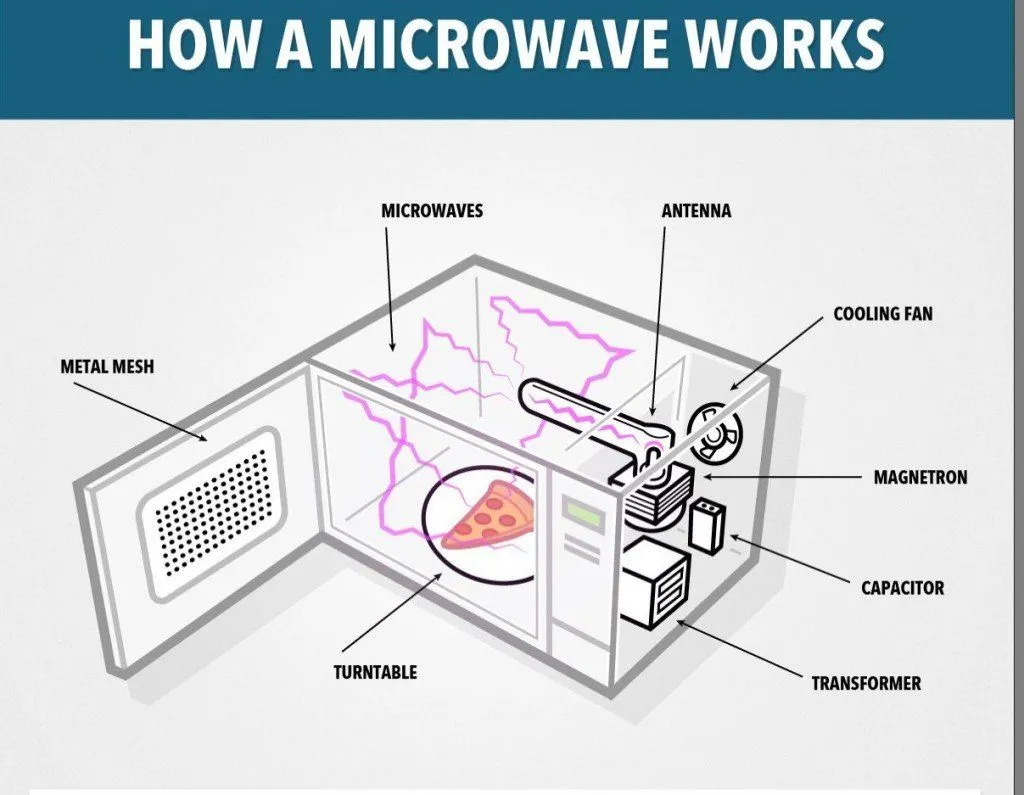
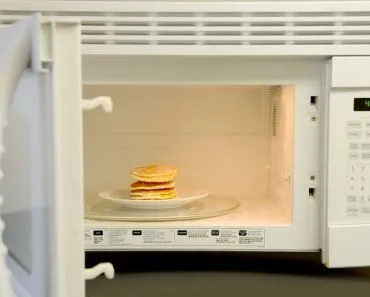
Microwaves are a form of electromagnetic radiation, like radio waves. They are generated by a device called a magnetron, and they pulse rapidly back and forth inside an oven at a carefully calibrated frequency.
The magnetron is connected to a high voltage source, and it directs the microwaves into the metal box where our food is placed. These waves bounce off the oven’s interior metal walls and pass through paper, glass, and plastic, but they get absorbed by the food. More specifically, these waves are absorbed by the food’s water content. This absorption makes the molecules oscillate back and forth, creating heat and cooking the food from the inside out, the outside in, or uniformly, depending on where the water lies.
What Happens When We Put Metal Inside?
While microwaves are easily able to pass through ceramics, plastics, and paper, they show a much different behavior when it comes to metals. Metals are laden with a large number of free electrons and are therefore great conductors of electricity.
When you place a metal item inside the oven and the microwave starts doing its work, the free electrons start moving from one side to another very rapidly. This causes the microwaves to reflect, thus preventing them from entering the vessel to heat the food.
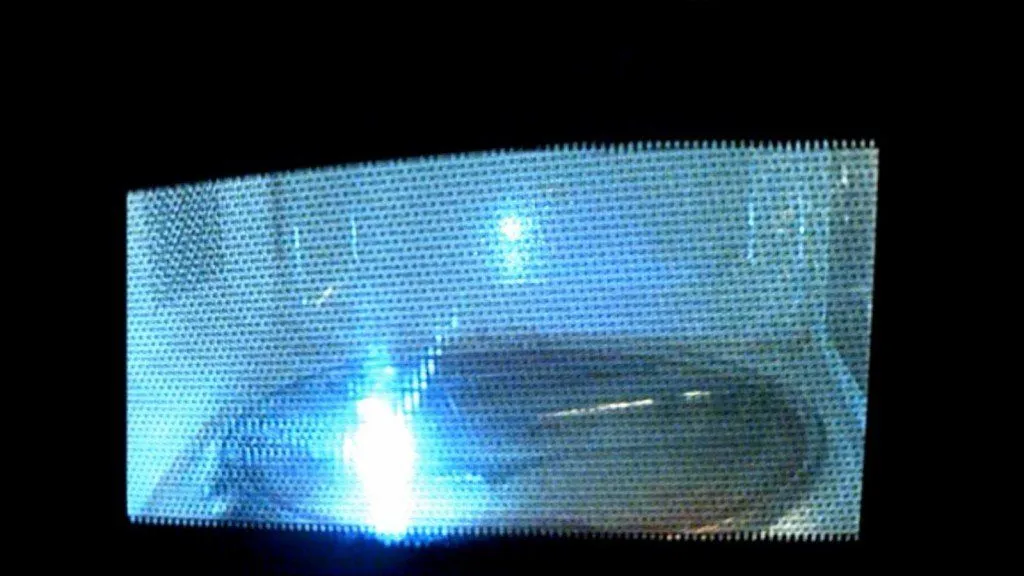
You may have noticed sparks coming out of any metallic objects that you place inside the oven for too long. This is because when microwaves hit the object, the object becomes charged, which causes an accumulation of electrons on its surface. The high surface charge density can increase the potential, which can cause a dielectric breakdown of air (reduction such that more current flows). This may lead to sparks appearing to fly from the object.
How Does It Affect The Oven?
If the sparking occurs too often, it may burn small holes in the metal wall, thus destroying the microwave. This may render the microwave oven dysfunctional and significantly reduces the “life expectancy” of this kitchen appliance.
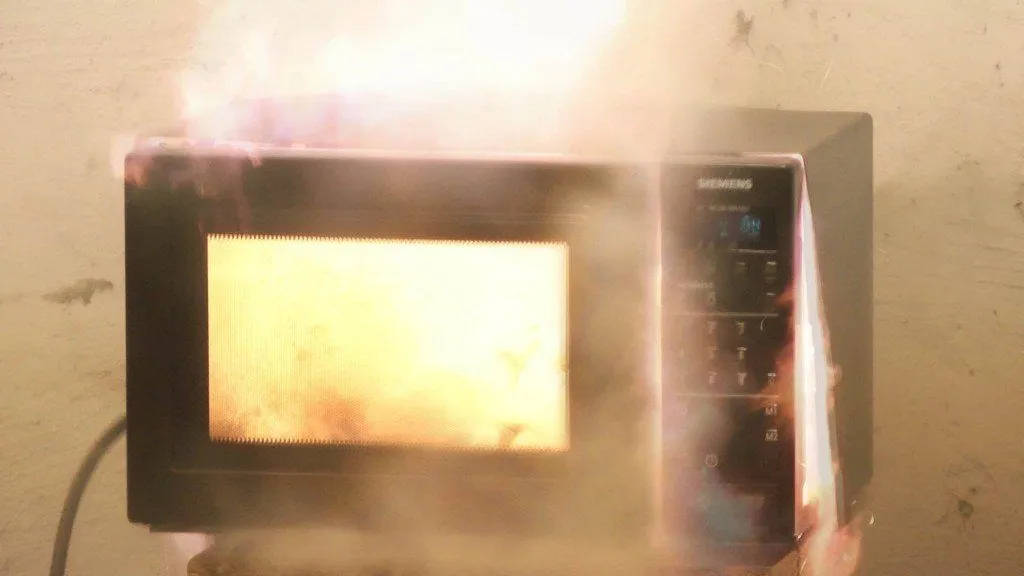
Humans are always looking to overcome every weakness; it’s part of our nature. Manufacturers have therefore used the fact that metal sometimes gets very hot when placed inside the oven to their advantage. Some microwavable soups, pizzas and pies are packaged with a thin metallic layer under a non-metallic lid; essentially, the food trapped against the metal gets cooked nicely. However, if you leave those snacks in for just a few minutes too long, they might incinerate.
That’s Not It! You May Not Always Notice Sparking
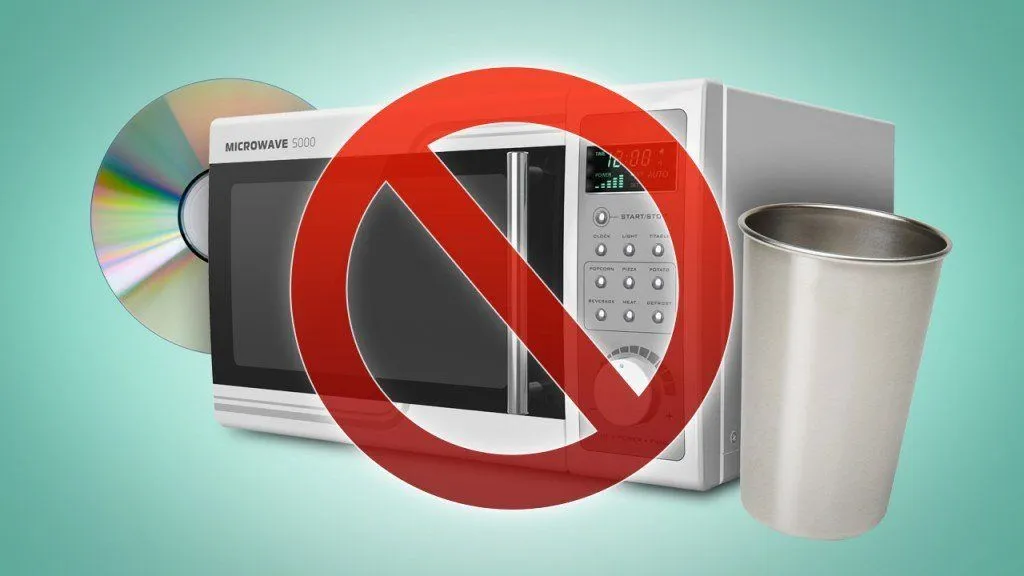
You can microwave metals of certain shapes. Usually, sharp edges are the most dangerous culprits. For instance, it is okay to microwave a spoon for some time, but a fork is definitely a bad idea, because a fork has sharp edges, which causes the electrons to accumulate at the edges, thus causing sparks almost instantly. On the other hand, a spoon has a curved surface, which leads to the electrons being distributed uniformly over it. Thus, sparking is not very prominent with that particular utensil.
Therefore, metal itself is not the reason that sparking occurs; instead, it’s the shape of the object that is actually to blame. Objects with sharper edges cause sparks, while those with round edges are safer.
However, using any type of metal to heat up food is not a very good idea, unless you want to end up with red-hot burned hands.
Can A Microwave Actually Melt Metal?
Here’s the part that trips a lot of people up. Watching a fork throw sparks, you might assume the metal is about to turn into a puddle. It almost never does. Remember that a microwave heats food by making water molecules jiggle, not by dumping heat straight into solid objects. When the waves hit a chunk of metal, most of that energy is simply reflected rather than absorbed, so a solid spoon or a steel bowl barely warms up at all.

Melting takes serious temperatures. Tin gives up at around 232 °C (450 °F), aluminum needs roughly 660 °C (1,220 °F), and copper holds out until about 1,085 °C (1,985 °F). A foundry uses a dedicated furnace to reach those numbers. Your kitchen microwave, typically 600 to 1,200 watts, simply isn’t built to push a reflective solid metal object anywhere close. Long before a fork could melt, the reflected energy bounces back toward the magnetron and risks cooking that part instead.
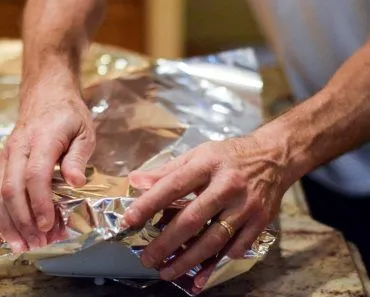
What you can get is localized drama. Thin foil, twist-ties or the sharp tines of a fork concentrate charge and arc, and that pinpoint heating can make a sliver glow red and even tear or burn. That’s a world away from melting a solid lump. Researchers do coax extreme local temperatures out of ordinary microwaves for materials work, but only by carefully engineering tiny, microwave-absorbing particles, never by tossing in a regular metal object. So no, your microwave isn’t a secret metal smelter.
Is It Safe To Use Your Microwave After You’ve Put Metal In It?
We’ve all done it: a foil-wrapped leftover or a forgotten spoon goes in, there’s a flash, and you yank the door open in a panic. So is the appliance ruined? Usually not. A brief accidental run with no real arcing, or a single small spark, rarely does lasting harm. The damage that matters is cumulative. Repeated or prolonged arcing is what slowly burns the cavity and stresses the magnetron, as we saw earlier.

Do a quick check. Look inside the cavity for scorch marks, pitting or burned spots, especially on the back wall and the floor, and make sure the door still closes firmly and isn’t bent or warped. The U.S. Food and Drug Administration is blunt on this point: don’t use a microwave if the door doesn’t close properly or is bent, warped or otherwise damaged. Ovens sold in the United States must keep leakage below 5 milliwatts per square centimeter measured 5 cm away, a level far below anything known to harm people, and they carry two independent door interlocks plus a backup monitor that shut the magnetron off the instant the door opens.
If everything looks clean and the oven still heats a cup of water normally, you’re almost certainly fine. The warning signs that say stop are a persistent burning smell, fresh burn marks, sparking even with nothing metallic inside, or food that no longer heats. At that point, retire the unit or have it checked. And remember that some models should never be run completely empty, so glance at the manual before you test it.
References (click to expand)
- How do magnetrons work? - Explain that Stuff. explainthatstuff.com
- Why can't we put metal objects in a microwave?. The MIT School of Engineering
- Why does metal, like a fork or aluminum foil spark when .... The University of California, Santa Barbara
- Microwave Ovens. U.S. Food and Drug Administration (FDA)
- Facile growth of carbon nanotubes using microwave ovens. Nanoscale Advances, Royal Society of Chemistry
- Tin - Element information, properties and uses. Royal Society of Chemistry