Table of Contents (click to expand)
The picture during an eye examination, be it a hot air balloon or a small house on a farm, is meant to keep your eye focused on a single point during the test. Staring into an otherwise blank screen in the autorefractor can cause twitching or strain in the eye.
How does it feel to be able to see the world without effort? Well, those of us who can relate to the image below probably miss the luxury of perfect eyesight. This hot air balloon and house mark the beginning of a very tedious process that helps to determine just how poor your vision really is. All you have to do is stare at this picture and the machine will tell you what power spectacles or contact lenses you need.
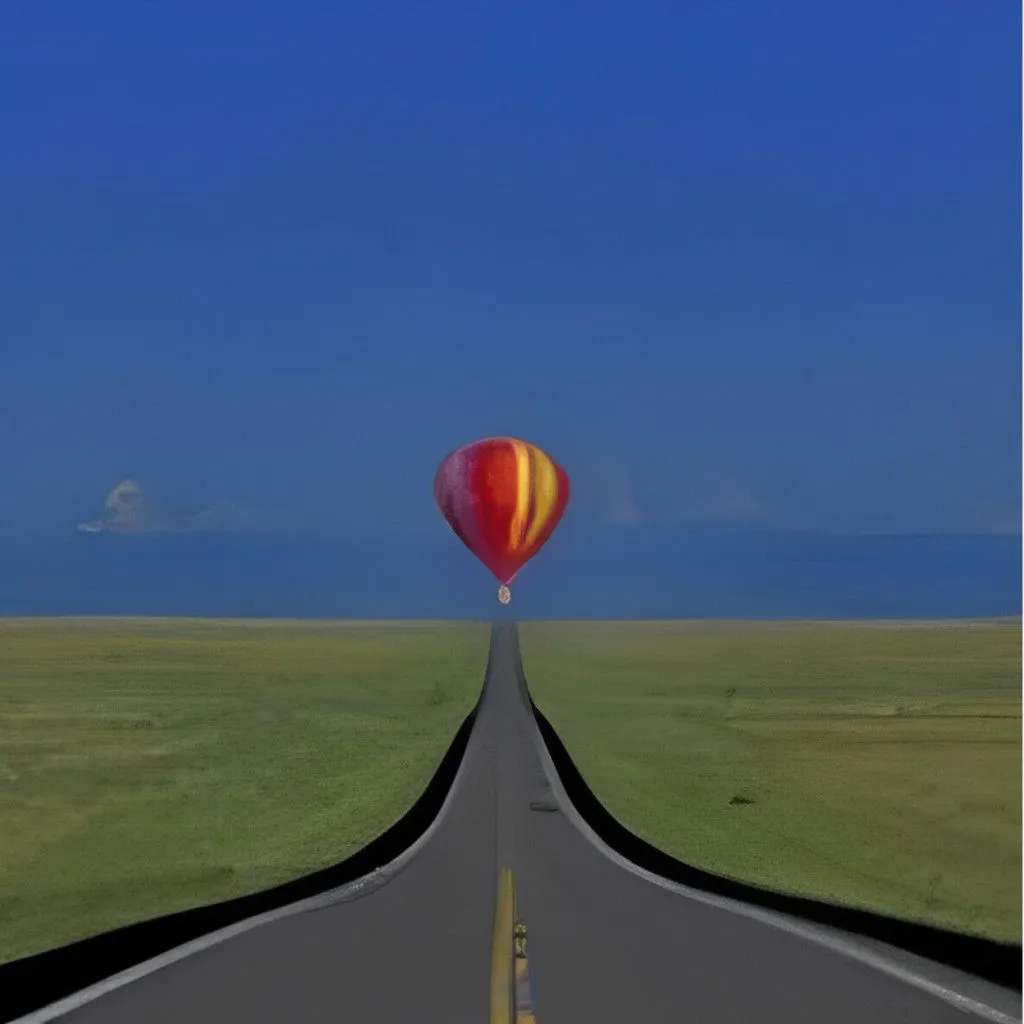
How does staring at this image help identify your eye power?
The eye machine that commonly uses the hot air balloon image is called an autorefractor. They’re the most commonly used machines to check patients’ eye power.
So, how does the autorefractor work and why does it require you to stare at a picture?
How Do Eye Tests Work?
There was once a time when a manual refraction test was the only technique used to investigate the refractive error of our eyes. It relied on a retinoscope that projected a beam of light into the patient’s pupil. The optometrists could then determine the refractive error by observing the light reflex coming from the patient’s pupil.
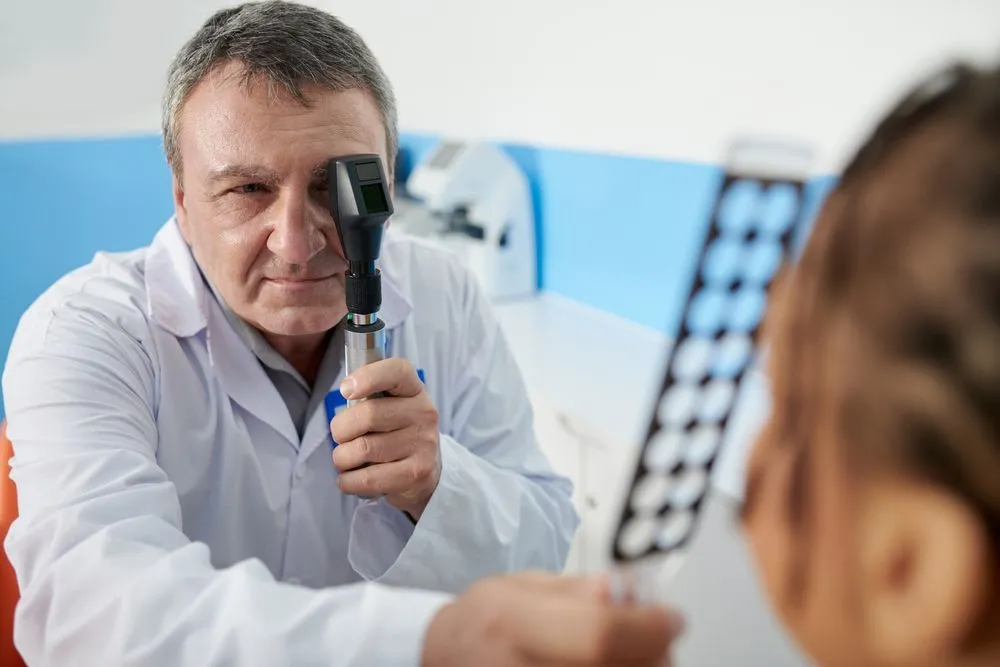
However, this was a subjective, time-consuming procedure and the accuracy of the results largely depended upon the skills of the optometrist. Thus, there was a need to automate refractors in order to evaluate the refractive error accurately. Not to sound clichéd, but necessity is the mother of all inventions, and this need led to the birth of autorefractors.
How Does The Autorefractor Work?
Autorefractors assess your vision by measuring the refractive error of your eyes based on how infrared light is reflected from your retina. Now, what does a ‘refractive error’ refer to in the first place?
Refractive errors of the eye prevent you from seeing clearly. The cornea and the lens inside your eye work together to bend incoming light so that it focuses precisely on the retina. In fact, the cornea contributes about two-thirds of the eye’s total focusing power, while the lens fine-tunes the focus. When there is a refractive error, the eye’s optical system is bending the light too much or too little, and the image that forms on the retina won’t be very focused.
Refractive errors happen when there is a change in the natural shape of the eye. In the case of myopia (shortsightedness), the eyeball is longer than normal, causing light to focus in front of the retina. In hypermetropia (farsightedness), the eyeball is shorter than usual, so light focuses behind the retina.
Autorefractors can measure this refractive variation.
How Does The Machine Measure Refractive Error?
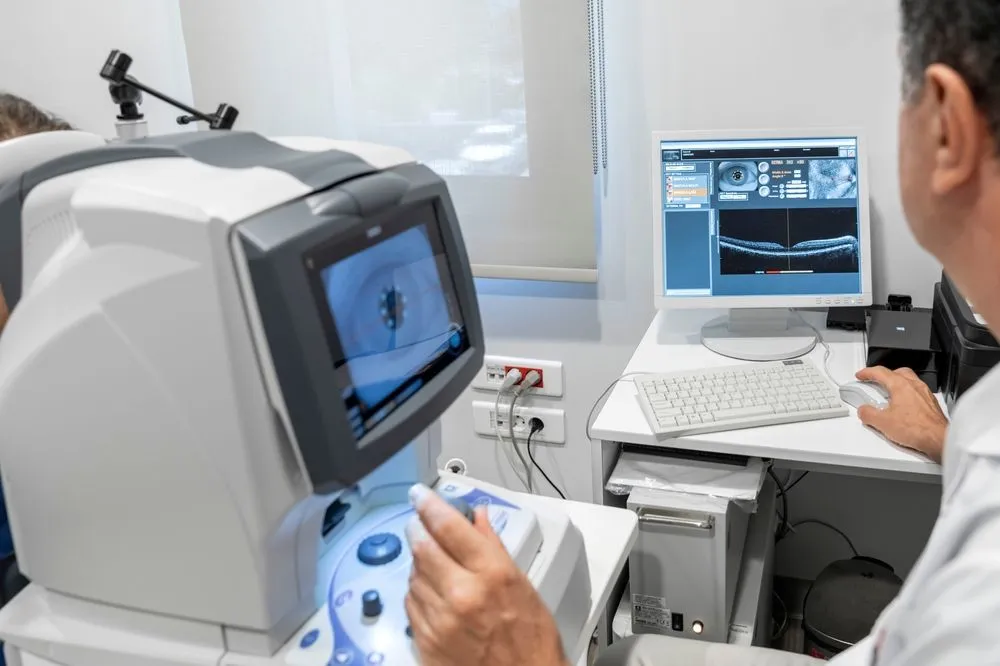
Once you are seated near the machine with your chin resting on the chin rest, you will be asked to observe the hot air balloon. The machine will bring the image in and out of focus. This is called "fogging," a technique used to relax the eye’s focusing muscles (accommodation) so the machine can get an accurate reading of your natural refractive state. During this process, the machine beams near infrared radiation (NIR) into your eye. This is a wavelength of light that your eye’s sensors cannot detect, but the cornea and lens will still bend the NIR light. A sensor present in the machine then detects the NIR light being reflected back from the retina (the fundus of the eye).
The autorefractor calculates the refraction by analyzing the changes in the wavefront caused by the eye’s optical system. The measurements include information about the eye’s focusing ability, astigmatism (if present), and other refractive errors.
But Does The Hot Air Balloon Have Any Importance?
Now, coming back to the picture itself. What exactly is the role of the hot air balloon at the end of a long road? Well, it doesn’t really have a major role to play in determining the power of the eye.

The picture (be it a hot air balloon or a small house on a farm) is meant to keep your eye focused on a single point during the eye examination. Staring into an otherwise blank screen in the autorefractor would cause twitching or strain in the eye. It should go without saying, but a relaxed eye ensures that the autorefractor can do its job to perfection.
What Is The House Picture In Some Eye Tests?
Maybe you have never seen a hot air balloon in the machine at all. Plenty of people remember staring at a small red house or a barn at the end of a long, straight road, while others recall a parachute or a house sitting in an open field instead. If that is you, do not worry: you were not given a different test. These are simply alternative fixation targets, and they all do the same job. StatPearls notes that some autorefractors use "colored photos of outdoor scenes to make them understandable and comfortable for the patient," which is why one clinic shows a balloon and the next shows a farmhouse.

So why a scene with depth, rather than a simple dot? The picture almost always sits at the far end of a road or field for a reason. Your eyes have to relax their focusing muscles (an effect called accommodation) to "see into the distance," and a relaxed eye is exactly what the autorefractor needs in order to measure your true refractive state. If the machine just showed a flat target a few centimeters from your face, your eyes would strain to focus up close, and the reading would drift toward shortsightedness. A long road heading off toward a balloon or a cottage tricks your visual system into settling, as if it were gazing at the horizon. The machine then nudges that scene gently in and out of focus, a step known as fogging, which is built into modern autorefractors precisely to relax accommodation before the measurement is taken.
In other words, the specific scene is interchangeable. A balloon, a house, a barn, or a parachute will all work, as long as the image gives your eye a comfortable, distant-looking point to rest on. You can think of the balloon and the farmhouse as the same idea wearing different costumes.
Is The Hot Air Balloon Test The Same As The Air Puff Test?
Here is a mix-up that trips up a lot of people: the hot air balloon is not the test where a quick puff of air is blown at your eye. Those are two separate machines doing two completely different jobs, even though they often sit side by side in the same exam room.

The balloon belongs to the autorefractor, which measures how your eye bends light so the optometrist can estimate your glasses prescription, which is also why your lens prescription can change over time. The puff of air comes from a different instrument called a non-contact tonometer, and its job is to measure the pressure inside your eye. According to StatPearls, these instruments "use a small puff of air to applanate the central cornea," meaning the burst of air briefly flattens the front surface of your eye while a sensor records how it responds. From that, the machine calculates your intraocular pressure without ever touching the eye, which is why no numbing drops are needed.
Why does eye pressure matter? It is one of the main screening checks for glaucoma, a group of conditions that can damage the optic nerve. As the US National Eye Institute puts it, "high eye pressure increases your risk for glaucoma," so a quick pressure reading is a useful early warning. Worth knowing: the air puff version is a fast screening tool rather than the final word, and a higher-pressure result is usually rechecked with a more precise contact method. So if you stared at a peaceful balloon and also got startled by a small gust of air, you simply had two tests in one visit: one for your prescription, and one for the health of your eyes.
The Eye Power
So now the optometrist knows the refractive error of your eye… who cares? The optometrist still has to figure out what glasses to give you in order to correct this error. The refractive error of your eye will inform what lens your glasses should be, aka, your eye power.
Ironically, eye power points out how weak your vision is, and helps establish the value of your lens power. The lens power is measured in dioptres, which tells you the strength of the glasses and the level of correction you require to achieve normal vision. The value is shown in either minus or plus eye power.
It's important to note that the autorefractor reading is a starting estimate, not a final prescription. Optometrists will then insert a series of lenses based on the value given by the autorefractor into a device called a phoropter. Wearing this changeable lens equipment, you must try to read the letters or numbers written on a chart. This chart is called the Snellen chart, and should be kept at a distance of 20 feet (6 meters) from you.
Then you will go through the tiresome process of “Is this lens better or… this one?” until you finally find the lens that gives you an HD view of the world. The same process is done for both eyes, and voila! You now have an accurate prescription that suits your eye power.
Conclusion
The purpose of the pastoral image is to simply get your eyes to focus on a single point during the eye exam. It isn’t really important what image is used, so long as it gets the patients to focus on one point.
Assuming that you’re one of the many who have to wear glasses to get a clear view of the world, have you ever wondered if not wearing them would make your eyesight worse? Click here to find out.
Or if you’re just someone who wants freedom from the clutches of wearing glasses everywhere every day, you might be interested to know more about the latest advances in vision correction, including AI-powered autorefractors and portable handheld devices that are making eye exams more accessible than ever.
References (click to expand)
- B Gurnani. Autorefractors - StatPearls - NCBI Bookshelf. National Center for Biotechnology Information
- Myopia, Hyperopia and Astigmatism: A Complete Review with .... ijsr.net
- Borish's Clinical Refraction - ScienceDirect.com. Elsevier
- Automated Refraction: Design and Applications.
- Tonometry - StatPearls - NCBI Bookshelf. National Center for Biotechnology Information
- Glaucoma and Eye Pressure. National Eye Institute (NIH)