Table of Contents (click to expand)
Squinting helps you see better mainly through the pinhole effect: narrowing the eyelid aperture cuts off the most divergent rays of light, shrinking the blur circle on the retina and extending the eye’s depth of focus. It works best for uncorrected myopia, but also helps with hyperopia, astigmatism, and age-related presbyopia.
This is something that all of us have noticed countless times in our daily lives. Whether you are trying to read the fine print during a commercial, trying to make out a person’s face from a distance, or even reading this very article – it always helps to see better when you squint your eyes.
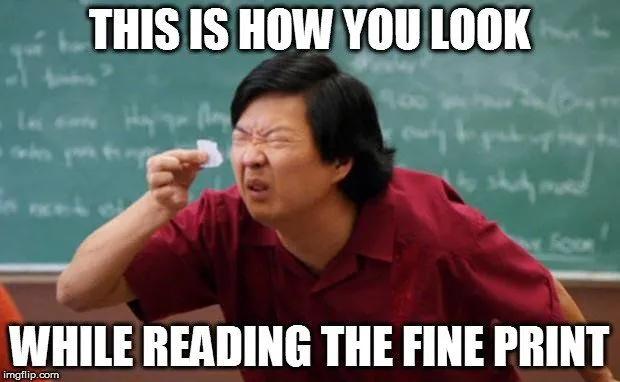
Has it ever occurred to you why this happens? Why temporarily reducing your eyes’ size suddenly improves your vision?
Short answer: Squinting narrows the aperture of light reaching your retina (the pinhole effect), which shrinks the blur circle from any out-of-focus image. A much smaller secondary effect comes from gentle eyelid pressure that nudges the cornea’s shape.
How Do We See Things?
When I say the word ‘eye’, you might mentally visualize the rotund, blinking pair of organs that sit on either side of your nose. However, contrary to general perception, the combination of a number of biological components actually constitute the human “eye”.
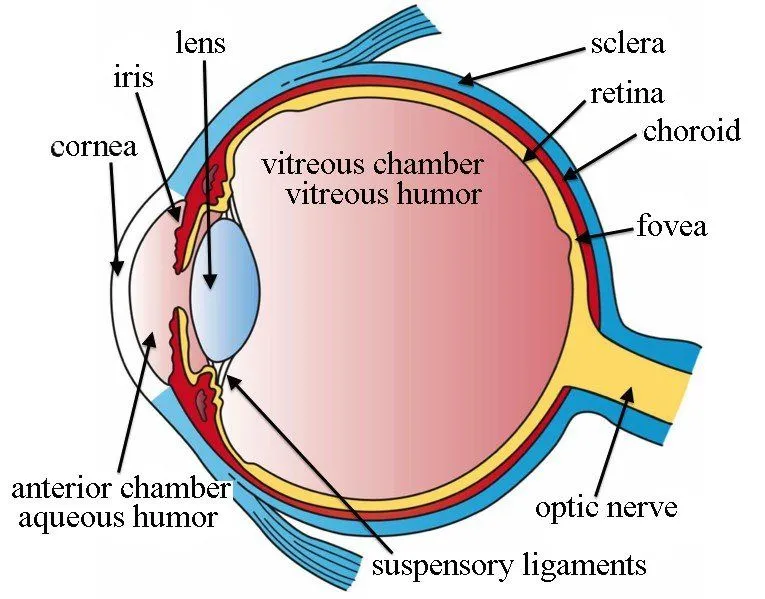
You might already know that when light hits an object, it bounces off its surface and enters our eyes, allowing us to see the object. The light, however, is in the form of multiple rays (made of photons), which first enter the pupil and travel through the eye lens. The lens is equipped with ciliary muscles that contract and relax to change the shape of the lens, allowing us to see things at varying distances.
The lens then focuses the light rays, which fall on a sensory screen at the back of the eye (known as the retina). A chemical present in the retina converts light into electric signals, which are then transmitted to the brain via the optic nerve. The brain processes the signals and ultimately allows us to see stuff.
How Does Squinting Help To See Better?
Squinting does two major things to improve vision, albeit only temporarily, i.e., as long as you are squinting.
The Pinhole Effect (How Squinting Sharpens Focus)
The act of squinting narrows the aperture of light that reaches your retina, and that’s really the key. With a smaller aperture, only the rays that pass close to the optical axis make it through; the wide-angle rays that would otherwise cause blur in an out-of-focus eye are blocked off. The result is a smaller blur circle on the retina and a sharper image. This is the same principle that lets a pinhole camera produce a crisp picture without any lens at all.
The pinhole effect is also why senior citizens often squint at the menu. As we age, the lens of the eye gradually hardens and loses elasticity, reducing its ability to focus on near objects — a condition called presbyopia, which is why most people over 40 need reading glasses. Squinting won’t fix presbyopia, but the narrower aperture buys you a little extra depth of focus.
There is a tiny portion of the retina, called the fovea, that is packed with cones and gives us the ability to see things as crisp and clear as they really are. When the pinhole effect tightens the blur circle and lands the image squarely on the fovea, the world looks noticeably sharper.
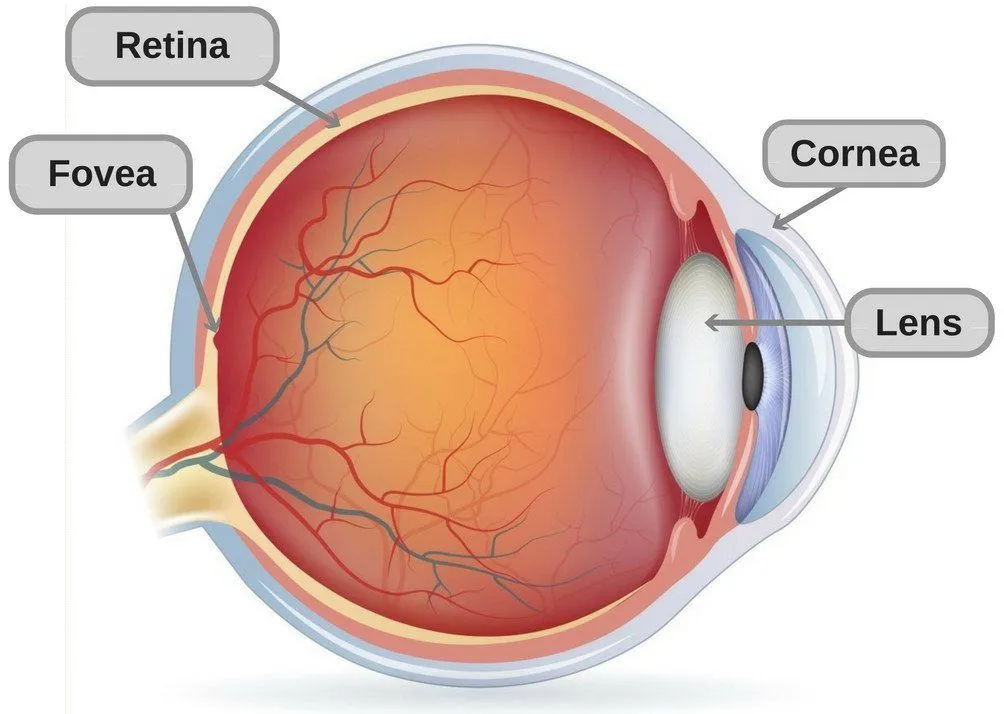
By squinting, you change the shape of the eye, ever so slightly, so that the light accurately focuses on the fovea, improving the visual detail of the thing at which you are squinting.
Reducing The Incoming Light From Other Directions
Have you ever noticed that when you look specifically at something, say, this very text, you can also look at its surroundings and simultaneously perceive your own surroundings without actively trying to do so? This happens because humans, like many animals, have impressive peripheral vision.
What this means is that light from different sources (other than the light being reflected off these words) also enter and are subsequently perceived by the eye. Normally, this is a great thing, as it feeds your situational awareness.
However, when you’re trying to focus on something, like reading the words in this paragraph, you want to minimize the light entering from sources other than the computer or smartphone screen (or whichever device you are reading this article on). The optical problem with refractive errors is that light rays from a single point fail to converge to a single point on the retina, spreading out across a small disk instead. A wider aperture lets in more of those divergent rays, which makes the blur worse.
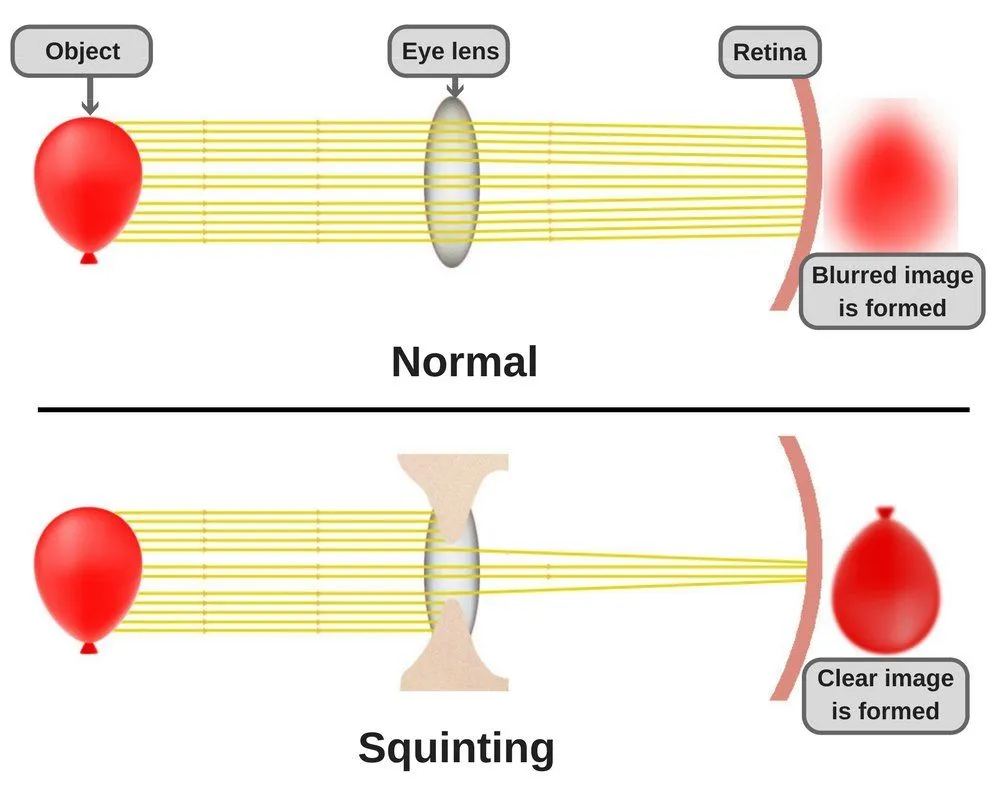
By squinting, the eyelids block out most of the divergent rays, leaving only the central, well-aligned rays to reach the retina. The blur circle shrinks, the image sharpens, and you can suddenly read that menu across the room. Squinting helps the most with uncorrected myopia (nearsightedness), but it also gives a noticeable bump for hyperopia, astigmatism, and presbyopia.
By the way, there is a very simple, yet astoundingly effective trick that can help you see anything much more clearly, regardless of whether or not you use corrective glasses.
So, the next time you can’t quite make out the writing on a distant sign, try a gentle squint — you’ve just turned your eyes into pinhole cameras.