The infinite chocolate paradox is an optical illusion. A chocolate bar is sliced diagonally and rearranged so it looks like you've gained a spare block, but the rearranged bar is slightly shorter than the original. The "extra" block is exactly the chocolate that disappeared along the diagonal cut. It's often pitched as a real-world Banach-Tarski paradox, but Banach-Tarski only works for abstract mathematical points, not real matter.
In Jan 2018, a chain of French supermarkets decided to sell Nutella, also known as God’s sacred nectar sent from heaven, at a 70% discount. This astonishing slash in price resulted in what one could logically expect – a riot.
However, I’m not using the word ‘riot’ in its metaphorical sense. I mean it in the literal sense.
The ‘riots’ spread across the supermarkets forced them to summon the police for help when customers resorted to fighting and jostling. During the hunt for discounted chocolate, one woman had her hair pulled, while another customer left with a bleeding hand.
What Is The Infinite Chocolate Paradox?
This phenomenon, known as the Infinite Chocolate Paradox, spread like a plague and caused outrage on social media. The procedure is simple: Take a chocolate bar that consists of 5×5 chocolate blocks. Cut the bar diagonally from slightly below the second block (from below) on the left of the vertical sides to slightly above the third block on the right.
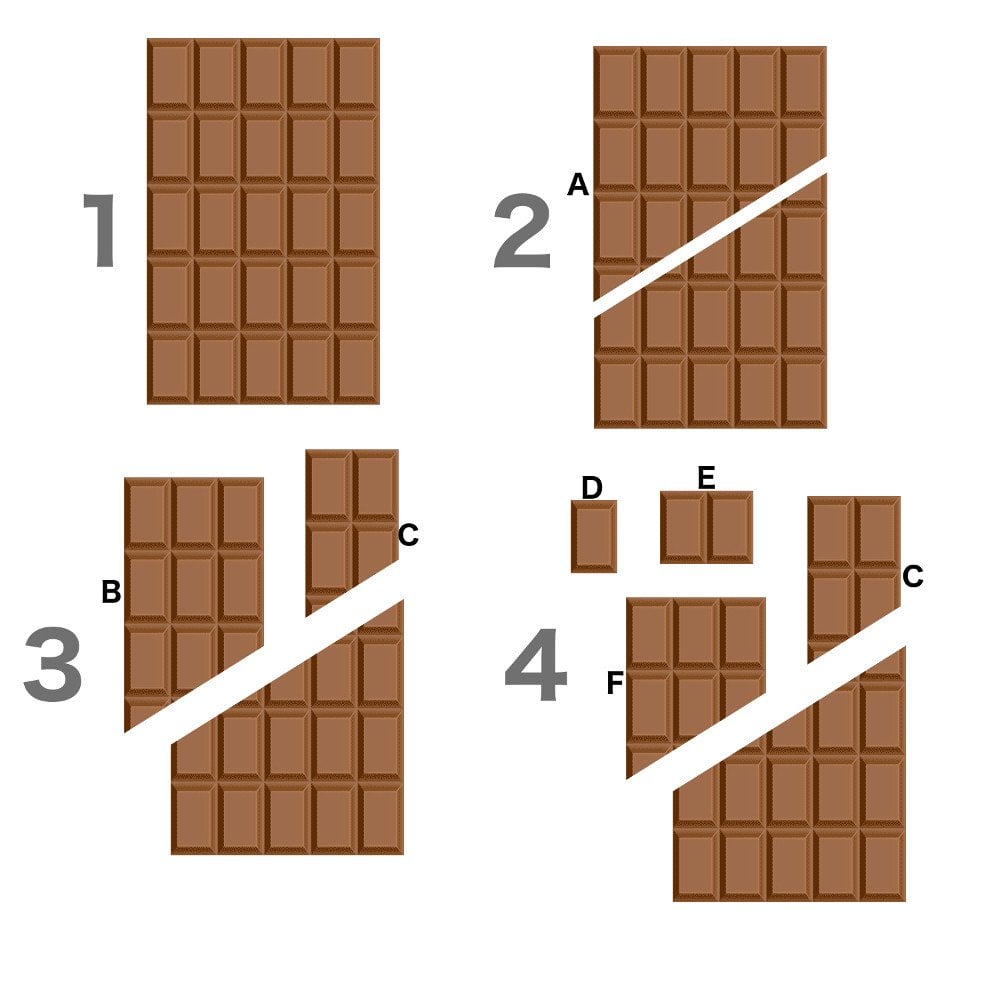
Next, slice the newly amputated piece, which we’ll call piece A, vertically from the third block (from the left) on its upper end. Let’s call this piece B and what remains as C. Chop off a square (D) and a 1×2 rectangle (E) from the chocolate blocks constituting the first three blocks of piece B. The remaining piece from this partition is F.
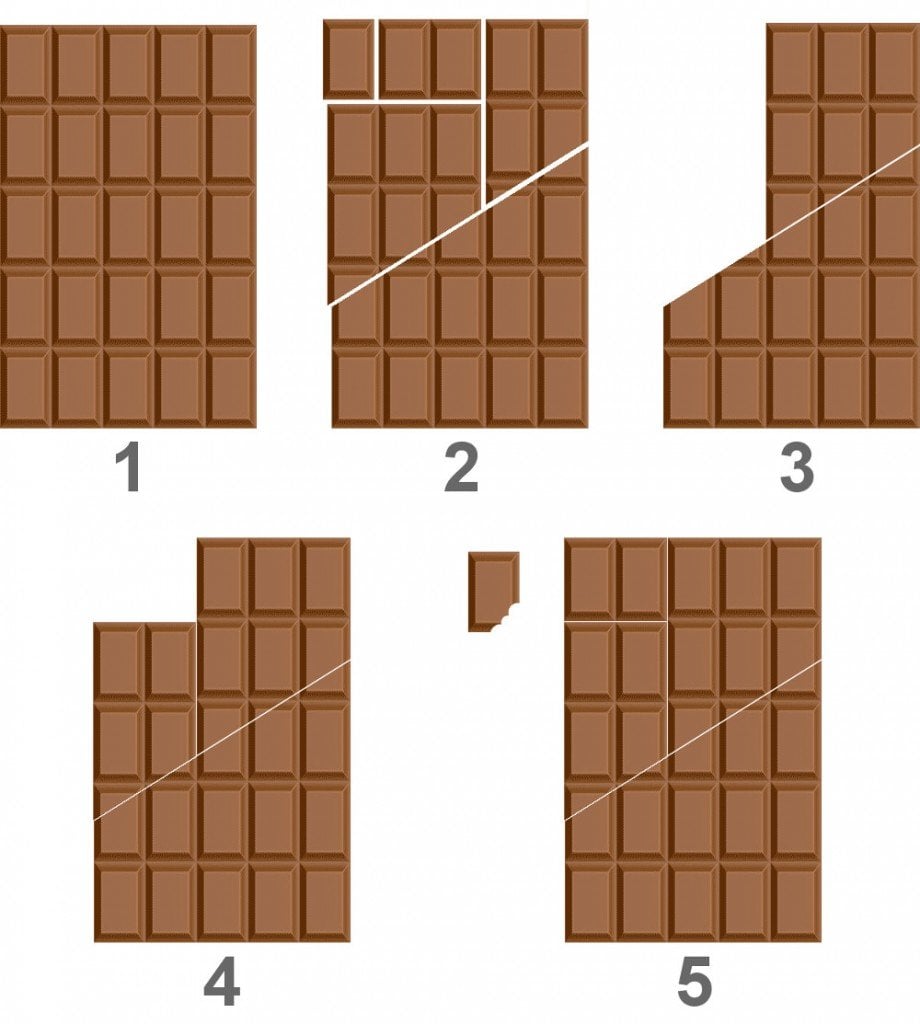
Now, let the magic begin. Shift F to the right and fill the void left by F by placing C in it. Next, play the easiest game of Tetris by dropping the 1×2 rectangle over the 1×2 void above C. The 5×5 block is rearranged, with an additional block of chocolate to spare. Repeat this process to obtain infinite chocolate!
How Does The Infinite Chocolate Trick Actually Work?
If the bar can’t really breed, where does that spare block come from? The viral clip, usually shared online as the “infinite chocolate glitch,” is just a chocolate-flavored version of a classic geometry illusion called the missing square puzzle, a dissection paradox popularized by the amateur magician Paul Curry in 1953 (though tricks of this kind go back centuries).

The sleight of hand lives in that diagonal cut. When you slide the pieces over and drop the little rectangle into place, no chocolate multiplies. Instead, a thin sliver of chocolate, equal in volume to the “extra” block, is quietly shaved off and smeared along the length of the diagonal. Spread that loss across the whole bar and no single square looks any thinner, so your eye is happily fooled.
The pure geometric cousin makes the cheat obvious. Take a right triangle 13 units long and 5 units high, cut it into four pieces, rearrange them, and a 1-unit hole appears out of nowhere. The catch is that the long edge was never a straight line to begin with. The two sub-triangles have slightly different slopes (5:2, or 2.5, versus 8:3, or roughly 2.667), so the apparent “hypotenuse” bows by a hair, opening a sliver of exactly one square unit. Tellingly, the dimensions involved, 2, 3, 5, 8 and 13, are consecutive Fibonacci numbers. With the chocolate bar the giveaway is even simpler: measure it before and after, and the reassembled version is a touch shorter. That lost height is your bonus block.
Is The Infinite Chocolate Glitch Real, And How Long Can You Keep Cutting?
Short answer: no, and not for long. The only place the glitch “works” forever is in a looping GIF that quietly resets to the original bar on every cycle. Real chocolate is matter, and matter obeys the law of conservation of mass: rearranging atoms never creates new ones, so you simply cannot finish with more chocolate than you began with.

Every round of the trick removes a real, finite sliver. Do it once or twice and the loss hides easily, which is exactly why the demonstration is so convincing. But keep going and the deficit stacks up: the bar grows visibly stubbier until there is nothing left to “spare.” Far from being infinite, the trick is self-limiting, since every cut spends a little of the chocolate you already owned.
This is also why it is not a genuine real-world Banach-Tarski paradox, despite the flattering comparison. That theorem only “doubles” abstract objects built from infinitely many points; a chocolate bar is a finite heap of atoms, and you cannot slice it any finer than its molecules allow. So enjoy the trick for the tidy piece of science-flavored magic it is, but keep your day job: the only thing the infinite chocolate trick reliably produces is slightly smaller chocolate.
The Banach-Tarski Paradox
Of course, this isn’t plausible (duh). The gif illustrating the paradox is grossly skewed; it is only an illusion. Calling it an illusion means that it is fake: when the pieces are rearranged, the resulting bar isn’t the same bar we began with. Measure the vertical lengths of the two bars before and after performing the procedure, and you will realize that this absurd way of cutting it in half has rendered it slightly shorter. The apparently extra block of chocolate comes at the cost of reduced size.
The infinite chocolate paradox is a crude representation of the Banach-Tarski paradox, which, through a notorious misinterpretation, allows the most daunting mathematical atrocity , 1=2. According to it, it is possible to divide a solid 3D sphere into 5 pieces and rearrange them to form two identical copies of the original sphere! There isn’t even stretching involved, only reassembling will produce replicas of the same density, same volume, same everything.
The mathematics underlying the paradox is, as you may have guessed, extremely esoteric and therefore incomprehensible, defying common sense and challenging our intuitive perception of spatial concepts such as “volume” and “density.” It operates in the strange realm of infinity, a concept that has always puzzled mathematicians.
The ridiculous phenomenon is possible only if one assumes that the sphere or matter is generally infinitely divisible, which it obviously is not. The matter is based on rigid structures held by atoms. The concept is applicable only in the abstract world, not in the real world, because, in the real world, the matter is limited by size.
However, in the abstract world, where the paradox is possible, matter can simply be considered a collection of points, in this case, infinite points.
Different Infinities
The paradox deals with measurable sets composed of immeasurable quantities. Consider the set of numbers 0,1 and all the numbers between them. This set is denoted by [0,1]. This measurable set can be further divided into uncountable, infinite real numbers starting from 0.000000000000000000001 followed by 0.0…2 and so on.
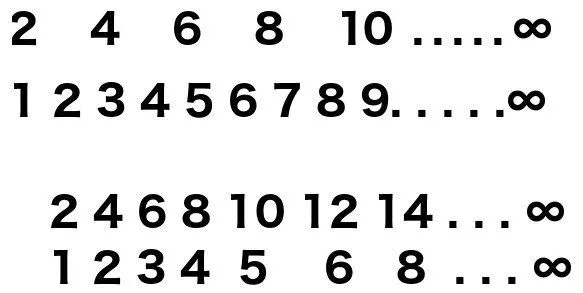
The length of these infinite numbers can be divided into two halves. The points constituting both the halves have the same cardinality because infinity divided by two is still infinity. This implies that there are as many even numbers as there are natural numbers!
Another way to magically conjure an additional set of infinite numbers from a given set of infinite numbers out of thin air is to distinguish between ‘countable’ and ‘uncountable’ infinities.
People who believe that the number of natural numbers until infinity and the infinite number of real numbers between them are equal, such that each natural number can be assigned to each real number, are clearly wrong. This is because you can diagonally move down the real numbers and simply increment the numbers you progressively parse.
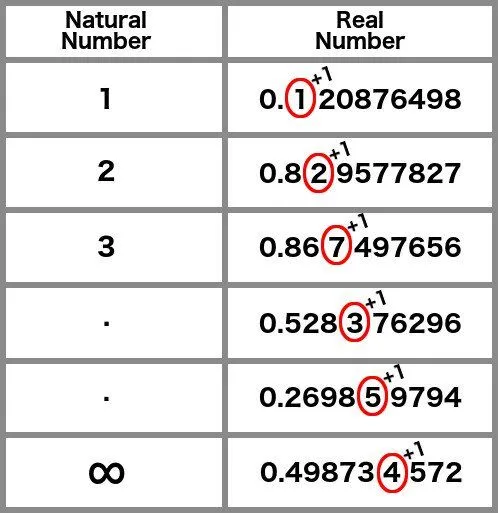
Since all the natural numbers are exhausted (they are 'countable'), there are no natural numbers left to assign, meaning the infinity of real numbers is strictly larger than the infinity of natural numbers. We can now separate the newly created numbers to form another set of infinite numbers.
This explains how the sphere can decay into two identical spheres, albeit by painful simplification, as the density reduced to half is still infinite.
Remember that this only works for mathematical points, not for physical atoms.
Moreover, the five shapes into which the sphere divides are highly eccentric, complex, and distorted entities, unlike any “shape” you have ever encountered.
Enjoy your finite bar of chocolate.
References (click to expand)
- Banach-Tarski Paradox -- Math Fun Facts - www.math.hmc.edu
- Banach–Tarski paradox - Wikipedia. Wikipedia
- Hilbert's Hotel - NRICH - Millennium Mathematics Project. The Millennium Mathematics Project
- Missing square puzzle - Wikipedia
- Curry Triangle - Wolfram MathWorld
- The geometry vanishes - Cosmos Magazine
- Conservation of mass - Encyclopaedia Britannica