Table of Contents (click to expand)
Standard dice have 6 faces, but fair gaming dice are commonly made with 2 (a coin), 3, 4, 6, 8, 10, 12, 20, 24, 30, 48, 60, and 100 sides. The largest mathematically fair die ever manufactured is The Dice Lab's 120-sided d120 (a disdyakis triacontahedron); 120 sides is the proven upper limit for an isohedron, where every face is geometrically equivalent.
The majority of board games are incomplete without dice. Whether it’s Monopoly or Snakes and Ladders, there is always a tiny corner of the box dedicated to them. Typically, when you hear the word dice, your mind immediately conjures up an image of a 6-sided cube. The world of dice, however, is much more expansive than your run-of-the-mill cubes numbered from 1 to 6.
First of all, a clear definition of dice should be laid out before we get into the details. Mathematically speaking, a die can have as many sides as a person desires. In fact, a die with an infinite number of sides would become a perfect sphere. When you think about it, even golf balls are technically dice, but would it be fair to use something like a golf ball in a game? Probably not!
The only dice that can be used in a game are fair dice. Fair dice are those in which the probability of one side of a die turning up is no greater than any other side. Considering that probability is of the utmost importance in any game, fair dice are carefully produced to be mathematically sound and balances. In other words, I am confining the definition of dice to the fair dice that are manufactured to be used in a game.

Non-cubic dice are often popularly dubbed ‘Dungeons and Dragons’ dice, as the players of the game Dungeons and Dragons tend to use unusual polyhedral dice to generate a wider range of outcomes. Of course, there’s no reason you can’t use these unusual dice in classic board games too!
Less Than 6
Yes, there are dice that have less than 6 faces. In fact, there are dice with only 2 sides! Believe it or not, you use them all the time. Don’t agree with me? That’s because you know these 2-sided dice by another name – coins!
That’s right! Used in many games with every side having an equal probability of turning up, a coin toss is nothing more than a dice roll with fewer outcomes.

Apart from coins, there are also 3-sided dice that look like prisms.
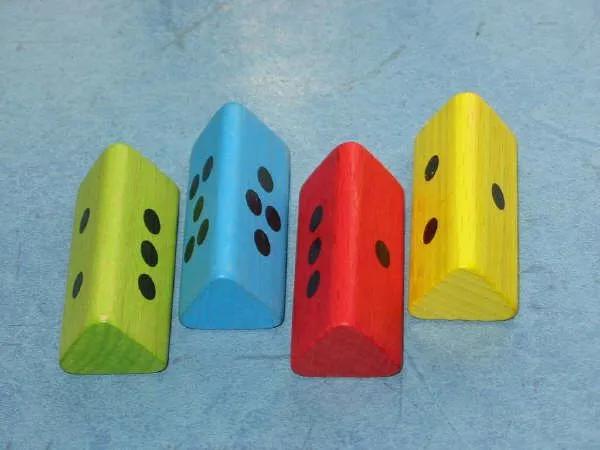
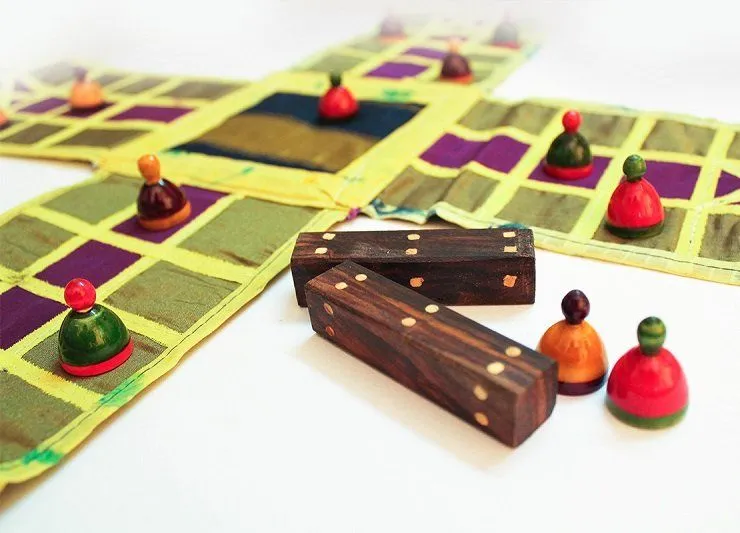
Four-sided dice have been used in India since ancient times in games like Pachisi and Chaupar. These four-sided dice even have mythological relevance to the Indians due to their mystical use in various stories, such as the Mahabharata.
More Than 6
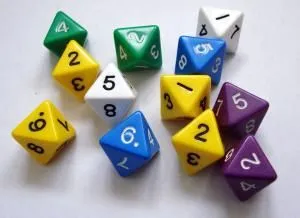
Dice with 8 sides usually come in the shapes of octahedrons, which is basically two square pyramids attached together.
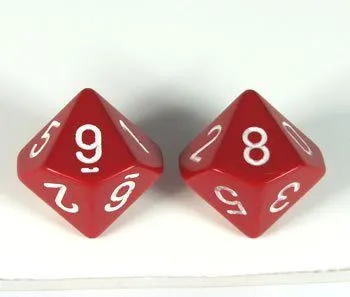
10-sided dice come in the shape of pentagonal trapezohedra; this shape resembles two pentagonal pyramids that have been fused at their bases in such a way that the faces of one pyramid line up with the edges of the other. These dice are usually used to derive percentiles in role-playing games.
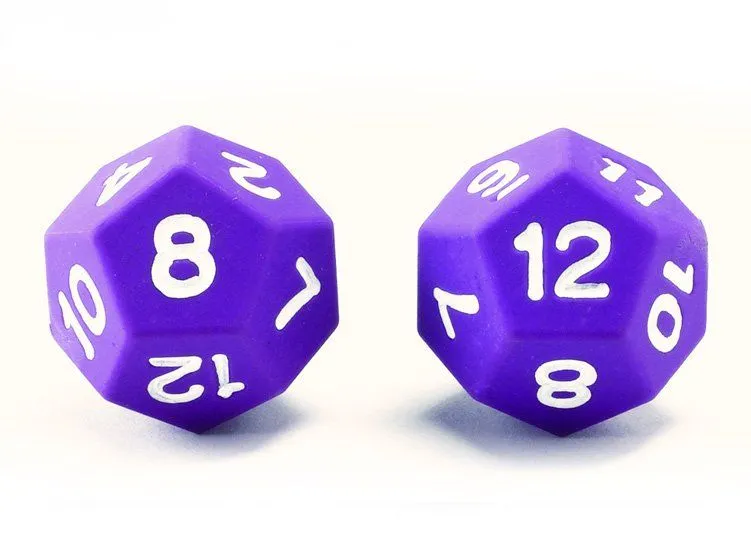
12-sided dice are based on the Platonic solid dodecahedron. Scientists have even uncovered these in ruins of Greek and Roman civilizations! However, today you can find them in table-top role-playing games and mathematical puzzles.
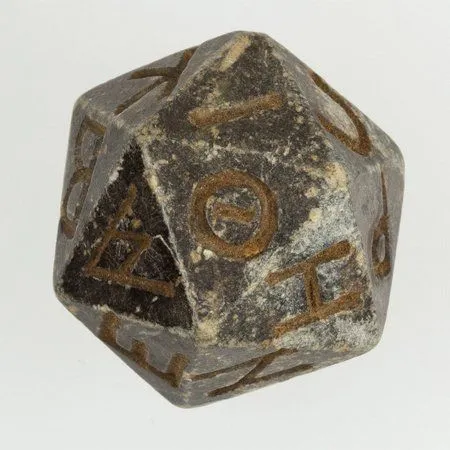
Another kind of dice found in ancient Roman archaeological sites is the 20-sided die. This shape is called an icosahedron.
Similarly, you can find many other dice of increasing complexity, such as dice with 24, 28 or even 30 sides!
Much More Than 30…
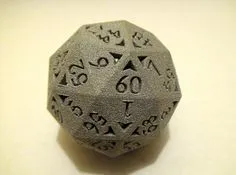
These are the rarest dice of all. Unless they have been crafted very carefully, most of them are quite impractical for any use, as their shape does not allow them to stop quickly. They usually just continue rolling along a flat surface until an external force is applied to their motion. For example, a 60-sided die has too much momentum for it to function effectively in a game.
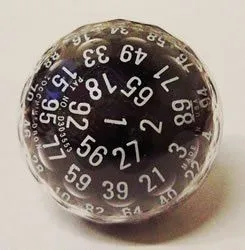
A 100-sided die is actually much more stable in comparison, as it is hollow inside. The ridges created around its external body also add to the friction created every time it’s rolled, enabling it to stop abruptly, as dice should.
And that’s not all folks! Believe it or not, there are 120-sided dice and 144-sided dice as well. So, the next time you have to play a board game on your family vacation, imagine the crazy fun you could have if you owned some of these much more rare varieties!

How Are The Numbers Arranged On A Standard Die?
We have talked a lot about how many sides a die can have, but here is the question people actually pause on when they pick up an ordinary cube: how are the numbers laid out, and why? A standard six-sided die carries the values 1 through 6, marked as small dots called pips. Add those up (1 + 2 + 3 + 4 + 5 + 6) and you get 21 pips in total spread across the six faces.

The arrangement is not random. On a modern die, opposite faces always add up to seven: 1 sits across from 6, 2 across from 5, and 3 across from 4. This is the only way to pair the numbers 1 to 6 so that every opposing pair shares the same sum, which gives the cube a pleasing balance. The convention is genuinely ancient. Terracotta dice excavated at Mohenjo-daro, in the Indus Valley, date to roughly 2500 to 1900 BCE, and at least one of them already follows the same opposite-sides-add-to-seven rule we use today.
There is one more subtle detail. The faces showing 1, 2 and 3 all meet at a single corner, and the direction they run around that corner decides the die's "handedness". If 1, 2 and 3 read counterclockwise, the die is right-handed; if they read clockwise, it is left-handed. Western dice are usually right-handed, while Chinese dice are typically left-handed. Next time you have a die in your pocket, take a look. The number 3 is hiding more design than you would expect.
Why Are Most Dice Shaped Like Platonic Solids?
Have you noticed that the classic role-playing set, the d4, d6, d8, d12 and d20, keeps showing up again and again? That is no coincidence. Those five shapes are the Platonic solids, the only convex solids whose faces are all identical regular polygons meeting in exactly the same way at every corner. Because every face is interchangeable with every other, each one has an equal chance of landing face up, which is precisely what a fair die needs.

The technical requirement for fairness is that the die be an isohedron, a solid whose symmetry lets any face be swapped for any other. The Platonic solids satisfy this, which is why the cube (d6), the octahedron (d8, two square pyramids base to base), the dodecahedron (d12) and the icosahedron (d20) have served as honest dice since antiquity. The ten-sided d10, by the way, is not a Platonic solid; it is a pentagonal trapezohedron, added to the modern set later because it makes reading percentages easy.
The odd one out in handling is the four-sided d4, a tetrahedron. It is the only common die with no face pointing up when it lands, because a tetrahedron always comes to rest on a face with a sharp point on top. So instead of reading the top, you read the result either from the hidden bottom face or from the number printed near the base of each of the three faces you can see. It is a small reminder that a die's shape decides not just how fair it is, but how you even read it.