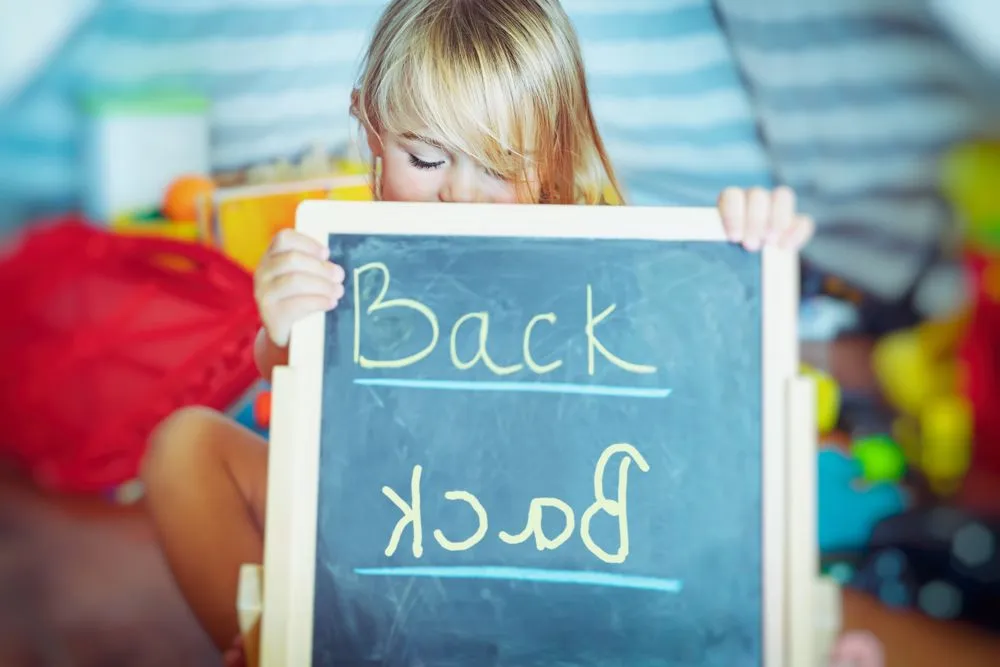
Mirror writing (where letters like J, Z, 3, and 7 come out flipped) is a normal developmental phase in 4-to-7-year-olds: a still-maturing brain tends to write all asymmetric letters facing the same way (rightward), so the few that should face left get flipped. It is not, on its own, a sign of dyslexia, autism, or giftedness.
Parents and teachers all over the world put a lot of effort into educating children. They prod and poke 4-year-olds to read bat, rat, and cat, to say the three golden words, ‘please, thank you, sorry’, and to write all their letters within the dotted lines. However, one quirk most children share that frustrates adults is writing 3, R, S and B backwards!
These poor children are probably confused as to why their teacher keeps telling them to flip the letters, but with repeated practice and corrections, children gradually begin writing letters that face the correct way, to everyone’s great relief!
Yet, is it strange that children write certain letters as a mirror image?

What Is Mirror Writing?
Mirror writing is writing that would look correct when reflected in a mirror. The writing runs in the opposite direction of normal English script (right to left), with individual letters being reversed.
Mirror writing isn’t completely anomalous and even adults may do it in some capacity. If you’re right-handed, try writing with your left hand. You may find that your left hand tends to mirror write, meaning that you have to actively suppress the urge to flip your writing into the “right” orientation. Research has shown this phenomenon on a larger scale: left-handers often find mirror writing particularly easy.
Leonardo da Vinci, who was left-handed, filled his private notebooks with mirror writing, switching to the normal direction only when he was writing something meant for other people. Nobody knows his reason for sure. Popular theories include secrecy (making his ideas harder to steal) and simple practicality: a left-hander writing from left to right drags his hand through the ink he has just put down, smearing it.
Children typically mirror-write between the ages of 4 and 7, when they are first learning to form letters; the habit usually fades by the end of second grade as systematic literacy instruction takes hold. They are inconsistent mirror writers, only making errors with certain asymmetric characters, most commonly J, Z, and the digits 3, 7, and 9.
Why Children Mirror Write?
British neurologist Macdonald Critchley, who wrote one of the first dedicated papers on mirror writing in 1927 (and turned it into a small book the following year), suggested that children simply forget the orientation of certain letters.
In his paper, The significance of mirror writing, he writes, “In the case of children learning to write there persists for some little time an element of doubt as to the correct orientation in space not only of letters, but even of words, which after all is purely an arbitrary arrangement. This is particularly true in the case of children who attempt to write before they have completely mastered their letters. This indecision accounts for the occasional reversals of letters or words seen in the earliest efforts at penmanship in many normal children.”
Later research noted that children tend to mirror write letters and digits that face left (like 3) more often than those that face right (like D). One reason for this, as researchers have suggested, is that children convert all letters to right-facing letters when they can’t remember the right orientation. This makes sense, as most asymmetrical letters face right, meaning that they have an extension on the right hand side (E, D, B).
These studies and the hypotheses they put forth still don’t account for why children don’t completely mirror write. We also don’t know the exact neurological underpinnings of why children mirror write. To oversimplify the issue, we know that the brain doesn’t stop developing until the end of adolescence, and young brains are still more malleable. How do young brains process images differently than older, more mature brains? Mirror writing might give us some insight into that.
We also don’t fully understand how the visual system works or to what extent certain cognitive functions of the brain influence spontaneous mirror writing in children. Much of the neurological information we have on mirror writing comes from neurological injuries, such as from a stroke.
Why Does A Young Brain Confuse b And d?
Here’s the strange part: the very thing that makes young children flip their letters is a skill our brains are built to have. Picture a lion strolling across the savanna from left to right. If it turns around and walks the other way, it is still the same lion, and you had better recognize it instantly. Scientists call this ability mirror invariance (or mirror generalization). Our primate visual system treats an image and its left-right mirror image as the same thing, so we can recognize an object no matter which side we see it from.

This wiring runs deep. In a 2000 study published in Science, researchers at Carnegie Mellon University recorded from single neurons in the inferotemporal cortex, a shape-recognition region of the brain, in macaque monkeys. These neurons responded more similarly to a pair of left-right mirror images than to a pair of top-bottom mirror images. That matches a pattern seen in humans and animals alike: we confuse b and d more often than we confuse b and p.
For a lion, mirror invariance is a feature. For the alphabet, it’s a bug. The Latin alphabet contains letters that are mirror images of each other (b and d, p and q), and the only thing separating them is which way they face. So when a child learns to read, their brain has to overcome a habit that served our ancestors perfectly well.
Brain imaging shows where this happens. A 2010 study led by French neuroscientist Stanislas Dehaene scanned French and Japanese readers and found that the visual word form area, a patch of the left fusiform gyrus that becomes a major site of learning as we learn to read, showed strong mirror generalization for pictures but none for words. A follow-up study in 2011 showed that the same region tells apart the left-right orientation of single letters in skilled readers, while still treating mirror-image pictures of similar complexity as the same. In other words, reading carves out a special exception for letters. The researchers suggested that this built-in mirror invariance may explain children’s temporary mirror errors.
Even more striking is what happens in people who never learn to read. A 2011 study in the Journal of Experimental Psychology: General compared unschooled illiterate adults with literate adults, including adults who had learned the alphabet later in life. When a task required paying attention to mirror-image differences in shapes (not letters), the illiterate adults performed far worse than every other group. Learning an alphabet with mirror letters, the authors concluded, pushes the beginning reader to break the mirror invariance of the visual system, and the change spreads beyond letters to other shapes too.
So a 5-year-old writing a backwards 3 isn’t being careless. Their visual brain is doing exactly what a primate brain is built to do; it just hasn’t received the memo about the alphabet yet.
Is Mirror Writing A Sign Of Dyslexia, Autism, Or Giftedness?
If you’ve just watched your kindergartener write a perfect mirror-image “J”, your next Google search is probably “is mirror writing a sign of something serious?” The short, evidence-based answer: usually no.
Dyslexia. Letter reversals before age 7 are not, on their own, a sign of dyslexia, and most kids who reverse letters at that age don’t end up having dyslexia. Reading Rockets, Understood.org, and the International Dyslexia Association all stress that reversing letters is a developmental quirk, not a marker. What does warrant a closer look is a child who is still reliably flipping common letters past age 7–8 and is struggling with reading, sounding out words, or remembering letter shapes, in which case, an evaluation is reasonable.
Autism. Mirror writing on its own is not a diagnostic marker for autism either. There is no medical test for autism; doctors look at a child’s developmental history and behavior to make a diagnosis, not at their handwriting.
Giftedness. The viral claim that mirror writing means your child is the next Leonardo da Vinci does not hold up. Studies looking for a link between mirror writing and intelligence have come up empty; one found no significant difference in intelligence between mirror-writing and non-mirror-writing children of the same age. Da Vinci was extraordinary; his backwards handwriting wasn’t the reason.
How Can You Help A Child Who Writes Letters Backwards?
If your preschooler keeps producing backwards 3s, the first piece of advice is to relax. Reading Rockets notes that mirror writing by itself is not troubling in a kindergarten student, because beginning writers are still mastering directionality (which way print runs). That said, a little gentle practice helps the brain lock in the right orientation. Understood.org suggests a few strategies:
- One letter at a time. Work on b until your child has mastered it before introducing d.
- Use more than one sense. Have your child trace the letter in sand or “skywrite” it in the air while saying its sound out loud.
- Give it a memory hook. For b, “the bat comes before the ball”: the tall stick (the bat) goes down first, then the round belly (the ball) is added.
- Teach one flowing movement. Show your child how to form each letter with a single, flowing stroke, so the hand learns the shape along with the eye.
That last tip fits neatly with the brain research above. Signals from handwriting are among the inputs that researchers think help the visual word form area learn to tell mirror letters apart.
When is it time to check in with the teacher? Understood.org suggests reaching out if a child is still reversing letters a lot by the end of second grade. Reading Rockets adds that the stronger early warning signs for reading difficulty lie elsewhere: weak phonological skills (hearing and playing with the sounds inside words), a family history of reading difficulty, or a speech or language delay, along with persistent trouble learning letter names and sounds, recognizing rhymes, or retelling simple stories.
Why Do Some Adults Mirror Write?
Mirror writing isn’t only for kindergarteners. Neurologists have documented it in adults, too, and the circumstances are revealing. According to a 2007 review in the Journal of Neurology, Neurosurgery & Psychiatry, the most frequent circumstance in which adults acquire mirror writing is after a stroke affecting the left hemisphere of the brain.

As psychologists Robert McIntosh and Sergio Della Sala put it, the prototypical adult mirror writer is a right-hander who loses the use of the right arm after a left-hemisphere stroke and is forced to write with the left hand. Studies of stroke patients have put its frequency anywhere from 2.5% to 13%, and as high as 24% when only left-hemisphere strokes are counted. Mirror writing has also been reported after head injury and in essential tremor, Parkinson’s disease and spinocerebellar degeneration, and it may be more common in older people, especially those with cognitive impairment.
Why would a brain produce backwards script at all? The leading explanation is about movement, not vision. Your left hand is a mirror image of your right. When the left hand runs the movement program the right hand learned, without the brain translating it first, the result comes out flipped. That translation takes mental effort, which is why it can slip when attention lapses and is especially vulnerable after brain damage. There’s a mechanical reason, too: movements away from the body’s midline are generally more natural and more accurate than movements toward it, so a pen held in the left hand travels more readily leftward. Even among 86 healthy volunteers in one study, writing with the left hand produced at least some reversals in 7% of people, while writing with the right hand never did.
This helps explain Leonardo da Vinci. The 2007 review notes that his mirror writing dated from age 21 or earlier, was written for himself rather than for others, and was probably innate: a natural left-hander, unrestrained by anyone telling him otherwise, simply wrote in the direction his hand preferred. Interestingly, people whose languages are written leftward, such as Hebrew, also show a high rate of left-handed mirror writing, which points to the direction of writing, rather than the shapes of the letters, as the key factor.
A Final Word
Mirror writing is common in young children, and a normal part of their development. As children write more frequently, they learn to write correctly and fluently; whether they develop good handwriting is a different matter altogether.
Writing today, I think, isn’t as important as it once was. Many of us have transitioned to typing on our phones and computers rather than taking notes in our notebooks. This is a relief for those of us who live with the curse of bad handwriting.
References (click to expand)
- Portex, M., Hélin, C., Ponce, C., & Foulin, J.-N. (2018, March 19). Dynamics of mirror writing compared to conventional writing in typical preliterate children. Reading and Writing. Springer Science and Business Media LLC.
- Fischer, J.-P. (2011, June). Mirror writing of digits and (capital) letters in the typically developing child. Cortex. Elsevier BV.
- Fischer, J.-P., & Koch, A.-M. (2016, April). Mirror writing in typically developing children: A first longitudinal study. Cognitive Development. Elsevier BV.
- Schott, G. D. (2007, January 1). Mirror writing: neurological reflections on an unusual phenomenon. Journal of Neurology, Neurosurgery & Psychiatry. BMJ.
- FAQs about reversing letters, writing letters backwards, and dyslexia. Understood.org.
- Should I Be Concerned About Mirror Writing? Reading Rockets.
- Rollenhagen, J. E., & Olson, C. R. (2000). Mirror-image confusion in single neurons of the macaque inferotemporal cortex. Science.
- Dehaene, S., Nakamura, K., Jobert, A., Kuroki, C., Ogawa, S., & Cohen, L. (2010). Why do children make mirror errors in reading? Neural correlates of mirror invariance in the visual word form area. NeuroImage.
- Pegado, F., Nakamura, K., Cohen, L., & Dehaene, S. (2011). Breaking the symmetry: mirror discrimination for single letters but not for pictures in the Visual Word Form Area. NeuroImage.
- Kolinsky, R., Verhaeghe, A., Fernandes, T., Mengarda, E. J., Grimm-Cabral, L., & Morais, J. (2011). Enantiomorphy through the looking glass: literacy effects on mirror-image discrimination. Journal of Experimental Psychology: General.
- Pegado, F., Nakamura, K., & Hannagan, T. (2014). How does literacy break mirror invariance in the visual system? Frontiers in Psychology.
- McIntosh, R. D., & Della Sala, S. (2012). Mirror-writing. The Psychologist. British Psychological Society.
- Schott, G. D., & Schott, J. M. (2004). Mirror Writing, Left-handedness, and Leftward Scripts. Archives of Neurology (JAMA Neurology).
- Activity: Mirror Writing. Leonardo da Vinci. Museum of Science, Boston.
- Clinical Screening and Diagnosis for Autism Spectrum Disorder. Centers for Disease Control and Prevention (CDC).
- Frequently Asked Questions. International Dyslexia Association, Pennsylvania Branch.