Table of Contents (click to expand)
The Vitruvian Man is Leonardo da Vinci's c. 1490 pen-and-ink drawing of a male figure inscribed in both a circle and a square, with his navel at the center of the circle and his groin at the center of the square. It illustrates the ideal human body proportions described by the Roman architect Vitruvius in his treatise De architectura.
The Vitruvian Man is a beautiful drawing that was created in around 1490 by Leonardo da Vinci, an Italian polymath of the Renaissance and one of the brightest men to have ever lived. You’ve surely come across this picture at some point: a man in two superimposed positions with arms and legs outstretched in a square and a circle. One might think of it as merely a beautiful drawing, but there’s actually much more to it!
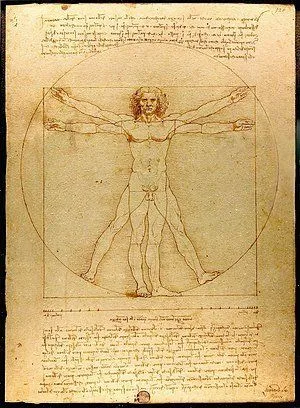
This seemingly simple drawing created in pen and ink on paper is actually Leonardo's elegant answer to an age-old geometric puzzle that had artists pulling their hair out for years: how to fit a single human figure neatly inside both a circle and a square!
The notes accompanying the drawing, sometimes called the Canon of Proportions or the Proportions of Man, elaborately outline the significant concepts and interpretation of the drawing in geometric form. The drawing is also believed to be the philosophical solution to the nature of man.
This begs the question, what was the problem that had everyone so exasperated? However, let’s first try to understand a bit about this unusual Man!
Why “Vitruvian”: Origin Of The Name
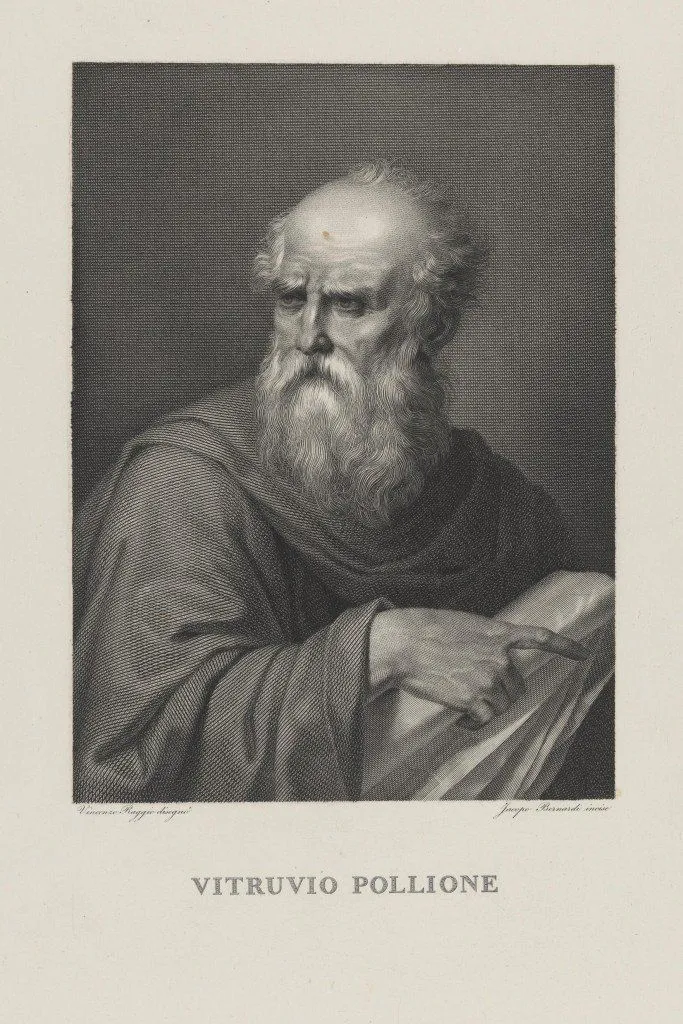
Marcus Vitruvius Pollio, commonly known as Vitruvius, authored the famous treatise on architecture entitled De Architectura. He greatly emphasized the importance of symmetry and proportion in his discussions on building and designing temples. The concept of the Vitruvian Man emerged through his belief that the principles governing the representation of the human form also applied to temple architecture in terms of weight, symmetry and proportion.
Squaring The Circle
The book records numerous interesting observations made by Vitruvius about the proportions of the human body. He laid out a whole system of measurements, noting that four fingers make a palm, four palms make a foot, six palms make a cubit, and four cubits make the height of a man. Among these was his observation that the navel is the center of the human body. He noted that if one takes the navel as a fixed point on a compass, a circle can be drawn perfectly around the body, with the fingers and toes just touching its edge. Another interesting remark found in his work was that the height of a man is nearly equal to his arm span. He observed that a sketch of a body with arms outstretched could perfectly be placed inside a square.
Leonardo da Vinci was particularly fascinated by these two ideas. The catch is that a circle and a square of the same width do not naturally line up, so getting one human figure to sit perfectly inside both shapes at once, using a single, consistent set of proportions, was the real challenge. (This is not the same as the famous impossible puzzle of squaring the circle, which asks you to build a square with exactly the same area as a circle using only a compass and straightedge, a feat that was eventually proven mathematically impossible.) Reconciling the man, the circle and the square was what made the case so unique and interesting.
Leonardo da Vinci was not the only one who worked on Vitruvius’ claim that a human body could simultaneously fit into a circle and a square; many artists had attempted to design the Vitruvian Man, but no one had made a precise drawing along these lines in the centuries since Vitruvius first composed his description.
Francesco di Giorgio, a lesser known but equally illustrative contemporary of Leonardo, sketched his version of the Vitruvian Man, which was suggestive, but not very precise. The elements of the drawing were rendered rather casually and did not attempt to show accurate proportions.
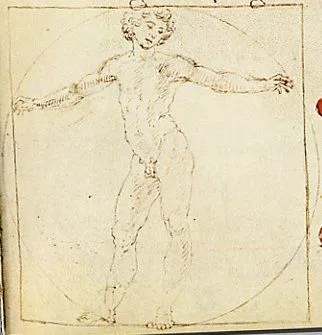
The many artists who had attempted to design the Vitruvian Man had struggled to depict the two postures of the man using a square concentric with the circle. Leonardo, however, solved the complication by separating the center of the two postures, one for the circle centered at the navel and the other for the square centered at the genitals. Some believe that this solution was first put forth by Giacomo Andrea, a dear friend of Leonardo and an expert on Vitruvius, who was killed and erased from history for his loyalty to the Duke of Milan after the French occupied Milan.
Geometry Of The Vitruvian Man
Leonardo’s drawing, unlike those of all the other artists, was meticulously done. His confident lines showed that he had planned this drawing very carefully and knew precisely what he was doing. Furthermore, the notes accompanying the drawing clearly elaborate on the classical architecture concepts employed, as well as Leonardo’s observations.
In the second part of his notes, he points out that:
If you open the legs so as to reduce the stature by one-fourteenth and open and raise the arms so that the middle fingers touch the level of top of the head, know that the centre of the extremities of the outspread limbs will be in the navel, and the space between the legs will make an equilateral triangle.
Leonardo da Vinci was a man of science and art, which explains why the Vitruvian Man (named in honor of Vitruvius) is a combination of both. You may have heard that Leonardo built the figure around the divine proportion or golden ratio (roughly 1.618), an idea made popular by stories like The Da Vinci Code. In truth, the geometry of the Vitruvian Man rests on the simple whole-number fractions handed down by Vitruvius (palms, feet and cubits), not on the golden ratio. Careful measurements of the drawing show its proportions follow these tidy integer ratios rather than the irrational value of phi.
He envisioned the Vitruvian Man as a cosmografia del minor mondo (cosmography of the microcosm). He saw man as a tiny version of the world, and the workings of the human body to be an analogy for the workings of the universe.
The Vitruvian Man Today
The original piece of work is kept in the Gallerie dell’Accademia in Venice, Italy, and is shown to the public only occasionally, like most works done on paper from that long ago.
Today, the image of the Vitruvian Man is considered to be an embodiment of health and fitness and is often used as a portrayal of a balanced, healthy man. It is also associated with the practice of medicine, symbolizing three essential attributes of an ideal physician – science, humanitarianism and artistry.
It was also inscribed on the 1 Euro coin in Italy, representing the coin to the service of man, instead of man to the service of money.
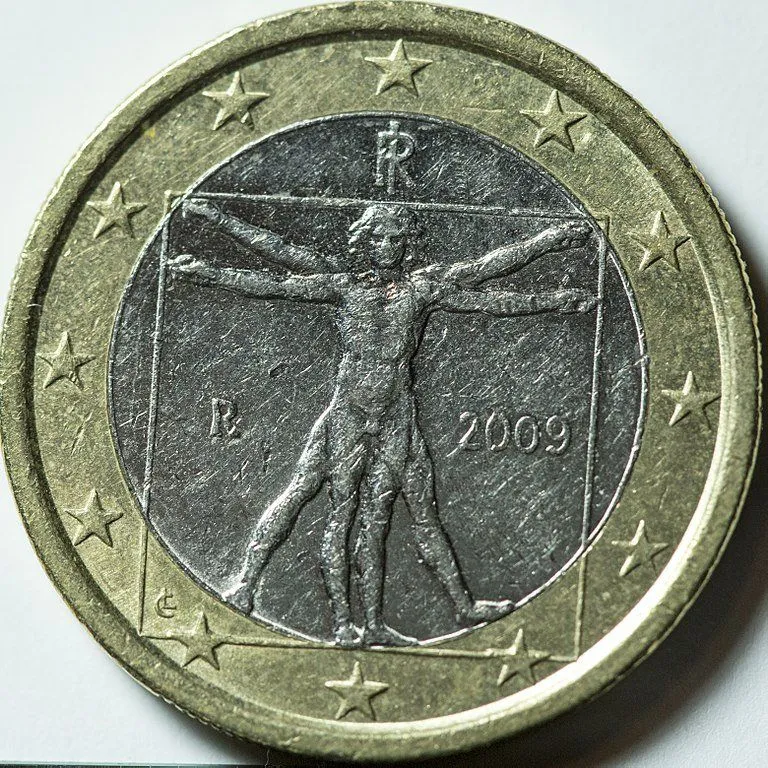
In conclusion, the Vitruvian Man represents a combination of architecture, anatomy and geometry, and embraces the idea that mathematics underpins both the natural and the man-made worlds. Leonardo da Vinci has given the design the power of symmetry, careful proportion and beauty, making it a true masterpiece in history that continues to thrill and impact us today!
References (click to expand)
- Leonardo Da Vinci - The Vitruvian Man. Stanford University
- an image of health / fitness / medicine - The Vitruvian Man. Stanford University
- Vitruvian Man. Encyclopaedia Britannica
- The Other Vitruvian Man: Was Leonardo da Vinci's Famous Drawing Based on the Work of an Unsung Architect? Bard College
- Did Leonardo da Vinci Copy His Famous Vitruvian Man? Scientific American