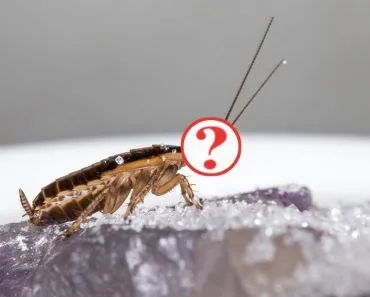
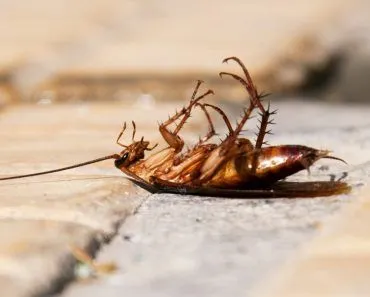
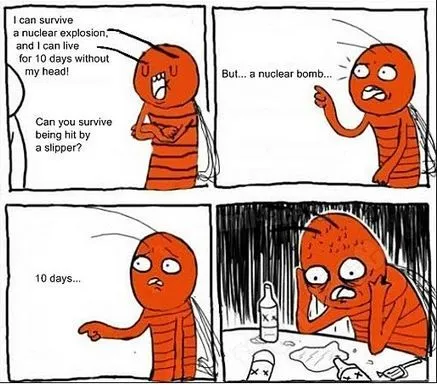
No, cockroaches cannot survive a direct nuclear blast. They can shrug off enormous radiation doses (around 67,500 rads for the American cockroach and 90,000–105,000 rads for the German cockroach, compared to 400–500 rads for a human), but the thermal flash and shockwave of a nuclear explosion would kill them instantly, like everything else inside the impact radius.
Cockroaches are fine when they stay on the ground, but you know that things are getting serious when you see one break out its wings and start flapping around your head. Cue running around your house, screaming like a small child. Don’t worry, we’ve all done it.
Cockroaches (and their close relatives) have been crawling around this planet for at least 300 million years, since well before the first dinosaurs. Modern cockroach lineages show up in the fossil record around 125 million years ago, in the Cretaceous, which means they were around to witness (and outlive) the asteroid that killed the non-bird dinosaurs.
The myth that cockroaches will inherit the Earth in the event of nuclear warfare surfaced shortly after the United States dropped atomic bombs on Hiroshima and Nagasaki in 1945. Reports claimed that the ancient insects were the only survivors in the rubble of the wrecked Japanese cities. What exactly are these buggers made of that enables them to survive such unbelievable energy and destructive force?
How Much Radiation Can Cockroaches Withstand?
In order to test the credibility of the claim that “cockroaches can survive nuclear warfare”, the MythBusters team (Discovery Channel) tested a set of German cockroaches to determine just how much radiation they could bear before finally succumbing. They used three different intensities of radiation from cobalt-60 for the experiment.
They started with a baseline exposure of 1,000 rads (the unit “rad” stands for radiation absorbed dose), which is an unsurvivable acute dose for a human (most victims die within days), and followed it up with 10,000 and 100,000 rad exposures on separate groups of roaches. For reference sake, the bomb dropped on Hiroshima emitted radioactive gamma rays at a strength of around 10,000 rads. The cockroaches finally gave in at 100,000 rad… unbelievable!
However, biologist Mark Elgar from the University of Melbourne claims that the results of the test that Mythbusters conducted are not entirely accurate, because the test only looked at how many days the cockroaches lived after exposure. They didn’t test their ability to produce viable eggs following exposure.
Researchers note that the US occupational annual limit for radiation workers is 5 rems. For those who don’t know, a “rem” is an amount of radiation that causes a measured, very specific amount of damage to human tissue. Without medical treatment, a single acute exposure of around 400–500 rems is enough to kill roughly half the people exposed, and around 800 rems is almost universally lethal. For context, the average American picks up about 30 to 50 rems over a lifetime from natural background and medical imaging combined (Source).
Cockroaches, on the other hand, are much ‘stronger’ than humans in terms of tolerating lethal radiation. For the American cockroach, the lethal dose is 67,500 rems, while for the German cockroach, the lethal dose lies somewhere in the range of 90,000 to 105,000 rems! So yes, it’s true that the amount of radiation cockroaches can withstand is equivalent to that of a thermonuclear explosion.
How Could Cockroaches Survive A Nuclear Explosion?
Cockroaches’ ability to withstand extreme radiation exposure is due to the simple design of their bodies and slower cell cycles. Cells are said to be most sensitive to radiation when they’re dividing, but given that a typical cockroach only molts about once a week, and its cells only divide within a 48-hour period during that week, about 3/4 of the cockroaches exposed to the blast would not be particularly susceptible to damage by ionizing radiation, at least, relative to those whose cells were currently dividing.
Humans are so vulnerable to these types of radiation because our cells are constantly undergoing changes and renewing themselves.
The results confirmed that cockroaches can survive a nuclear explosion in terms of the radiation, but they would still succumb to the high amount of impact that the bomb produces if they were exposed to the blast.
Nuclear explosions affect life in more ways than one. The impact from the initial blast, the tremendous amount of heat produced, and ionizing radiation released into the air following the blast are the primary ways by which a nuclear blast disrupts basically every form of life that falls within its ‘impact radius’.
Ionizing radiation permanently damages a living creature’s DNA, meaning that it messes up the chemistry of things. This is why prolonged exposure to ionizing radiation can increase one’s risk of cancer.
Following a nuclear explosion, a cockroach, if it’s well protected from the blast’s impact and heat, can survive for a while. However, if everything else has died, cockroaches would eventually run out of food and ultimately die too!
Did Cockroaches Actually Survive Hiroshima?
Here’s the part of the story everyone skips: did anyone actually see cockroaches crawling out of the wreckage of Hiroshima and Nagasaki? The popular version says yes, that the roaches strolled out of the ash while everything else was gone. The honest answer is that there is no documented evidence of it. Professor Tilman Ruff of the University of Melbourne, a physician who studies the health and environmental effects of nuclear weapons, has said he has yet to see any documented evidence that there were cockroaches scuttling through the rubble of the bombed cities.

So where did the “roaches inherit the Earth” line come from? Fact-checkers at Snopes trace the modern version to a 1993 article in PC Professional magazine that bundled together a list of “facts” doing the rounds in email chains. The Cold War did the rest, because a tiny bug shrugging off the ultimate weapon makes for a chilling little parable about nuclear war. Paul Eggleton of London’s Natural History Museum sums it up nicely: all the reading on this, he says, suggests it is “an urban myth, with a bit of truth to it.” The bit of truth is the radiation tolerance we covered above. The myth is the idea that a roach could stroll through the fireball itself. It couldn’t, and neither could anything else standing in the open near ground zero.
What Animal Can Actually Survive The Most Radiation?
If you’re picturing the cockroach as the undisputed champion of radiation resistance, I have bad news for the little guy: it isn’t even close. In the very same MythBusters experiment, the team also irradiated fruit flies and flour beetles alongside the German cockroaches. The flour beetle was the only insect that walked away from the brutal 100,000-rad dose that wiped out every roach, which makes the humble pantry beetle the tougher bug of the two.

Zoom out from insects and the cockroach looks downright fragile. Tardigrades (the chubby “water bears” that can survive the vacuum of space) shrug off a gamma dose with an LD50 of roughly 4,200 grays in adults, where 1 gray equals 100 rads. That is around 1,000 times the dose that kills half of all exposed humans. And the outright record holder isn’t an animal at all: it’s a bacterium called Deinococcus radiodurans, nicknamed “Conan the Bacterium.” It survives an acute dose of 5,000 grays (500,000 rads) with almost no loss of viability, and 12,000 grays still leaves about one in ten cells alive, because it can stitch its shredded DNA back together. So while a cockroach is genuinely tough, the real takeaway is the one Eggleton makes: insects in general have slow cell cycles, so cockroaches aren’t specially built to beat radiation. They’re just one bug in a long line of organisms that handle it far better than we do.
In a nutshell, a cockroach CANNOT survive a nuclear explosion.
The incredible resilience of cockroaches does make me wonder: What kind of toxins do they have to put in cockroach killers like Hit and Baygon?
References (click to expand)
- Cockroach FAQ - marlin. The University of Massachusetts Amherst
- If cockroaches can withstand extreme radiation, then why is it that they can't live through certain pest spray? - UCSB Science Line. The University of California, Santa Barbara
- Can Cockroaches Survive a Nuclear Bomb? Myths vs. Science - University of Florida Entomology and Nematology
- Not even cockroaches would survive nuclear war: “Urban myth” - Newsweek
- Tolerance to Gamma Radiation in the Tardigrade Hypsibius dujardini from Embryo to Adult - PLOS ONE (PMC)
- Deinococcus radiodurans - Wikipedia