No. When you cut, tear, or break an object, you don’t split its atoms. A blade or a tearing force is far too blunt and weak to crack an atom open; instead it breaks the weak bonds between molecules and simply pushes the atoms apart. Splitting an atom takes the enormous energy of a nuclear reaction or radioactive decay, not a pair of scissors.
It’s a simple question, and one that most of us have probably wondered; does tearing a piece of paper split apart its atoms? The answer, as with most things in science, is slightly more complicated than a simple yes or no, but for the most part we can say… NO, we are not splitting atoms when we apply macroscopic forces to tear or break an object.
When Do Atoms Break?
In the course of the 20th century, there was a great deal of talk about ‘splitting the atom’, and that’s a phrase often used to describe anything nuclear-related; radiotherapy, nuclear energy, radioactive decay, or the bombs dropped on Hiroshima and Nagasaki. Atoms are indeed split in these processes.
In radioactive processes, an unstable nucleus sheds energy by spitting out radiation, and that radiation comes in three flavors. An alpha particle is a clump of two protons and two neutrons (in other words, a helium nucleus). A beta particle is a high-speed electron (or its antimatter twin, the positron). A gamma ray isn’t a particle of matter at all, but a burst of high-energy electromagnetic radiation, like an extremely energetic cousin of light. We know that all three are, for lack of a better word… scary.
Forcing an atom apart in a reactor or a bomb takes an enormous amount of energy. But some atoms split all on their own, with no machinery and no trigger required. Take a look at this old-fashioned radium clock, for example.
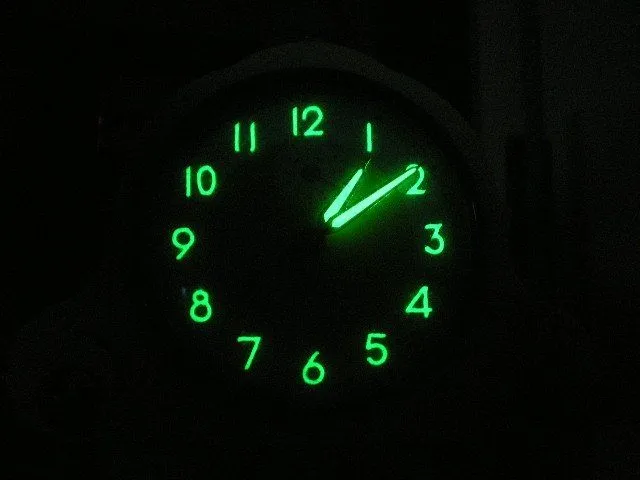
Back in the day, some clocks were painted with radium, which glows all the time, not just after being exposed to light. This is thanks to a process known as radioluminescence: as the radium atoms decay, the radiation they emit slams into a fluorescent phosphor mixed into the paint, and that phosphor gives off a steady glow. The decay happens whether or not anyone does anything to the radium, which is exactly the point, no outside force is splitting those atoms. Of course, the workers who painted those dials (the so-called “Radium Girls”) became gravely ill from the constant radiation, and the practice was eventually stopped.
What Happens When You Cut Or Break Something?
Using scissors to cut a piece of paper pulls the paper’s fibers apart from one another. Paper is mostly a tangle of cellulose fibers, with tiny gaps of air in between. Those fibers cling to each other through weak intermolecular forces (mainly hydrogen bonds and van der Waals forces), and it’s those weak links that give way when the blade passes through. As you can imagine, they are feeble compared to the strong interatomic and chemical bonds that hold the atoms inside each cellulose molecule together. Cutting separates the fibers; it doesn’t reach down and crack open the atoms themselves.

In fact, the molecules in a piece of paper when you cut it are simply pushed apart. Imagine a ball pit, full of colorful little atoms. If the ball pit is our piece of paper with little atomic balls, a scissor’s edge moving through it would be about the size of a building. Atoms are far too small to be affected by any single macroscopic force, they just move out of the way.
The Atoms Simply Move Away
Even if we did manage to shrink our scissors’ edge to be small enough, roughly one atomic length, the atoms would simply be repelled by the edge of the scissor and move away, because the electrons of the scissor’s edge and the electrons in the cellulose would repel each other. It’s kind of like sifting your hand through the balls in that ball pit – the balls would simply move out of the way.
So a blade or a tearing force never reaches an atom's nucleus. But splitting an atom is possible with the right tool, and what happens then looks nothing like cutting paper.
What Actually Happens When You Do Split An Atom?
To genuinely split an atom, you have to break apart its nucleus, the tiny, dense core where the protons and neutrons live. That core is held together by the strong nuclear force, which is millions of times tougher than the chemical bonds a pair of scissors deals with. The usual way to crack one open is nuclear fission: you fire a free neutron at a heavy, fission-prone nucleus such as uranium-235. The nucleus absorbs that extra neutron, becomes unstable, and breaks into two smaller nuclei (the fission fragments) plus a few spare neutrons.

The two fragments are usually mismatched rather than two equal halves. A common split of uranium-235 leaves products like barium and krypton, with the fragment masses clustered around 95 and 135. Each fission also throws out, on average, roughly 2.4 free neutrons. Here is the key part: the products together weigh slightly less than the original uranium nucleus plus its neutron, and that missing sliver of mass is converted into energy according to Einstein's E = mc2.
The numbers dwarf anything mechanical. A single uranium-235 fission releases about 200 MeV (roughly 3.2 × 10⁻¹¹ joules), on the order of 50 million times more than burning one carbon atom in coal or wood. About 85% of that energy comes out as the kinetic energy of the two fragments hurtling apart. And because each split also frees those spare neutrons, the neutrons can slam into more uranium nuclei and set off a self-sustaining chain reaction. Tamed and slowed down, that chain reaction is what heats a nuclear reactor; let loose all at once, it is what makes an atomic bomb. Tearing a sheet of paper, by contrast, only nudges some molecules apart and releases essentially nothing.
How Many Atoms Are In A Sheet Of Paper?
If tearing paper just shuffles atoms around, it is worth asking how many atoms you are actually shuffling. Paper is mostly cellulose, a polymer built from repeating glucose-derived units with the formula (C6H10O5)n. Each repeating unit holds 6 carbon, 10 hydrogen, and 5 oxygen atoms, so 21 atoms per unit, and a single cellulose strand chains hundreds to thousands of those units together.

You can estimate the total with a little chemistry. A typical printer sheet weighs about 5 grams. The cellulose repeating unit has a molar mass of roughly 162 grams per mole, so 5 grams works out to about 0.031 moles of those units. Multiply by Avogadro's number (6.022 × 10²³ units per mole), then by 21 atoms per unit, and you land at roughly 4 × 10²³ atoms, on the order of 400 billion trillion. Real paper also carries fillers, coatings, and a bit of water, so treat this as an order-of-magnitude figure rather than an exact count. The headline still holds though: a flimsy sheet of paper is built from hundreds of billions of trillions of atoms, and when you tear it, not a single one of them is split. You are only pulling apart a few of the weak bonds that link those atoms into fibers.
References (click to expand)
- Radioluminescence. Wikipedia
- How Are Elements Broken Down into Protons, Electrons and .... Scientific American
- Radiation Basics. United States Environmental Protection Agency (EPA)
- Radium Girls: The Women Who Fought for Their Lives in a Killer Workplace. Encyclopaedia Britannica
- Physics of Uranium and Nuclear Energy. World Nuclear Association
- The Fission Process. MIT Nuclear Reactor Laboratory
- Avogadro's Number and the Mole. Chemistry LibreTexts
- Polysaccharides (Cellulose). Chemistry LibreTexts