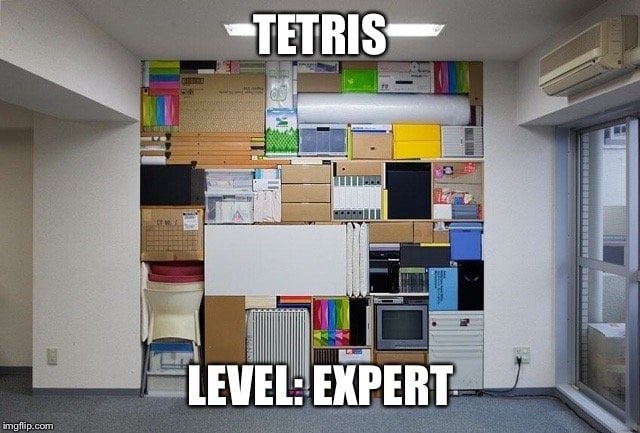
The Tetris effect (also called Tetris syndrome) happens after long stretches of playing Tetris, when its falling blocks start to intrude on your thoughts, mental images and dreams. You begin to see real-world objects as four-square shapes to slot together. Studies have tied heavy play to better spatial skills, more efficient brain activity, and fewer flashbacks after trauma.
Remember that old game where you constantly rearranged blocks made of four tiles called tetrominos? For many of you, Tetris may still be a beloved pastime if you’ve downloaded it as an app on your phone! Like any quintessential gamer, if you devote ample time and attention to this fascinating game, it begins to form patterns in your thoughts, mental images, and even dreams. This phenomenon is called the Tetris Effect (alternately, Tetris Syndrome). In other words, it is the tendency to identify every worldly object as being made of four squares and attempting to determine the best-fitting position for the objects.
What Exactly Is The Tetris Effect (Or Tetris Syndrome)?
If you have searched for tetris syndrome or tetris disease, here is the short answer: it is not a medical condition at all. The term Tetris effect was popularized by journalist Jeffrey Goldsmith in a 1994 Wired article titled This Is Your Brain on Tetris, and it simply describes what happens to perfectly healthy people who play the game for hours on end. The falling tetrominoes start to leak out of the screen and into the rest of your mental life. You catch yourself mentally rotating a row of cars in a parking lot, or you close your eyes and watch colored blocks tumbling into gaps that are not there.

So why do the pieces follow you around? The leading explanation is a mix of two ordinary brain processes. The first is perceptual priming: when you spend long stretches scanning for one type of shape, your visual system tunes itself to that shape and keeps flagging it even when the game is off. The second is the brain’s habit of consolidating a freshly practiced skill, which is why the imagery is strongest as you drift toward sleep. Crucially, the Tetris effect is not unique to one person or one console; the experience is so common that psychologists now treat it as the textbook example of a broader pattern called Game Transfer Phenomena, a research field defined by psychologist Angelica Ortiz de Gortari, in which elements of any heavily played game intrude on a player’s thoughts, images and sensations afterward.
Improvement Of Brain Efficiency
One of the earliest studies on the Tetris Effect was conducted by psychologist Richard Haier and his team in the Department of Psychiatry and Human Behavior at the University of California, Irvine, in the early 1990s to demystify the enigma behind the Tetris Effect. Using PET scans, they imaged the brains of Tetris players and found a steep learning curve associated with the game.
The answer that Haier was interested in learning was when the stimuli increase in speed (the speed at which the tetrominos fall) and the decision-making becomes harder, does the brain need more energy? Haier found that the brain actually requires less energy to play higher levels of Tetris. Haier agreed that this may sound counterintuitive, but he pointed out that it is consistent with the idea of high brain efficiency.
It was observed that for first-time users, Tetris significantly increased the cerebral glucose metabolic rates (GMRs) that are directly associated with brain energy consumption levels. Yet, after four to eight weeks of regular daily playing, the GMRs came back down to normal, while performance increased manifold. The best players of the game, who could efficiently deal with the intricate geometry of Tetris, were found to have the lowest GMR levels.
Improvement Of Spatial Skills
A study in 1994 conducted by researchers Lynn Okagaki and Peter Frensch found that Tetris had a positive effect on three areas of spatial skills, spatial perception, mental rotation and spatial visualization, for the participants who played this game incessantly for a prolonged period.
Enhancement In Memory Capacity
Richard Haier returned to the topic in 2009, this time leading a team at the Mind Research Network and publishing the results in the journal BMC Research Notes. They used MRI scans to study the brains of adolescent girls. The study compared two groups: one that played Tetris for about half an hour a day over three months, and another that didn’t play at all. Looking at the structural scans, the researchers found that the cortex (gray matter) of the girls who played the game had thickened in several regions, compared to those who didn’t play. The functional scans, meanwhile, showed the practiced brains working more efficiently, using less activity to play. Intriguingly, the thicker regions and the more efficient regions were not the same areas, so a thicker cortex did not simply translate into the efficiency gains. Even so, the study suggested that regular Tetris play can drive measurable, healthy changes in the brain.
The dream side of the effect has been studied too. In a well-known 2000 study published in the journal Science, Harvard sleep researcher Robert Stickgold and his colleagues had volunteers play hours of Tetris and then watched what happened as they drifted off to sleep. Many of them reported seeing falling, rotating blocks at sleep onset, the very images the game is built on. The strangest part involved a handful of amnesic patients who couldn’t consciously remember having played at all, yet they still reported the same falling-block imagery. That hints that the Tetris Effect taps into procedural memory (the system that quietly stores skills and habits) rather than the conscious, declarative memory we use to recall events.
Prevention In The Buildup Of Traumatic Memories
A 2009 study led by Emily Holmes and her colleagues at the University of Oxford found that playing Tetris soon after a distressing event can curb the recurring, involuntary recollection of traumatic images. In the experiment, healthy volunteers watched a film of traumatic scenes, and those who played Tetris within a few hours afterward had fewer flashbacks to those scenes over the following week. The idea is that the game’s demanding visual task competes for the same mental resources the brain needs to lock in vivid sensory memories, so it interferes with the flashbacks while leaving deliberate, factual recall of the event intact.
Does Playing Tetris Make You Smarter?
This is the question most people actually type into Google, and it deserves an honest answer rather than a hopeful one. The studies above show that Tetris reshapes the brain in real, measurable ways, so it is tempting to conclude that it raises your overall intelligence. The evidence does not support that leap. What Tetris reliably improves are visuospatial abilities, the skills involved in tracking, rotating and fitting shapes together, and these gains tend to stay close to the task that produced them.

A 2017 study by Alex Lau-Zhu and colleagues, published in Applied Cognitive Psychology, makes the point cleanly. The researchers had people play a few minutes of Tetris and then measured a range of mental abilities. Tetris scores correlated strongly with a standard test of visuospatial working memory (your short-term store for shapes and positions), but showed no meaningful link to general IQ or verbal reasoning. As the authors put it, the lack of any association with IQ suggests the benefit "is not mediated by general fluid abilities" and that there is "something very specific" shared by Tetris and visuospatial tasks. In other words, the game makes you sharper at the kind of thinking Tetris itself demands, the same family of skills you would use for spatial intelligence tasks like reading a map or packing a suitcase, but it will not turn you into a better essayist or boost your score on an IQ test.
Not Just Tetris
The Tetris Effect is not restricted to Tetris alone. A similar phenomenon can be experienced with other games too. The involuntary visualization of the Rubik’s cube algorithm or an illusion of curved lines after completing a jigsaw puzzle are a few examples of this bizarre effect.
References (click to expand)
- Okagaki, L., & Frensch, P. A. (1994, January). Effects of video game playing on measures of spatial performance: Gender effects in late adolescence. Journal of Applied Developmental Psychology. Elsevier BV.
- Is Tetris Good For The Brain? - ScienceDaily. Science Daily
- Holmes, E. A., James, E. L., Coode-Bate, T., & Deeprose, C. (2009, January 7). Can Playing the Computer Game “Tetris” Reduce the Build-Up of Flashbacks for Trauma? A Proposal from Cognitive Science. (V. Bell, Ed.), PLoS ONE. Public Library of Science (PLoS).
- Haier, R. J., Karama, S., Leyba, L., & Jung, R. E. (2009). MRI assessment of cortical thickness and functional activity changes in adolescent girls following three months of practice on a visual-spatial task. BMC Research Notes. BioMed Central.
- Stickgold, R., Malia, A., Maguire, D., Roddenberry, D., & O'Connor, M. (2000). Replaying the game: hypnagogic images in normals and amnesics. Science. American Association for the Advancement of Science.
- Lau-Zhu, A., Holmes, E. A., Butterfield, S., & Holmes, J. (2017). Selective Association Between Tetris Game Play and Visuospatial Working Memory: A Preliminary Investigation. Applied Cognitive Psychology.
- Ortiz de Gortari, A. B. The Tetris film & Game Transfer Phenomena (on the origin of the “Tetris effect” term). Game Transfer Phenomena.