Table of Contents (click to expand)
- Cobwebs Are The Work Of Spiders
- Cobweb Spiders (Family: Theridiidae) Make Cobwebs
- Other Web-building House Spiders
- What About Individual Strands Of Dust?
- Spider Webs Do Not Decompose Easily
- What's The Difference Between A Cobweb And A Spider Web?
- Why Is It Called A "Cobweb"? (And What "Cobwebs" Means Figuratively)
- Conclusion
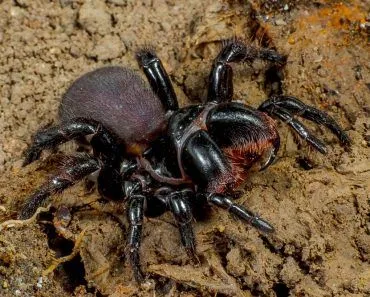
Most cobwebs actually consist of abandoned spider webs. These home-abandoning spiders, mainly those of the species Theridiidae, build these sticky webs for catching prey.
Cobwebs are a great reminder that it’s time to clean the hard-to-reach parts of your home. These annoying cobwebs form in the corners of our rooms, on the edges of the ceilings and on the sides of our walls. You can get rid of them easily, but they seem to come back in no time!
The conventional assumption is that these cobwebs form out of the blue because dust particles stick to each other, maybe they are just lonely, but cobwebs do not form spontaneously. Actually, the real secret behind cobwebs is much scarier.
Cobwebs Are The Work Of Spiders
As it turns out, the majority of cobwebs actually consist of abandoned spider webs!
Web-building spiders create elaborate webs for catching prey (wandering spiders chase after their prey, rather than building webs). Over time, however, mechanical stress and dust accumulation weakens the web, forcing the spider to abandon it and build a new one. That’s why you never see a spider on a cobweb, even though the eight-legged arachnid is responsible for its creation!
The word cobwebs comes from Old English, coppewebbe, and originated sometime in the 14th century. Coppe comes from attercoppe, which means spider or literally “venomous head.” Web also has its origins in Old English and means tapestry or something intricately woven.
Cobweb Spiders (Family: Theridiidae) Make Cobwebs
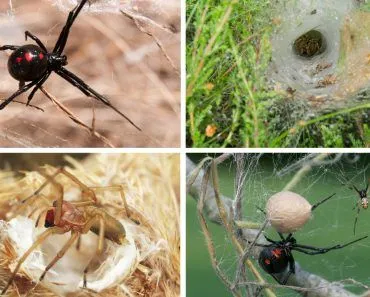
Literally, cobwebs are only old spiderwebs, but one family of spiders got the top title – Theridiidae or “cobwebs-spiders.” These home-abandoning spiders (forming one of the largest spider families, with more than 2,600 known species) get their name from their distinctly disorganized webs. Their tangled web formations don’t have any discernible pattern. The different species have different disorganized patterns of web-building, but there are some overall commonalities.
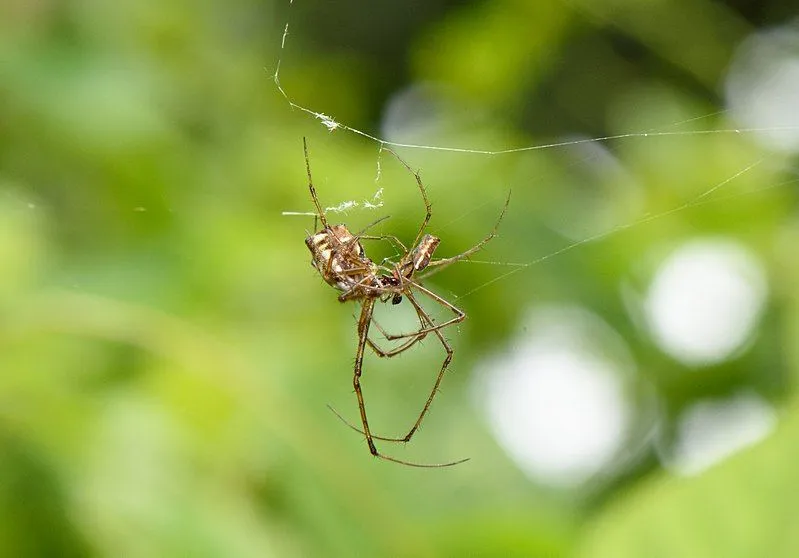
Most are skilled hunters. They anchor their nets to support structures such as beams and wall corners, creating a three-dimensional noose. This noose then becomes a common nuisance in the home as soon as it serves its real purpose for the spider.
The ends of these nets, when active, have sticky droplets that stick unsuspecting insects like flies to the net. The same sticky property of the net also attracts dust and pollen, agents that tend to damage the net.
Other Web-building House Spiders
The Theridiidae are not the only spiders that use the corners of our houses to build their nests. There are a few other spider species whose webs you may also find at your house.
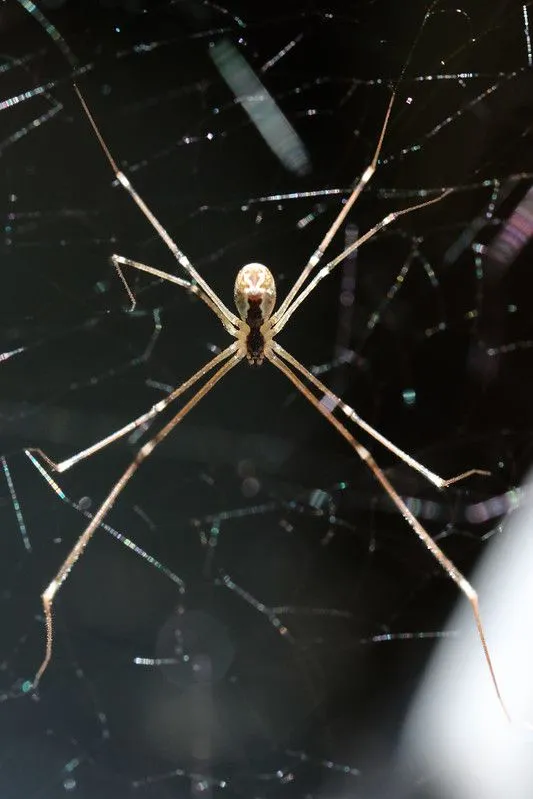
One group are the ‘daddy longlegs spiders’ (not to be confused with the other 8-legged daddy longlegs that live under rocks and is NOT actually a spider).
Once referred to as cellar spiders, they belong to the Pholcidae family. Their webs can also be found in ceiling corners, under stairs or other unfrequented places in your house. Their webs are irregular and could easily be mistaken for cobwebs by an untrained eye. However, their webs exhibit slight structural differences.
Some cobwebs have a funnel-shaped, tubular shape that spreads like a leaf. These cobwebs can be attributed to funnel web spiders, which consist of a few different species. Their cobwebs are usually found in dimly lit areas such as warehouses or in boxes and cupboards.
The last spider to be mentioned in this article are the orb-weavers, noted for their geometric circular spider webs, which graphic designers could use to demonstrate an ideal web. As part of the Araneidae family, they are more common in gardens and trees, but sometimes also in homes.
What About Individual Strands Of Dust?
Okay, so now we know that the haphazard cobwebs were once active spider webs, but what about the individual strands of dusty material you see hanging from the ceiling? Are spiders also responsible?
In fact, they are.
Spiders, as well as a few other tiny arthropods, have the ability to produce silk strands for travel and protection. Spiders use silk in two main ways. As a safety line, they trail dragline silk (also called major ampullate silk) behind them when they jump, drop, or swing from place to place, a bit like Spider-Man.
For long-distance travel through the air, they use a different technique called ballooning. A spider climbs to a high point, raises its abdomen (a posture called “tiptoeing”), and releases several fine threads of gossamer silk into the air. These threads catch updrafts (and, as a 2018 University of Bristol study confirmed, atmospheric electric fields can provide enough force to lift the spider on their own), carrying it like a tiny parachute, sometimes for hundreds of kilometers.
So gossamer silk is the lightweight thread used for ballooning, while dragline silk is the tougher safety line. Dragline silk also serves as a scaffolding for parts of the web.
Again, these left-over strands of silk gather dust over time, resulting in those single irritating dust strands that we’ve all walked through and then had a tiny panic attack while trying to pull them off our face.
Spider Webs Do Not Decompose Easily
An even more intriguing thing is how long a spider web lasts. Spider silk is a tough, strong and durable material, and scientists have been trying for some time to replicate its tensile strength and elasticity, which also gives it some immunity against degradation.
Although dust and pollen damage the web and render it unusable for the spider, it does not simply crumble when the spider is not there to care for it. A team of scientists studied the strength of 4-year-old stray spider silk and found that, although its mechanical strength had diminished, it was still surprisingly strong.
Spider silk can be degraded by enzymatic action (spiders can eat their silk, after all), but environmental degradation is much slower. Silk strands consist of complex amino acid crystal structures that make the silk very durable.
What's The Difference Between A Cobweb And A Spider Web?
If you've been using "cobweb" and "spider web" to mean the same thing, you're in good company, but there's a neat distinction hiding in the two words. In everyday English, a spider web is the structure while it's still working: clean, freshly spun, and tended by its owner. A cobweb is what that same structure becomes once it's been abandoned and left to gather dust, which is why the term carries that grimy, neglected feeling.

There's a second, more biological meaning too. To arachnologists, "cobweb" describes a particular kind of web: the tangled, three-dimensional jumble of threads built by spiders of the family Theridiidae, with no obvious pattern to it. That sets it apart from the famous orb web, the flat, wheel-shaped design with spokes and a sticky spiral that orb-weavers (family Araneidae) build and often rebuild from scratch each night. So depending on who's talking, a cobweb is either an old, dusty web of any sort or, more precisely, the messy tangle-style web of a cobweb spider, as opposed to the tidy geometry of an orb web. Either way, the eight-legged builder is the same: there's no such thing as a spider-free cobweb.
Why Is It Called A "Cobweb"? (And What "Cobwebs" Means Figuratively)
Here's a small mystery in plain sight: there's no "cob" in a cobweb, so where did the word come from? The answer is that "cob" is a very old, now-forgotten English word for spider. According to the Online Etymology Dictionary, "cobweb" goes back to the early 14th-century Middle English coppewebbe. That first element, -coppe, comes from the Old English atorcoppe, meaning "spider" and literally "poison-head" (a nod to the venom most spiders carry). Stitch coppe ("spider") together with web ("something woven") and you get, quite logically, "spider's woven thing." The familiar spelling with a b only appeared in the 1500s, probably borrowed from the unrelated word "cob."
What about people searching for what "cobwebs" means beyond the literal threads? The word picked up a figurative life centuries ago. Merriam-Webster defines this sense as "something that entangles, obscures, or confuses," and that flimsy-but-tangling image is genuinely ancient: in the 1570s, writers were already echoing the Greek essayist Plutarch, who credited the 6th-century-BCE sage Anacharsis with comparing laws to cobwebs that catch small flies while wasps and hornets break straight through. That's also where everyday phrases like blowing away the cobwebs (shaking off mental dullness) and having cobwebs in your head (feeling foggy or out of practice) come from. The mental picture is always the same: a dusty, neglected corner that just needs a good clear-out.
Conclusion
Spiders are the secret behind the dust snakes that casually adorn our homes. As strange as it may sound to some people, spider lovers may find cobwebs interesting, as they can be used to track the movements and habits of spiders in web building. Or maybe not.
Spider webs are very difficult to spot because of the wafer-thin strands they are made of, and by the time they are discovered, the spider is likely to have disappeared and the web is already covered in the dust left for a newer, more invisible home!
References (click to expand)
- Cobweb Spiders - University of Kentucky. The University of Kentucky
- Theridiidae - tolweb.org
- Graphic: A spinner's secrets, Science (AAAS, archived)
- Pholcidae - tolweb.org (archived)
- Spiders Commonly Found in Houses - Susan Masta. web.pdx.edu
- Spider Identificationand Management - store.msuextension.org
- Cobweb - Etymology, Origin & Meaning. Online Etymology Dictionary
- Spider web - Wikipedia
- Morley & Robert, Electric Fields Elicit Ballooning in Spiders. Current Biology (University of Bristol)