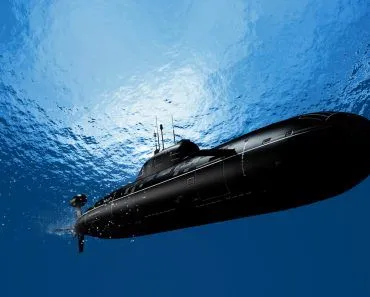
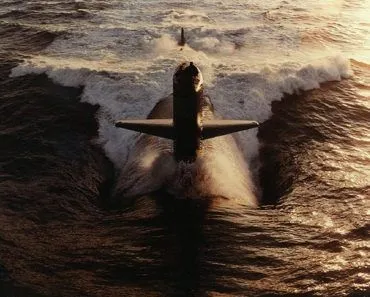
Submarines are black or dark grey mainly for camouflage. A dark hull is very hard to spot against the deep ocean, especially at night or when the sub is just below the surface. Most modern submarines also wear dark, sound-absorbing rubber “anechoic” tiles that soak up enemy sonar, and those tiles happen to be black too.
At the start of the first World War, the Allied forces, especially Britain and France, were harassed by a new, all-powerful weapon in naval warfare: the German U-boats, or submarines. These sneaky machines stayed submerged and picked off enemy ships with ease.

Submarines had actually proven themselves as a weapon decades earlier. In 1864, during the American Civil War, the hand-cranked Confederate sub H.L. Hunley became the first submarine to sink an enemy warship, the USS Housatonic. By the time the U-boats arrived, no one had any idea how to deal with the threat.
Unrestricted Submarine Warfare
In fact, there was a thing called ‘unrestricted submarine warfare’ during the first World War, which signified a type of naval warfare in which submarines could attack and sink enemy vessels and even merchant ships without warning.
Suffice to say that submarines enjoyed an unfair advantage for a very long time.
That was the case because the biggest strength of a submarine was that it could submerge and remain submerged underwater for long periods of time, thereby making it impossible for enemy vessels and battleships to attack them.
However, even if a submarine ‘surfaces’, i.e., comes out in the ‘open’ to the surface of the water, you may not be able to see it from a distance, especially if the sun has set!
This has a lot to do with how submarines are usually painted.
Why Are Submarines Painted Black Or Grey?
Submarines are usually painted shades of black (yes, there is more than one) for one primary reason: camouflage.
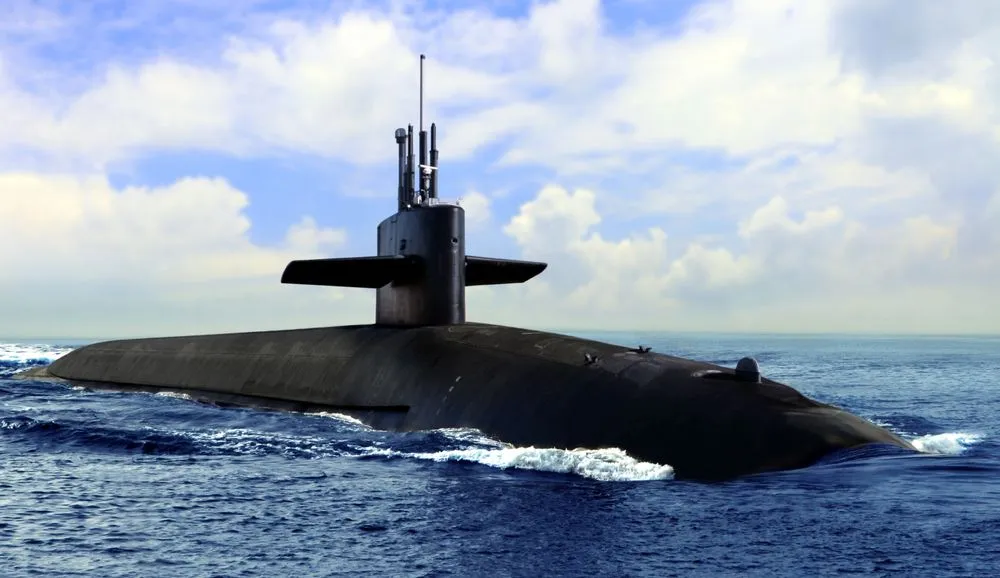
When you’re on the deck of a battleship or any regular vessel, it’s fairly easy to spot an object on the surface. From a tall mast or bridge, the curve of the Earth still limits the naked eye and binoculars to a horizon of roughly 16-32 km (10-20 miles), so anything beyond that drops out of sight. In addition, all modern battleships and destroyers carry radar and sonar that can detect ships and aircraft far over that horizon.
However, things are not so straightforward when you’re in a giant metal tube submerged a few hundred feet underwater.
Submarines Have Only One Way To See Other Submerged Objects
Underwater, light and radar are useless over any real distance, so a submarine has essentially one way to locate other submerged objects: Sound Navigation And Ranging (SONAR). Sonar comes in two flavors. Active sonar sends out a sound pulse and listens for the echo that bounces back off another object, much like a bat. Passive sonar emits nothing at all; it simply listens for the sounds other vessels make, such as their propellers and machinery.
Here’s the catch: the moment a sub pings with active sonar, that pulse also announces exactly where it is. So submarines lean heavily on passive sonar, quietly listening rather than broadcasting, and use active sonar only in short bursts when they really need a precise range. Staying quiet, and unseen, is the whole point.

Sonar is for finding other vessels, not for knowing where the sub itself is. GPS signals can’t penetrate water, so a submerged sub keeps track of its own position with an inertial navigation system (a package of gyroscopes and accelerometers), grabbing a quick GPS fix only when it raises a mast near the surface. For actually seeing and tracking other submerged objects, though, sonar remains the most reliable tool a submarine has.
What makes a submarine such a formidable weapon of naval warfare is that it can attack and then disappear beneath the waves, away from probing eyes, torpedoes and the missiles of enemy vessels.
Since subs are designed to operate underwater, they do not have enough firepower to defend against surface attacks. That’s why it’s very important for them to remain as invisible as possible when they do surface, or even when they cruise just below the surface of the water.
This is the biggest reason why submarines are painted grey or some shade of black, in order to blend in with their surroundings. This is also why submarines usually prefer surfacing at night, so that they can’t be easily spotted.
There’s a second reason a modern sub looks so dark, and it ties straight back to sonar. Rather than relying on paint alone, most modern submarines are clad in thick rubber “anechoic” tiles. These tiles are riddled with tiny air pockets that absorb an enemy’s active sonar pulses instead of bouncing them back, making the boat far harder to detect. The trick dates to World War II, when German engineers developed a rubber hull coating codenamed Alberich. The tiles happen to be dark, so the same skin that quiets a submarine acoustically also helps it disappear visually.
Black Is NOT The Only Color For Submarines
Although black or grey are the most commonly used colors to paint submarines all over the world, there are some countries that paint their submarines in different colors for other reasons.
For instance, this is a North Korean submarine, painted in a shade of green:
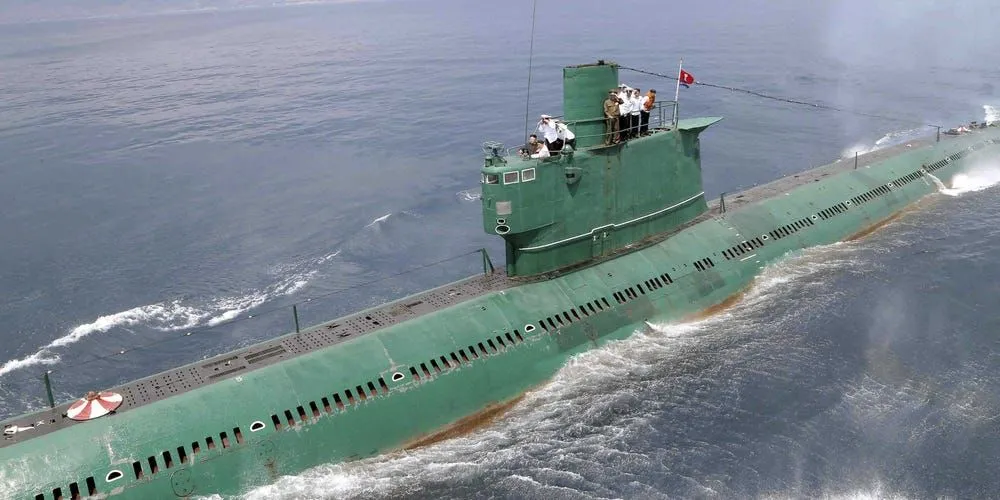
Similarly, certain submarines of some other countries, such as Iran and Israel, are also painted green, as they mostly function in clear, shallow and coastal waters. In such contexts, the green color blends in well.
Also, note that not all submarines are used for military operations. Subs may also be used for deep-sea exploration and search and rescue missions. In these scenarios, camouflage is not a priority, so you may see submarines of different colors.
If you plan to manufacture a submarine and use it to do reconnaissance missions and/or attack enemy vessels in the open ocean, you should consider painting your sub black, as that’s just an added layer of security for the submarine, apart from its obvious strength of submerging at will!