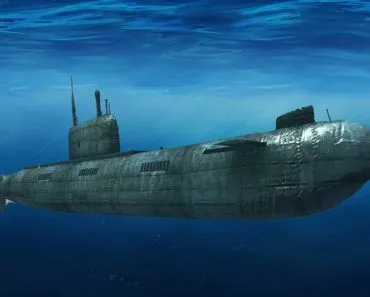
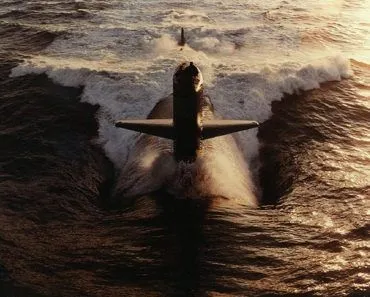
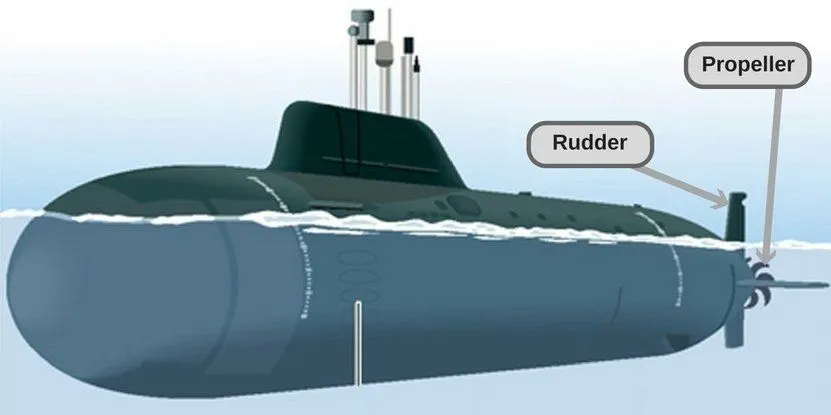
A submarine dives by venting its ballast tanks so the air escapes and seawater rushes in, making the boat denser than the surrounding water. To resurface, compressed air is blown into the tanks to push the water out and the submarine becomes lighter than the water it displaces. Two hydroplanes and a tail rudder control the angle of dive and direction of travel.
Turning a corner on a road is no big deal when you’re driving a car, but things change dramatically when you need to maneuver a downward (or upward) turn in a gigantic metallic tube – more specifically, in a submarine – operating underwater. So, what goes on inside a submarine when it dives and resurfaces?
A Little Something About Submarines…
A submarine is a brilliant piece of technology specifically designed to operate underwater. It’s a special ship that has the ability to operate independently (i.e. without any external support) underwater. Initially manufactured for militaristic purposes (indeed, the biggest submarines currently in operation belong to navies from various countries), submarines these days are also used for carrying out research and experimentation underwater.
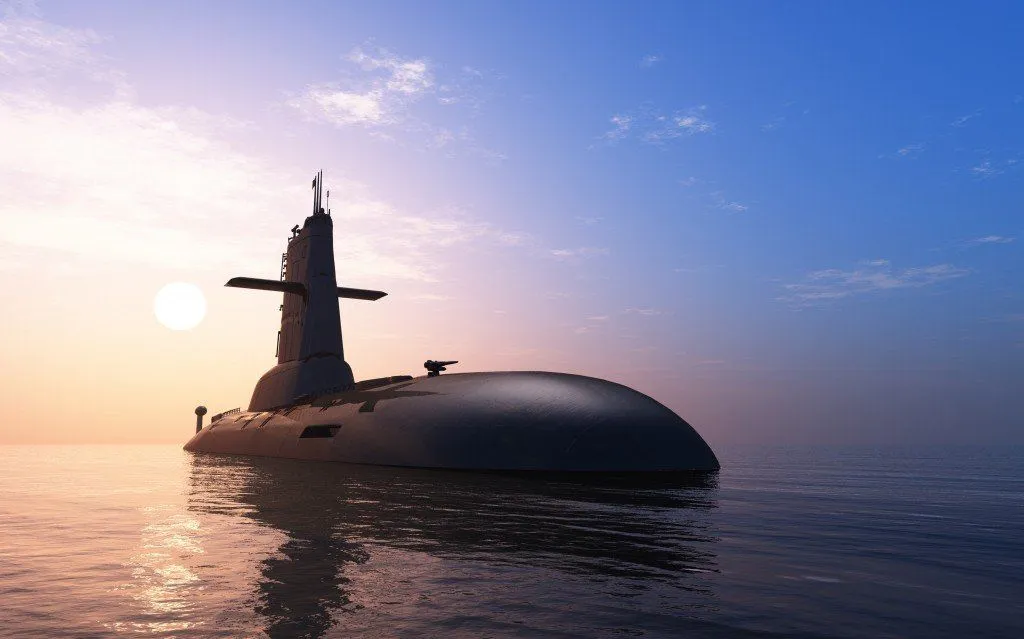
How Does A Submarine Dive And Resurface?
Before we discuss how submarines break the surface and go underwater, let’s do a quick recap of an important physical phenomenon of water that you surely studied at some point in a science class: buoyancy.
Buoyancy is basically an upward force that keeps everything from wooden planks to gigantic vessels from sinking. While messing with this force can have disastrous consequences, the ability to control it can be highly advantageous.
If the weight of water displaced by an object is equal to its own weight, then it floats; otherwise, it sinks. While most boats and vessels don’t dare to mess with this equilibrium, since it keeps them afloat, submarines manipulate this effect on purpose. In order to control the buoyant force acting on it, a submarine fills/empties itself with the surrounding water to dive/resurface. A submarine consists of ballast tanks (and trim tanks too, in some models) that can be filled by either water or air according to navigational requirements.
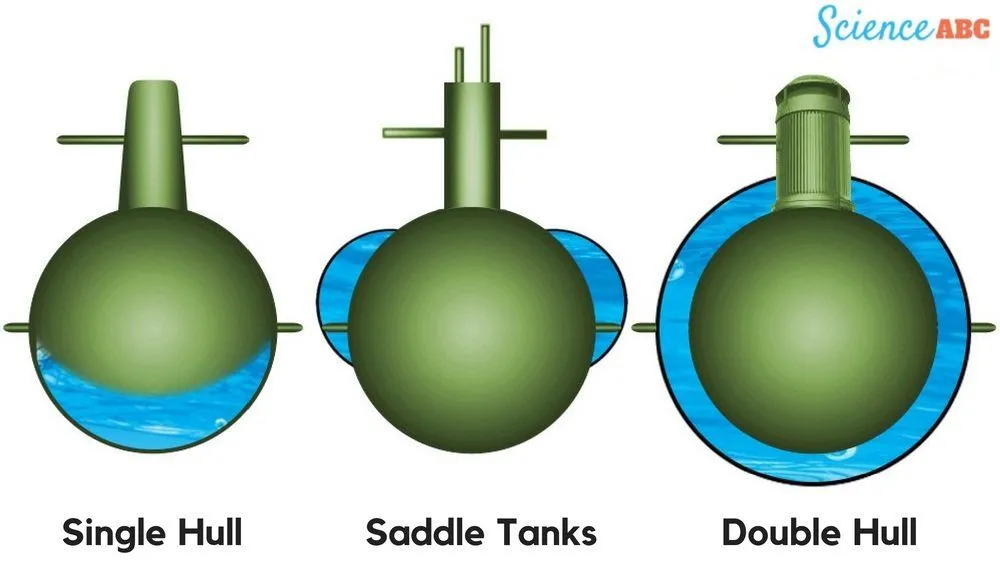
It works like this: when the submarine is above the surface of the water, the ballast tanks are filled with air, which means that the overall density of the submarine is less than the water it displaces. However, when the submarine needs to dive, it releases a vent in the ballast tanks that causes the surrounding water to rush in. The crew allows the surrounding water to fill the tank until the desired depth is reached, after which the valve is closed to stop any more water from rushing in.
In addition to the flooding of the tanks, two ‘diving planes’ also aid in controlling the speed of descent for the submarine. The angle of these ‘wings’ directly influences the speed of the dive.
On the other hand, when a submarine has to resurface, compressed air is blown into the ballast tanks from air flasks, which pushes the water out of the tanks at a rapid rate. This results in a decrease in the overall density of the submarine, causing it to rise to the surface. Furthermore, the hydroplanes are angled in such a way that water moves over the stern, pushing it down and making the submarine ascend faster.
Making Turns Underwater
Once you’ve acquired a cruising depth, you want to ensure that the submarine moves while staying submerged at the same depth without losing/gaining any further depth. To do this, the level of water and air present in the ballast tanks must be balanced. The tail rudder can be controlled to turn starboard/port (right/left), while the hydroplanes are used to control the fore-aft angle.
How Does A Submarine Go Up And Down?
So far we’ve talked about diving and surfacing as if they were two switches: flood the tanks to go down, blow the tanks to come up. In practice, a submarine spends most of its time somewhere in between, gliding along at a steady depth, and getting there is all about a state called neutral buoyancy. A submarine is neutrally buoyant when its total weight exactly equals the weight of the water it displaces, so it neither bobs up to the surface nor sinks toward the seabed. It simply hangs in the water, suspended, with no tendency to rise or fall.
The large main ballast tanks are too coarse for this delicate balancing act. To fine-tune things, submarines use much smaller trim tanks (sometimes called depth-control tanks) near the bow and the stern. The crew pumps water between the forward and aft trim tanks to keep the boat level and to nudge its overall weight until it sits right at neutral buoyancy. Because seawater density shifts with temperature and saltiness, the trim has to be adjusted continually as the submarine passes through different patches of ocean.
Once it is neutrally buoyant, the submarine doesn’t need to flood or blow its main tanks every time it wants to change depth a little. Instead it leans on its hydroplanes (the wing-like diving planes on the hull and sail) exactly the way an aircraft uses its elevators. Angle the planes down and the water flowing past pushes the bow under, so the moving submarine glides deeper; angle them up and it climbs; level them off and it cruises flat. In short, the ballast tanks handle the big, slow changes between the surface and the depths, while the hydroplanes handle the quick, gentle adjustments while the boat is under way.
How Does A Submarine Navigate Underwater?
Here’s the genuinely hard part. The moment a submarine slips beneath the waves, it goes blind to the outside world. GPS does not work underwater, because the radio signals beamed down by navigation satellites barely penetrate a few centimeters of seawater before they fade out (salt water is a good conductor and rapidly soaks up the high-frequency GPS signal). There are no landmarks, no road signs, and for a military boat trying to stay hidden, no popping up to the surface for a look around. So how does a several-thousand-tonne steel tube find its way across an entire ocean in total darkness?
The answer is a self-contained inertial navigation system (INS), often called a Ship’s Inertial Navigation System. It is built around gyroscopes, which sense every change in the boat’s orientation, and accelerometers, which measure every push and slow-down. Starting from a known position, an onboard computer continuously adds up all that turning and accelerating, a technique called dead reckoning, to work out exactly where the submarine has moved to. The clever part is that it needs no outside signal at all, which is precisely what a vessel built for stealth wants. These systems are remarkably good: Encyclopædia Britannica notes that nuclear submarines have crossed under the north polar ice cap guided by inertial systems alone, drifting off by less than a mile a week.

There is a catch in “less than a mile a week,” though: inertial error slowly creeps in and grows the longer the boat runs, so the system has to be corrected now and then. To do that, a submarine eases up to periscope depth and briefly raises an antenna to grab a GPS fix, resetting the inertial system to a precise position before sliding back into the deep. Where the seabed has been carefully charted, it can also check its position by matching the underwater terrain passing beneath it.
For sensing what’s around it, the submarine relies on sonar (short for sound navigation and ranging), because sound, unlike radio or light, travels superbly through water at roughly 1,500 meters per second. Active sonar sends out a pulse, or “ping,” and times the echo bouncing back to measure how far away an object is and in which direction it lies. The snag is that pinging announces your presence to anyone listening, which is the last thing a hidden submarine wants. So most of the time submarines run on passive sonar instead, silently listening with sensitive hydrophones to the noise made by other vessels and identifying them by their acoustic signature, all without ever giving themselves away. Between inertial navigation telling it where it is and sonar telling it what’s nearby, a submarine can travel for weeks beneath the surface without once needing to see the sky.
Submarines are a formidable piece of engineering, in that they not only operate under incredibly high-pressure conditions hundreds of meters underwater, but also keep nations’ maritime borders protected from intruders and facilitate scientific research beneath the waves.
References (click to expand)
- Beare, A. N., Bondi, K. R., Biersner, R. J., & Naitoh, P. (1981, August). Work and rest on nuclear submarines. Ergonomics. Informa UK Limited.
- Psoma, A., & Sattler, G. (2002, April). Fuel cell systems for submarines: from the first idea to serial production. Journal of Power Sources. Elsevier BV.
- How Submarines Work - ffden-2.phys.uaf.edu:80
- Inertial guidance systems. Navigation. Encyclopaedia Britannica.
- Characteristics and limitations of GPS L1 observations from submerged antennas. Journal of Geodesy. Springer.
- Navigating a Submarine. Time and Navigation. Smithsonian National Air and Space Museum.
- Sonar. Wikipedia.