Table of Contents (click to expand)
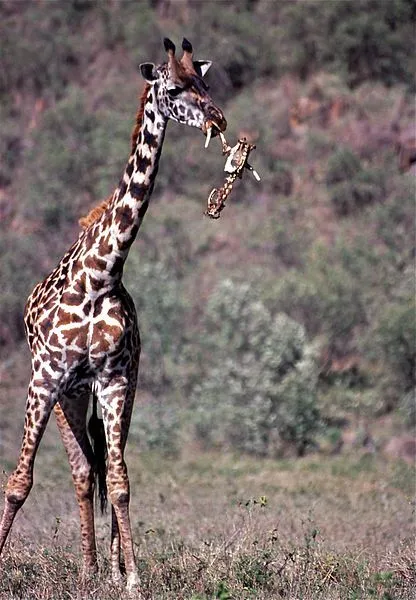
Giraffes are herbivores that mostly eat leaves, but they are sometimes seen chewing on bones from carcasses. This behavior is called osteophagia, and the leading explanation is a shortage of calcium and phosphorus in their leafy diet, especially during the dry season. They gnaw bones rather than swallow them.
Giraffes are the poster children for herbivores. You’re likely to see pictures of them in school textbooks or nature documentaries peacefully munching on foliage from atop trees. The camera zooms onto their happy faces as they munch with their herbivorous molars.
You look away for a moment and then spot them eating a bone, and you begin to question the biology you’ve learned so far.
A Giraffe Eating A Bone
I imagine a dropped jaw, wide eyes, and raised eyebrows on the faces of the researchers who first saw such behavior. Sitting in their safari jeep, donned in full ecologist camouflage, complete with a hat and binoculars, they probably said, “I can’t believe it!”
The official name of such behavior is osteophagia. “Osteo” which means bone, and “phagia,” which means to eat. The earliest paper that noted such behavior in giraffes was by E.M. Nesbit Evans, a zoologist at the University of Cambridge.
Evans followed a group of 11 Rothschild giraffe (Giraffa camelopardalis rothschildi) across the Maralal in Kenya between 1967-8. He noted that one female ate the stomach contents of a dead eland (a species of antelope), while another female briefly picked up the lower jaw bone of that dead eland. “The phenomenon of chewing bones and eating stomach contents has never previously been recorded for giraffe,” Evans writes in the paper.
It is one thing for a giraffe to move the bone around out of curiosity, but why chew on a bone?
A Giraffe’s Diet
Giraffes primarily eat leaves, something nature documentaries did get right, and they eat a lot of them (about 2-4% of their body weight). If that doesn’t sound like much, remember that a big male giraffe can weigh up to about 1,930 kg (4,250 lbs), which comes out to somewhere around 34 to 75 kg (75 to 165 lbs) of leaves per day. Compared to their size, this isn’t a large amount.
So much leafy foliage isn’t all that easy to find in the African savannah, so they spend most of their day foraging and browsing. When they find what they’re looking for, such as the leaves of Acacia (a popular tree in every documentary about the African savannahs), including Faidherbia (white acacia), Terminalia, and Combretum (velvet bushwillow) species, the giraffes feast.
They mainly like feasting on new leaves. These plants produce tannins to make the leaves bitter in order to deter herbivores like giraffes from eating them. Newer leaves, that are much higher, don’t have as much tannin. (Source)
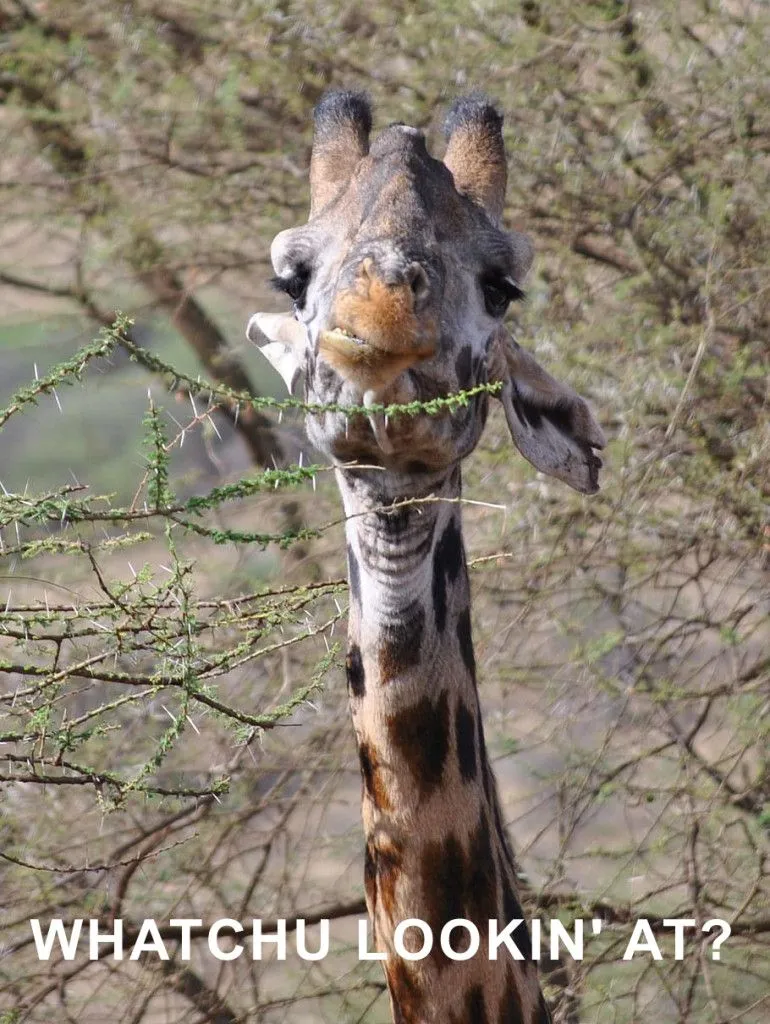
These trees are rich in nutrients, such as proteins and essential minerals, including calcium, a nutrient the lanky (a big male can stand over 5.5 m, or 18 feet, tall) giraffe needs, but a purely leafy diet doesn’t always give them what they need.
Missing Calcium And Phosphorus
When researchers first noticed such behavior, they must’ve been puzzled, but not entirely perplexed. This wasn’t the first time they’d seen a herbivore chew on bone. Cattle (and other ungulates, the animals with hooves) also chew on bones, and researchers don’t need a visa to observe this behavior. The hypothesized reason for this behavior is a lack of calcium and phosphorus.
Many plants aren’t rich in calcium and phosphorus. Calcium can still be found in enough quantities in some plants, like the giraffe’s favorite, Acacia. However, phosphorus is a harder mineral to come by for a herbivore, and with bones as long as a giraffe’s, it becomes absolutely critical to get that phosphorus.
Fortunately, bones are high in both calcium and phosphorus, and the wild savannah does have a few carcasses lying around. Researchers have found that such behavior increases during the winter months when food is scarce and the nutrient quality of the plants decline.
Other tall herbivores have also been seen to pick up bones, antlers and even ivory.
Giraffes don’t swallow the bones whole. Instead, they roll a bone around the mouth and gnaw on it for long stretches, much the way many carnivores do. How much of the mineral payload they actually absorb, though, is an open question. When researchers (Bredin and colleagues) tested whether bone fragments would dissolve in giraffe rumen fluid, the bones barely lost any calcium or phosphorus. So the deficiency may explain why giraffes reach for bones, even if the bones aren’t a very efficient way to fix it.
This scavenging isn’t restricted to bones. Giraffes have also been seen eating the earth itself. Evans noted, “The chestnut-colored female at Maralal licked salt and picked up a stone, which suggests that there may have been a mineral deficiency in the diet.” This behavior is called geophagia, and like osteophagia it tends to show up most in the dry season, when forage is poorest in minerals.
A Final Word
Humans, the only animals that study themselves and other animals, as far as we know, like to put things in boxes. We’ve neatly categorized and labeled anything and everything we can see. You could say that it gives our lives some predictability in this unpredictable ball of matter on which we live. We label an animal as carnivorous if it only eats meat. The same goes for herbivores with plants, and omnivores with anything. In our attempt to label and classify the world around us, we have learned more about the natural world than ever before, but not every label fits every time! Just remember, when we encounter the natural world, there’s still plenty out there to awe us.
References (click to expand)
- Nesbit Evans, E. M. (1970). The reaction of a group of Rothschild's giraffe to a new environment. African Journal of Ecology. Wiley.
- Giraffes (Giraffa spp.) Fact Sheet: Diet & Feeding. ielc.libguides.com
- LEUTHOLD, B. M., & LEUTHOLD, W. (2008, April 29). Food habits of giraffe in Tsavo National Park, Kenya. African Journal of Ecology. Wiley.
- Gordon, J. G., Tribe, D. E., & Graham, T. C. (1954, April). The feeding behaviour of phosphorus-deficient cattle and sheep. The British Journal of Animal Behaviour. Elsevier BV.
- Langman, V. A. (1978, January). Giraffe Pica Behavior and Pathology as Indicators of Nutritional Stress. The Journal of Wildlife Management. JSTOR.
- Bonjour, J.-P. (2011, October). Calcium and Phosphate: A Duet of Ions Playing for Bone Health. Journal of the American College of Nutrition. Informa UK Limited.
- Rubanza, C. D. K., Shem, M. N., Bakengesa, S. S., Ichinohe, T., & Fujihara, T. (2007, March 6). The content of protein, fibre and minerals of leaves of selected Acacia species indigenous to north-western Tanzania. Archives of Animal Nutrition. Informa UK Limited.
- Bredin, I. P., Skinner, J. D., & Mitchell, G. (2008). Can osteophagia provide giraffes with phosphorus and calcium? Onderstepoort Journal of Veterinary Research.