Table of Contents (click to expand)
Residential and small-office bathroom doors usually swing inward (push to enter, pull to exit) to keep the door out of busy hallways, protect passersby, preserve privacy, and keep the smell inside. The rule flips for high-occupancy public restrooms: under the International Building Code, any door serving 50 or more people must swing in the direction of egress (outward), and ADA guidance recommends outward swing for single-user accessible restrooms so first responders can reach someone who has collapsed against the door.
Let’s talk about bathrooms.
People go to the bathroom for a number of reasons – to answer nature’s call, to wash/clean their hands or their clothes on which they’ve dropped mustard, or to ruminate and ponder the purpose of their lives. Then, there are those people who access the restroom to take a selfie or two.

Now, here’s a thing that I have noticed in my years of using washrooms – and I doubt I’m alone – most bathroom doors open inwards, i.e. they are designed in a ‘push to enter’ and ‘pull to exit’ style. In other words, you have to push the restroom door to enter it and then pull on the door to exit.
However, some say that it would make more sense if it were the other way round, i.e., you would pull the door to enter the restroom and push to exit. The primary reason behind this is that, in such a setting, you wouldn’t have to touch the door knob/handle with your clean hands as you exit; you could just push the door and be on your way.
First, let me tell you that not all restroom doors are the same. There ARE restrooms whose doors are “pull to open”. I have been to quite a few such restrooms myself. So, we are only discussing the majority of restroom doors, i.e., those that are “push to open”.
As it turns out, restroom doors opening inwards is not just a random design thing. There are, in fact, multiple reasons behind that particular setting…
Don’t Block The Hallway/corridor
This is actually the most pertinent reason behind the “push to enter” doors. The best thing about “push to enter” doors is that, since they open inwards, they don’t block the hallway/corridor.
Suppose there’s a high ‘traffic’ restroom in the hallway. If people keep going in/coming out of the restroom, the door (a “pull to open” type) will not only hijack some space in the hallway, but also cause a nuisance/disruption to people walking down the hallway, especially if it’s a busy area.
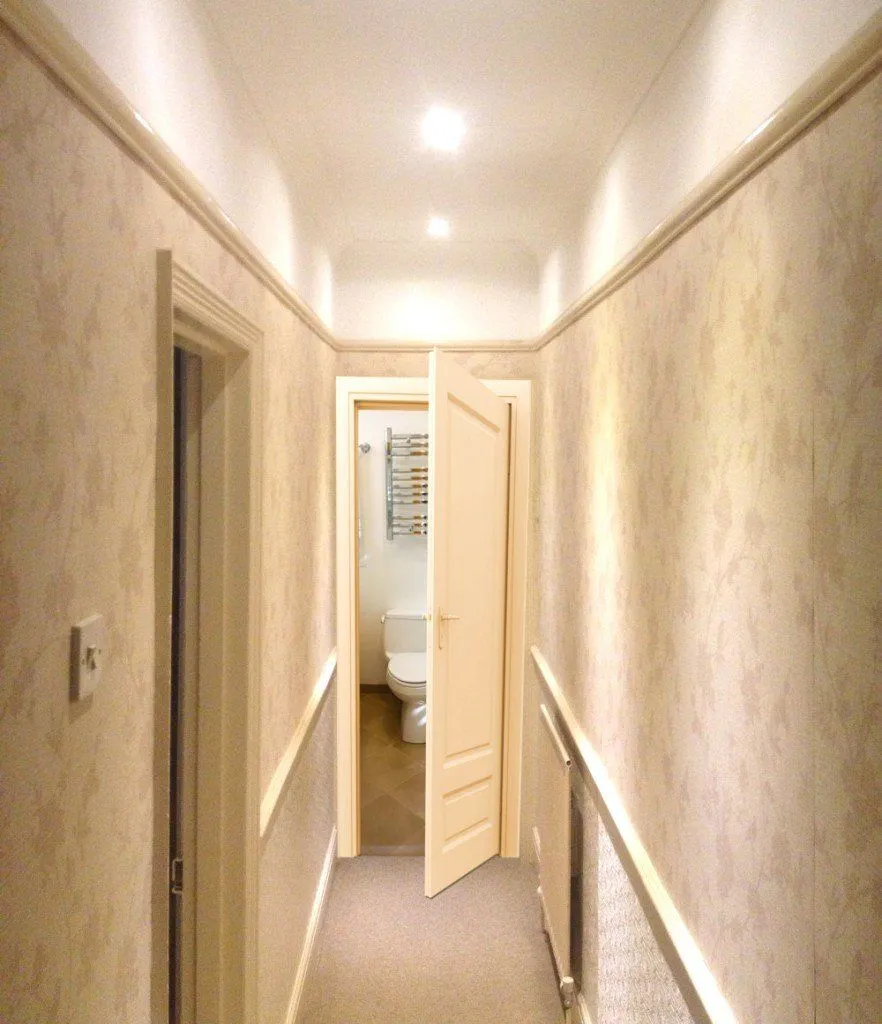
Additionally, many public bathrooms have drinking fountains, closets, or other utilities near them. If you have a “pull to open” door there, it will make things somewhat less convenient for people who need to use those utilities.
A “pull to open” door can be even worse if the corridor is narrow and/or there’s an emergency. You can’t really afford to have a restroom door blocking or hindering the movement of people (during an evacuation) through the narrow corridor.
That said, the rule flips for high-traffic public bathrooms. The International Building Code (IBC 1010.1.2.1) requires any door serving an occupant load of 50 or more to swing in the direction of egress travel, which for a busy public restroom means outward. The reasoning is exactly the panic-evacuation one: in a fire or stampede, a door that must be pulled open against a crowd is a death trap. That is why the bathroom door at a small office or your own home typically opens inward, but the bathroom door at a stadium, theater, or restaurant typically opens outward.
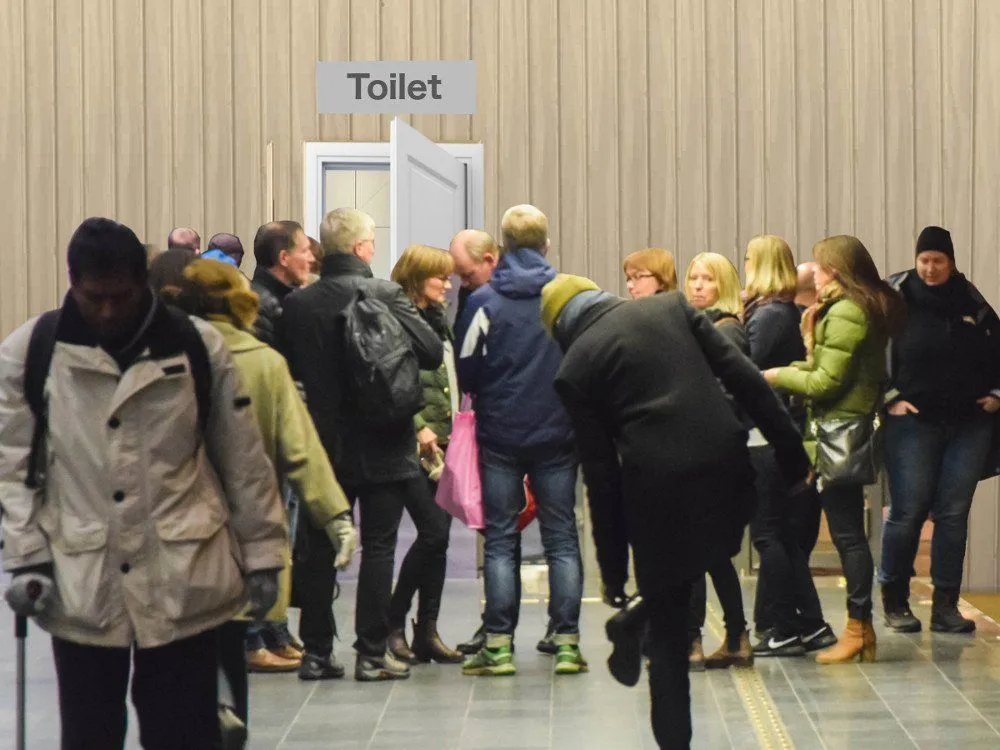
This is the primary reason behind the popularity of “push to open” doors in restrooms, but there are other reasons.
Safety
An inward-swinging door keeps the hinges on the bathroom side, so the hinge pins are not accessible from the hallway, which is a small but real anti-vandalism advantage. It also means a ‘push to exit’ door cannot swing out and knock over someone walking past the doorway, which is a serious concern in narrow corridors.
There is, however, a flip side. If someone collapses inside the bathroom (a fall, a fainting episode, a heart attack), an inward-swinging door can be blocked by their body and slow down first responders. This is one reason the Americans with Disabilities Act (ADA) and most modern accessibility codes recommend outward-swinging doors for single-user accessible restrooms, where rescue access matters more than hallway aesthetics.
Odor Control
Perhaps most notably, some washrooms don’t smell very good. A “push to enter” door helps somewhat to keep the “smell problem” under control. When a “push to enter” door opens into the washroom, some of the clean, non-smelly air from the outside is sucked inside and mixed with the washroom air.
However, if it’s a “pull to enter” door, this action is reversed. You now have your washroom air getting sucked out of the washroom, which may not necessarily be a great thing.
Privacy And Cleanliness
Humans generally want and prefer privacy while performing restroom-related activities. Most home and small-office bathroom doors swing inward to keep hallways clear, protect passersby, and preserve privacy. High-occupancy public restrooms swing outward by IBC code, and ADA recommends outward swing for accessible single-user restrooms.
Also, if you’re going into the washroom to clean/wash something off (e.g., your fingers, palms etc.), a “push to open” door is a better alternative, since you don’t have to touch the door handle to open it and enter the washroom.
Lastly, a personal observation – people are generally in more of a “hurry” when entering the washroom than while exiting it. Thus, a “push to enter” door saves a few precious nanoseconds, which may salvage some poor fellow from embarrassing himself and being tortured by the memory for the rest of his life.
Left-Hand Or Right-Hand: How Is A Door “Handed”?
So far we have only asked whether a door swings in or out. There is a second, sneakier question that trips up almost everyone who has tried to buy a replacement door or a new lock: is it a left-hand or a right-hand door? Every hinged door, your bathroom door included, has a “hand,” and the hardware is manufactured to match it.
The simplest definition is based on the hinges. If the hinges are on the left and the door opens into the room, it is a left-hand (LH) door; hinges on the right opening into the room make it a right-hand (RH) door. When the same door swings the other way, out of the room, the trade tacks on the word “reverse”: hinges on the left with an outward swing is left-hand reverse (LHR), and hinges on the right is right-hand reverse (RHR).
If you would rather not think about hinges, there is an old handyman’s trick. Stand on the side of the door where it swings toward you, put your back to the hinges, and see which hand is closest to the knob. Knob on your right means a right-hand door; knob on your left, a left-hand one. The “hand” refers to the hand you would reach out with, which is exactly why it is called handing and not “hinging.”
One warning: there is no single universal standard. Some suppliers describe a door from the opposite side or use their own labels, so it always pays to confirm the convention before you order. For your bathroom, though, none of this changes the in-or-out logic above; the hand only decides which jamb the hinges live on.
References (click to expand)
- International Building Code (IBC) 2021, Chapter 10: Means of Egress (Section 1010.1.2.1 door swing direction). International Code Council.
- Chapter 4: Entrances, Doors, and Gates. United States Access Board (ADA Standards).
- 2010 ADA Standards for Accessible Design. US Department of Justice.
- NFPA 101: Life Safety Code (egress door swing requirements). National Fire Protection Association.
- Ergonomic Design: Push Sign on a Pull Door. The Evergreen State College.
- Door Handing Guide (LH, RH, LHR, RHR definitions). Archtoolbox.
- Determining the Hand or Handing of a Door. The Natural Handyman.
- Inswing vs. Outswing and Left Hand/Right Hand: Door Terminology 101. RealCraft.