It is Pavlovian conditioning. After years of urinating only in bathrooms, your brain learns to associate the sight or sound of a toilet (and even the bathroom door) with relief, so it relaxes the pelvic-floor and sphincter signals it had been using to suppress the urge. The result is a sudden, much stronger need to pee the instant you arrive.
We’ll discuss the increase in our urge to pee near washrooms in a moment, but first, you should hear about a related and particularly famous experiment conducted during the 1890s by a Russian physiologist called Ivan Pavlov.
This legendary study related to how dogs salivate in response to not just the presence of food, but even the idea of the presence of food.
Pavlov’s Conditioning
Ivan Pavlov wanted to test something: whether he could condition a dog in a way that it would react predictably to a given stimulus.
The following is an oversimplified but representative account of the experiment.
Pavlov first rang a bell in front of a dog and noticed that, quite predictably, the dog gave no special response.
Then, Pavlov began his experimental procedure (he now rang the bell just before giving food to the dog). Upon seeing the food, the dog would salivate in anticipation.
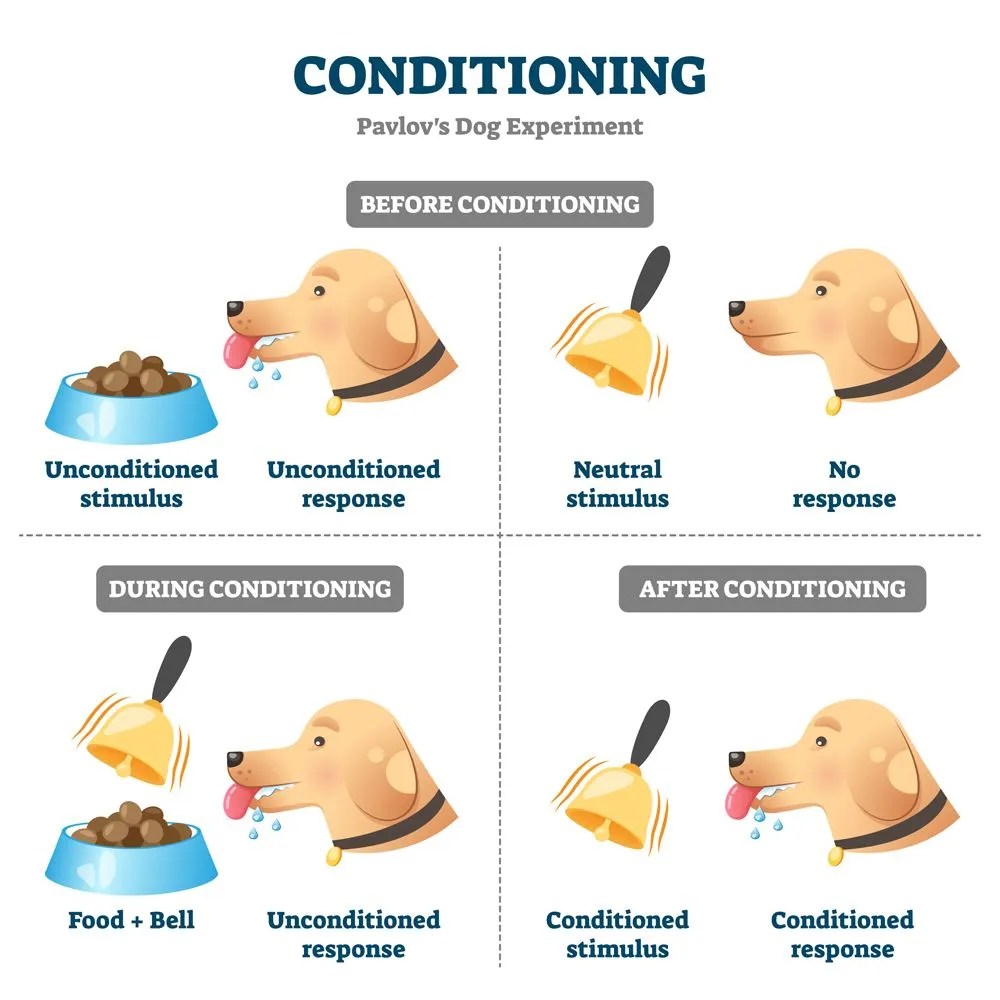
The scientist repeated this activity a number of times; just before he would give food to the dog, he would ring the bell. After multiple iterations of this, he noticed that when he rang the bell, the dog would start salivating, even if there was no food being presented to the dog!
The dog had learned an association between the bell and food, so it salivated just at the sound of the bell.
This phenomenon of learning through association is now referred to as Pavlovian conditioning or classical conditioning.
Association Between The Bathroom And The Urge To Pee
Although scientists are not exactly sure why we feel like peeing the moment we enter the washroom, it’s a popular belief that it’s related to Pavlovian conditioning (Source).
Think about this for a minute… how long have you been urinating in bathrooms? Pretty much all your life, right? That’s a decade or two, at least.
For years, you have associated your bathroom with answering nature’s call and relieving yourself. That is why when you approach the washroom door, or even enter your apartment, your urge to pee becomes stronger. This is because your brain, which had been controlling the urge for so long, suddenly realizes that you’re near the place where you can relieve yourself of the ‘pressure’.
The impact of the urge is different for different people; some people feel the urge getting stronger as they enter the washroom, some feel it when they enter their apartment, and others feel it the moment they see a urinal or even the sign for a restroom.
There are some other stimuli as well, such as getting up after waking up in the morning, being cold, and seeing running water.
Overactive Bladder
Some people experience this sudden, strong urge to pee more than others, which may be due to an overactive bladder (also called OAB).
This is how things work in a normal situation: as your bladder fills with urine brought in by the kidneys, the former stretches itself and makes room for the urine. Typically, we experience the first urge to urinate when the amount of urine present in the bladder is a little less than 240 milliliters (nearly 1 cup). Most people’s bladders can hold more than 480 milliliters of urine.
Having an overactive bladder means that you have a condition where the bladder squeezes out urine at the wrong time. As you can imagine, this is highly undesirable. You can read more about the symptoms, diagnosis and treatment for this condition here.
So, if you feel that you’re never able to resist the urge to pee for more than a few seconds and you urinate very frequently, it might be a good idea to consult a physician and get yourself medically checked out.
However, if you feel like urinating the moment you see a urinal or just a restroom sign, don’t worry… it’s a perfectly normal reaction of our classical conditioning, and all of us experience it from time to time!
Latchkey Incontinence: When The Trigger Has A Name
Here’s something most people don’t realize: when that urge spikes so hard that you’re fumbling with the door key, the sensation actually has a clinical name. Doctors call it latchkey incontinence (also known as key-in-the-door syndrome or turnkey incontinence). According to the Cleveland Clinic, it’s a form of situational urge incontinence in which a specific cue, like seeing your front door, slipping your key into the lock, or pressing the garage remote, sets off a sudden, hard-to-hold need to pee.

The door isn’t the only culprit. The two other most famous triggers are seeing or hearing running water and walking past a public restroom. It’s the same Pavlovian wiring we’ve been talking about, just turned up loud enough that the bladder actually contracts before it should, instead of merely sending a stronger “go soon” signal. It’s closely related to that desperate squirming you do when you’re holding it in and start to dance, only here the trigger is a familiar place rather than a full bladder alone.
So what is the brain doing in that moment? A 2025 randomized pilot study published in the journal Continence pointed to a region called the dorsolateral prefrontal cortex, the part of the brain that handles self-control and keeps impulses in check. In women who struggle with cue-triggered leaks, this region tends to be under-active, so it’s slower to override the bladder when a familiar trigger appears. Encouragingly, the same study found that mindfulness training and gentle, non-invasive brain stimulation aimed at that region both reduced how strongly participants reacted to their personal triggers, with benefits comparable to those of medication or pelvic-floor therapy.
For most of us, this is a harmless quirk you can laugh off. But if the urge regularly tips over into an actual leak, it’s worth mentioning to a doctor, because it’s a recognized, treatable condition, not just a lack of willpower.
References (click to expand)
- Environmental cues to urgency and incontinence episodes in .... Allied Academies
- Consumer Behavior Theories: Pavlovian Theory | Husson University - online.husson.edu
- Classical Conditioning. StatPearls, NCBI Bookshelf.
- Leron, E., Weintraub, A. Y., Mastrolia, S. A., & Schwarzman, P. (2018, March). Overactive Bladder Syndrome: Evaluation and Management. Current Urology. Ovid Technologies (Wolters Kluwer Health).
- Understanding Latchkey Incontinence. Cleveland Clinic.
- Mindfulness and Transcranial Direct Current Stimulation (tDCS) to Attenuate Situational Urgency Urinary Incontinence (UUI): A randomized pilot study. Continence (2025). PMC, NCBI.