Table of Contents (click to expand)
The shimmering âwaterâ on a hot road is a mirage â an optical illusion, not real water. The sun heats the dark tarmac, which warms a very thin layer of air sitting just above it. Hot air is less dense than the cooler air above it, so its refractive index is lower. Light rays from the sky travelling almost parallel to the road bend upward as they pass through that warm layer and reach your eyes, so the road looks like it is reflecting the sky â exactly the way a real puddle would.
While driving on a hot and sunny day, you may have been surprised to see a puddle of water a few hundred meters down the road, only to find that once you reach where the puddle was, the water is nowhere to be seen. It has moved a few hundred meters further down the road.
This continues to happen as you drive down the road.
Anyone who has ever chased such puddles of water on a hot day has learned the hard way that there is no water there. It is an optical phenomenon and acts like an illusion that confuses anyone who, on a steaming day, turns their eyes to the road in front of them.
How Does The Speed Of Light Change In A Dense Medium?
Light moves in a straight line at a constant speed of 300,000,000 meters per second. Its speed, however, is affected by the medium it travels through.
Light moves at this speed in a vacuum but slows somewhat when it goes from a thinner medium (air) to a denser medium (glass, water).
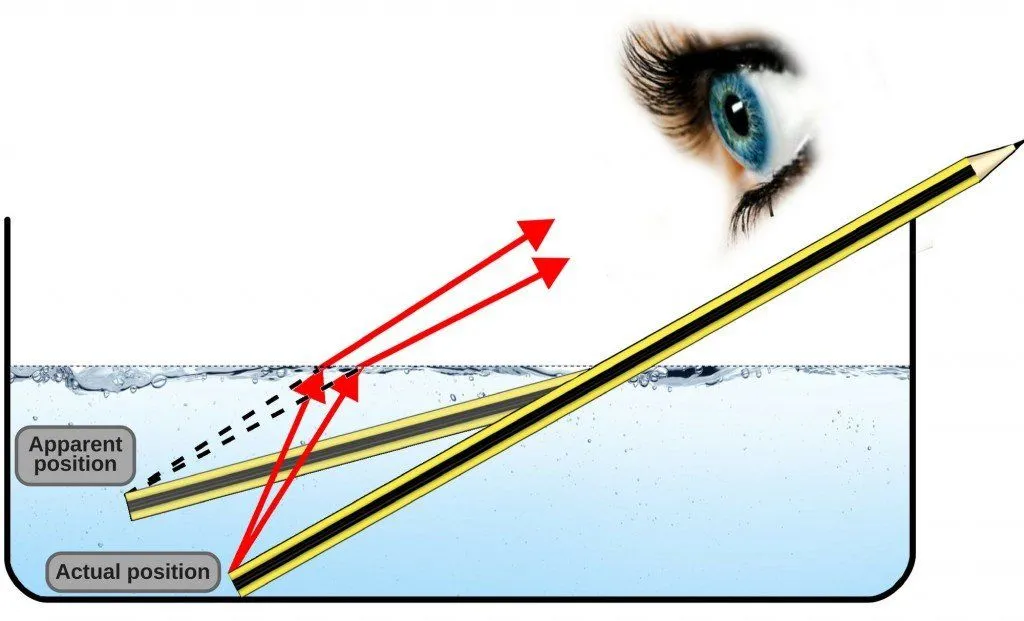
This apparent slowdown occurs when photons (microscopic particles that makeup ‘light’) interact with the particles of the medium they are traveling through.
As a result, they are absorbed and emitted repeatedly, which lowers the average velocity of light by a small fraction in a given medium.
The ratio by which light is slowed down in a specific medium is called the refractive index of that medium. It is a dimensionless quantity, and its value is usually greater than 1 (although it can be less than 1 too).
How Is The Refraction Of Light Related To ‘Fake Water’ On Roads?
A medium’s refractive index partly depends on its temperature. Typically, the higher the temperature of the medium, the less dense it becomes, and vice versa. This effect is more noticeable in gases.
The ‘fake water’ phenomenon is a common example of a mirage, which is why it’s also sometimes called a ‘highway mirage’.
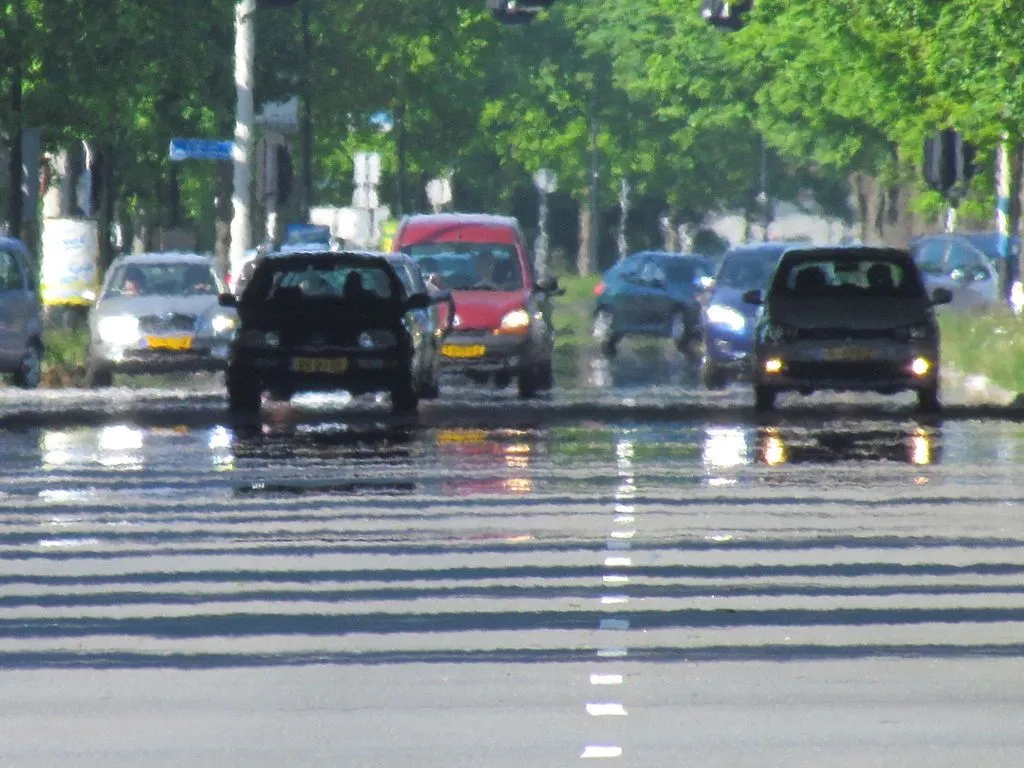
On a hot and sunny day, the sun heats everything, including the road. However, as roads are usually black, they absorb more heat and become hotter than light-colored objects. This, in turn, raises the air temperature just above the road’s surface.
As a result, there is a pocket of warm air underneath layers of relatively cooler air. This creates an uneven medium, where the air just above the road becomes less dense than the rest of the air.
When the sun’s rays pass through the air, they move in a straight line. However, their speed increases slightly upon reaching the relatively warmer and less dense layer just above the road, causing them to change course and become refracted. This refraction allows the rays to reach the observer’s eyes.
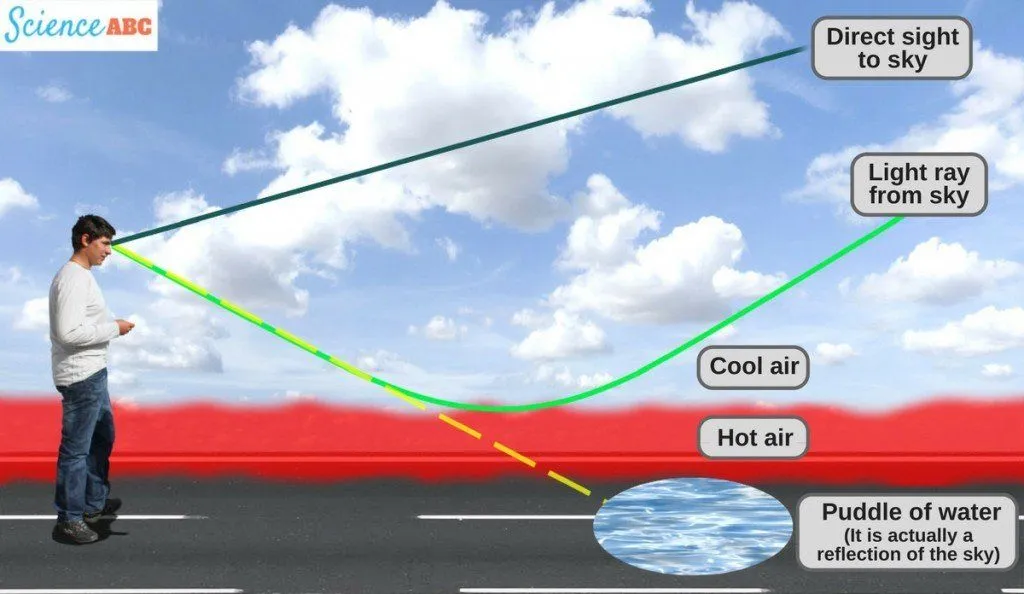
The water on the road is not really water but a reflection of the sky. Mirages are often observed on sunny days when the sun’s sweltering heat warms flat surfaces like roads and, subsequently, the air above these roads.
Mirages can be particularly cruel, especially for thirsty travelers who desperately need water in a sprawling desert. The optical illusion generated by a mirage makes it appear as though there is a body of water nearby. The water body, or at least an image of it, seems so perfect in a mirage that it is difficult to distinguish it from an actual body of water. Thirsty travelers quickly head toward the mirage, hoping to find water, only to discover that there is no water, just another mirage a few kilometers away.
This is a cruel trick of light, heat, and optics!
What Is This Water Illusion On The Road Called?
If you have ever wanted to put a name to the phantom puddle, here it is: it is an inferior mirage. The word ‘inferior’ has nothing to do with quality. It simply tells you where the false image sits, namely below the real object. The shimmering ‘water’ you see is actually an upside-down image of the sky, formed just beneath where the actual sky meets the road.
That positioning is what separates the two main families of mirage. In an inferior mirage, the bent image appears below the real object, which is why a road or a stretch of hot sand seems to be topped with a reflective pool. Its opposite is the superior mirage, where the image floats above the real object. Superior mirages form over cold surfaces such as the sea or an ice sheet, and they are the ones that can make a distant ship appear to hover in the air. The everyday hot-road version you meet on your morning commute is the most familiar mirage of all, which is exactly why it is so commonly searched for and so rarely named correctly.
So the next time someone calls it a ‘reflection’ on the road, you can gently correct them. There is no mirror and no water doing the reflecting. It is refraction, and the result is a textbook inferior mirage.
Why Does The ‘Puddle’ Keep Moving Away As You Get Closer?
This is the part that drives people slightly mad. You spot what looks like water a few hundred meters ahead, but no matter how fast you drive, you never actually reach it. The puddle always stays roughly the same distance in front of you, then quietly vanishes once you arrive at the spot where it ‘was’.

The reason comes down to angles. The hot, less dense layer of air only bends light enough to fool your eyes when the rays skim across it almost horizontally, at what physicists call a grazing angle. Light coming from a patch of road far ahead reaches you at one of these very shallow angles, so it gets bent upward into your eyes and you ‘see water’. Light from the road right in front of your bumper arrives at a much steeper angle and is barely bent at all, so that nearby stretch looks perfectly dry.
As you move forward, the geometry simply travels with you. The patch of road that now sits at the right grazing angle is once again a few hundred meters ahead, so a fresh ‘puddle’ appears there while the old one disappears. You are effectively chasing a horizon, and a horizon can never be caught. That receding behavior is also a handy giveaway: real rainwater stays put as you approach, while a mirage always keeps its distance.
Is The Desert ‘Oasis’ Mirage The Same Thing?
Yes, it is. The classic image of a parched, thirsty traveler stumbling toward a shimmering lake in the desert, only to find more sand, is the very same inferior mirage you meet on the highway. Swap black tarmac for sun-baked sand and the physics is identical: the surface heats up, warms a thin layer of air just above it, and that warm, less dense air bends grazing skylight upward into the traveler’s eyes. The brain interprets that patch of inverted blue sky as a sheet of water.
There is no special ‘desert magic’ at work, and no real oasis. The reason deserts feature so heavily in mirage folklore is simply that they offer the perfect recipe: vast, flat, intensely hot ground; long, unobstructed sightlines to the horizon; and a cloudless sky to supply the blue light. A flat salt pan, an airport runway, or a long, empty road on a heatwave afternoon will all conjure exactly the same ghostly water, for exactly the same reasons.
Last Updated By: Ashish Tiwari
References (click to expand)
- An Introduction to Mirages.
- Fraser, A. B., & Mach, W. H. (1976). MIRAGES. Scientific American, 234(1), 102–111. http://www.jstor.org/stable/24950264
- Tape, W. (1985). The Topology of Mirages. Scientific American, 252(6), 120–129. http://www.jstor.org/stable/24967686
- Types of Mirages. San Diego State University.
- Byrd, D. What causes a highway mirage? EarthSky.
- Stull, R. 22.6: Mirages. Practical Meteorology. LibreTexts (Geosciences).