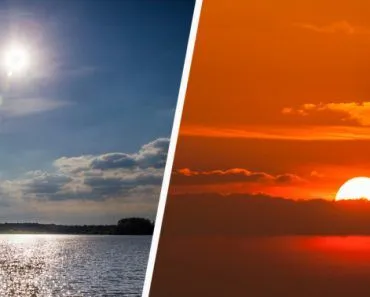
The bright "path of fire" you see when the Sun is low over the sea is called sun glitter. It happens because each little ripple of water acts like a tiny tilted mirror, its surface smooth enough to reflect sunlight directly (a specular reflection). When the Sun is overhead, those reflections bounce mostly straight back up at the sky; but when it sits low near the horizon, the rays graze the water at a shallow angle and bounce off at the same shallow angle toward your eyes, lining up into the familiar shimmering streak across the water.
If you’ve ever been on a beach in the wee hours of the morning, when the sun is just beginning to appear above the horizon, or even during dusk, when the sun is about to set, then you have probably observed the signature glint that it leaves on the sea water while rising/setting. The sight is truly magical, but it is also somewhat mystifying.
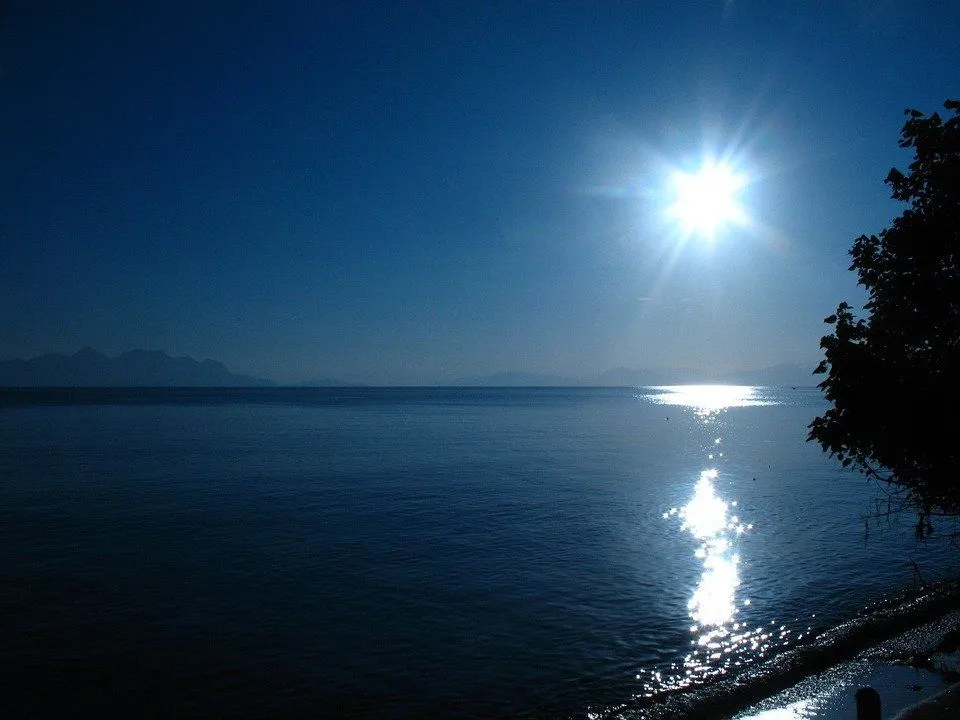
As beautiful as it looks, have you ever wondered why it occurs in the first place? I mean, the sun is up in the sky all day, but you don’t see those types of reflections throughout the day, right? What’s so special about the time when the sun is just above the horizon?
Short answer: It has everything to do with how the rays of the sun are reflected.
Reflection Of Light
You likely learned about the reflection of light in your high school Physics class. When light falls on a smooth surface, it bounces off it and moves away in a different direction (provided that the light falls on the surface at an angle). This is called the reflection of light. However, this is a very broad definition; the reflection of light can also be classified in two smaller categories: specular reflection and diffuse reflection.
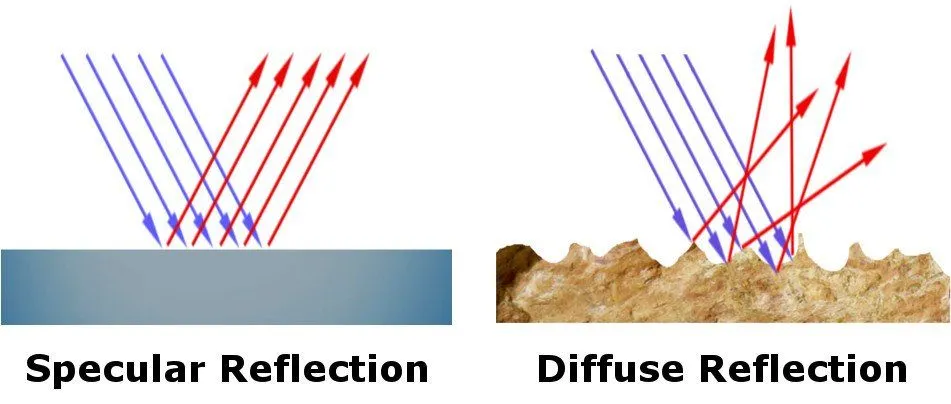
A beam of light is nothing but a bundle of light rays traveling parallel to each other. Specular reflection occurs when these light rays come from a single direction, fall on the surface and reflect off in a single outgoing direction. A mirror is a perfect example of this. On the other hand, when light rays are reflected in multiple directions, then diffuse reflection has occurred.
As you can probably guess, specular reflection occurs on plain surfaces, such as mirrors and still water, while diffuse reflection occurs on surfaces that are microscopically rough, including skin, clothes, paper and many other things that are part of our daily lives.
Sun Reflecting Off Water Bodies
Throughout the day, when the sun sits high up in the sky, the ocean’s water looks bright and evenly illuminated. You don’t usually see any patterns of light forming on the water’s surface. However, around the time of the sunrise/sunset, you will notice that the sun reflects off the water and appears to form an illuminated path of sorts on the surface of the water. Even if you throw a stone in the water, a quick ripple will create a glittering effect on the surface. This is known as sun glitter.
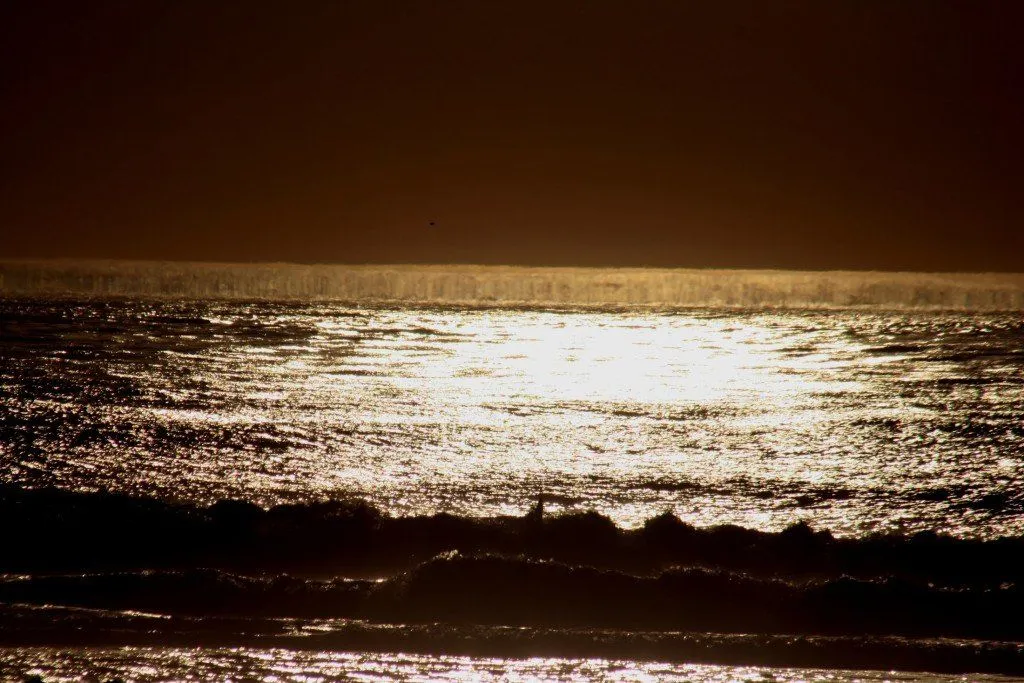
There are two main reasons behind this: first, when it comes to reflecting sunlight, sea water acts as a smooth surface on a macroscopic scale. A rippled – but locally smooth – surface will reflect the sun at different angles, creating different observable images of the sun.
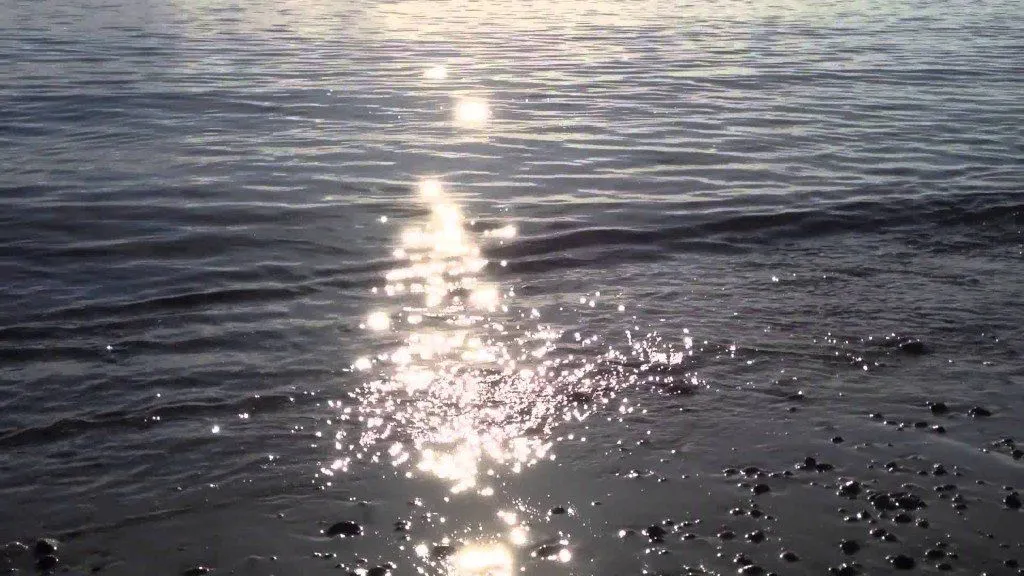
Another interesting thing about these different images of the sun formed on the water’s surface is that they move along with the viewer. This is due to the fact that when sunlight falls on the ocean’s surface, it’s reflected in all directions, but you see the illuminated line due to the light rays that are specifically entering your eyes.
The other reason pertains to the sun’s position in the sky. When it’s high up, light rays fall straight down on the ocean making a large angle with the surface, so there’s no observable glitter. However, when it’s above the horizon, its rays fall on the surface at a very shallow angle, and bounce off at the same small angle to reach the observer’s eyes, who is standing on the beach.

For another example of this effect, think of how a ball bounces on a smooth surface. When you drop it straight down, it bounces back straight up. Yet, when you throw it at an angle, it bounces off the ground away from you. The same thing happens with sun rays when they fall on the water at a shallow angle and bounce off towards the viewer.
This is the basic concept of sun glitter; you won’t see this sparkling phenomenon during most parts of the day, but when it appears, it’s truly a feast for the eyes!
What Happens When Sunlight Hits Water?
Here is the part most people miss: when a ray of sunlight strikes the surface of the sea, it doesn't simply bounce off. The surface acts as a boundary between two transparent media (air and water), and at any such boundary the light splits. Part of it is reflected back into the air, part of it crosses into the water and bends, which we call refraction, and as that transmitted beam travels deeper it is gradually absorbed. So the honest answer to "what happens when the Sun hits the water" is: a little is reflected, most is refracted into the sea, and the rest is soaked up.

How much gets reflected depends almost entirely on the angle at which the light arrives. When the Sun is high and its rays come down nearly straight onto a calm surface, only a tiny fraction bounces back, roughly 2% for water, whose refractive index is about 1.33. The other ~98% slips into the sea, which is exactly why the daytime ocean looks lit from within rather than mirror-bright. But as the Sun drops toward the horizon and the rays graze the surface at a shallow angle, the share that reflects climbs steeply, until near the horizon the water behaves almost like a mirror. That sharp rise in reflection at low angles is the real reason the dazzling glitter path only shows up around sunrise and sunset.
This also settles those tricky multiple-choice questions, the ones that ask whether the Sun's rays are "absorbed, diffracted, reflected, or refracted" by the sea. The honest answer is that they're both reflected and refracted at the surface (and then absorbed below it); the streak you actually see is the reflected portion.
Does The Ocean Reflect The Sky?
Have you ever wondered whether the sea is blue simply because it mirrors a blue sky? It is a tidy-sounding idea, but it's mostly a myth. According to the U.S. National Oceanic and Atmospheric Administration, the ocean is blue chiefly because water itself absorbs the longer, red wavelengths of sunlight and leaves the shorter blue wavelengths to scatter back to our eyes. Pure water has a faint intrinsic blue color, and the deeper the light travels, the more thoroughly the reds are filtered out, which is why a deep, clear sea looks a richer blue than a shallow puddle (we dig into this in detail in why sea water appears blue).
So where does the sky come in? Sky reflection does play a part, but only a supporting one. As physicists point out, you mainly notice the reflected sky when the water is calm and you look across it from a low, grazing angle, the same shallow-angle reflection that gives you sun glitter. Look straight down into clear water from a boat or a pier and the mirrored-sky effect largely vanishes, yet the water still looks blue, proof that the color is coming from the water, not the sky. The Library of Congress lists skylight as just one of several factors, alongside the water's own absorption, its depth, and any suspended particles. In short, the sea reflects some sky, but it would still be blue under a gray one.
Does Water Reflect UV Rays?
Visible sunlight isn't the only thing the sea bounces back. Water also reflects a portion of the Sun's ultraviolet (UV) rays, the invisible, high-energy part of the spectrum that causes sunburn. The exact fraction depends on the Sun's angle and how choppy the surface is, but the practical takeaway is simple: a day on or beside the water exposes you to UV arriving both directly from the sky and reflected up off the surface.
The U.S. Environmental Protection Agency flags this directly, advising people to "use extra caution near water, snow and sand," because all three "reflect the damaging rays of the Sun, which can increase your chance of sunburn." That bounced UV is one reason a long afternoon at the beach or on a boat can burn you faster than the same hours spent in a park, and why a burn can reach places the direct Sun barely touches, like the underside of your chin. The fix is the same advice lifeguards have always given: a broad-spectrum sunscreen, reapplied regularly, plus a hat and UV-blocking sunglasses. And no, slipping under the surface won't save you, because UV penetrates several meters into clear water, so swimmers are exposed too.
References (click to expand)
- Sun glitter - Wikipedia. Wikipedia
- Why does the Sun reflect off water? - How It Works. howitworksdaily.com
- Light and Color - Specular and Diffuse Reflection. Florida State University
- Light - Reflection and refraction. Encyclopaedia Britannica
- Why is the ocean blue? National Ocean Service, NOAA
- Why is the ocean blue? Everyday Mysteries, Library of Congress
- Ultraviolet (UV) Radiation and Sun Exposure. U.S. Environmental Protection Agency