Table of Contents (click to expand)
Batteries sit in a remote for months, and a high-resistance oxidation layer builds up between the contacts and the terminals. A remote draws so little current that it can't push through this film. Smacking it repositions the contacts and scratches off the oxide, lowering the resistance so current flows again.
The other day I was watching a movie at a friend’s place. The movie was quite boring, so I picked up the TV remote and pressed a button to change the channel. To my surprise, it didn’t work. I pressed the button harder, but still, it didn’t respond. Then, like any other run-of-the-mill viewer who faces the same problem, I pressed a lot of other random buttons on the remote, but couldn’t get any of them to work. It was then that my buddy snatched the remote from my hand, smacked it twice on his palm and gave it back to me, saying “Try it now.”
Sure enough, the remote worked!
Although I was aware of this technique for making remote controls work, I can’t help but wonder how this seemingly violent solution helps. How does a faulty remote control (which works on batteries), start working just fine after it’s smacked around a couple of times?
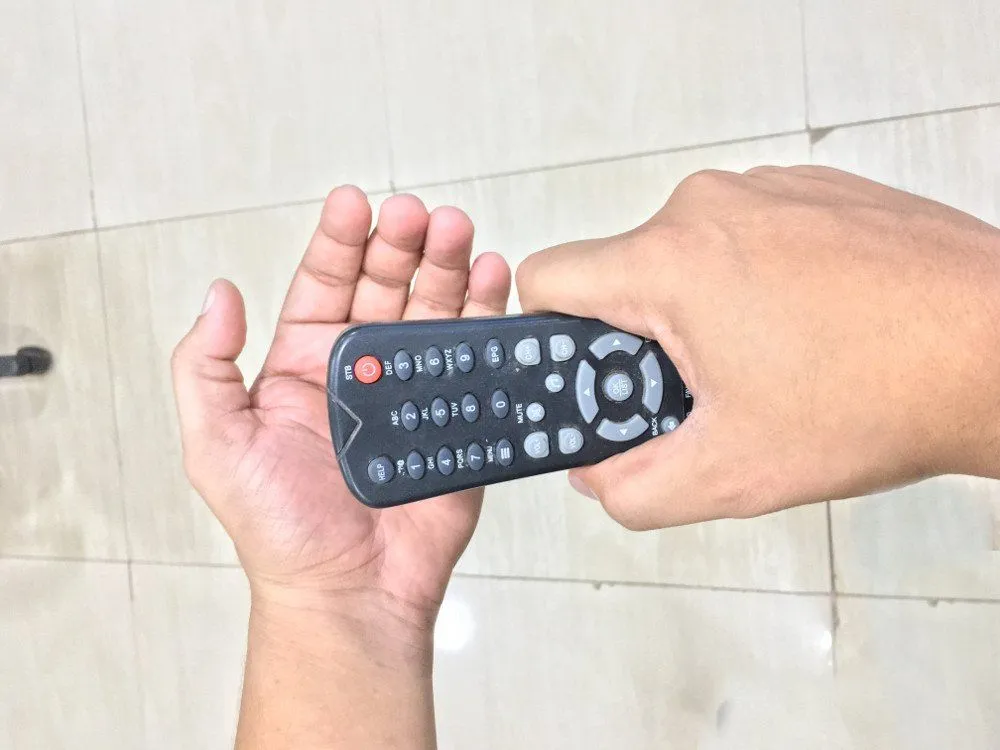
This is actually quite subjective; as in, it cannot be said with absolute certainty that whacking your remote control will make it work every time it stops working. However, it certainly works in some cases. Why does such a crude bashing of a device get it to work?
In order to answer that, it helps if we first understand the root cause of such minor remote control problems.
Formation Of An Oxide Layer
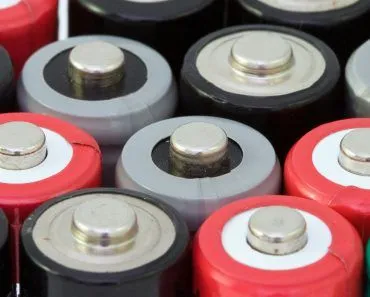
You know that the batteries used in remote controls often sit there for too long, for months or even years on end; it mostly depends on how frequently the remote is used. However, when the batteries sit inside a remote control for too long, an oxidation layer forms between the terminals (springs) and the battery contacts over an extended period of time.
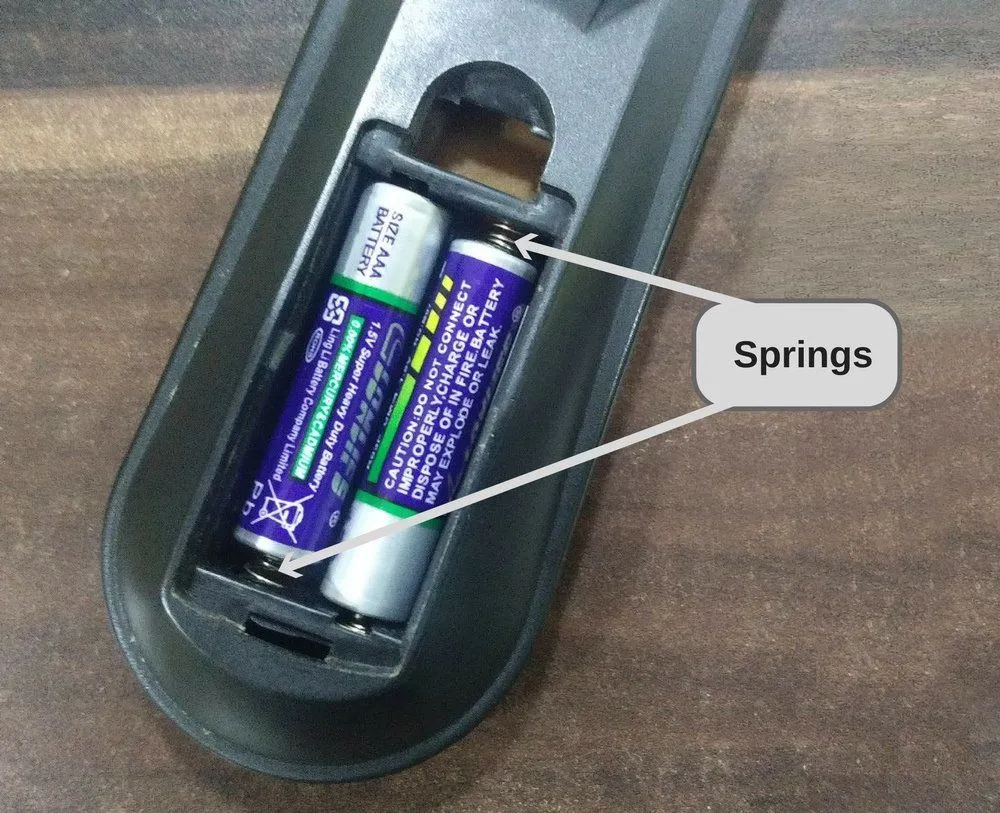
The thing about this oxide layer is that it has a high resistivity, meaning that it strongly opposes the flow of current through it. As a result, there is a significant voltage drop over the oxide layer. Therefore, it hampers the smooth working of the remote.
TV Remotes Do Not Use Much Power
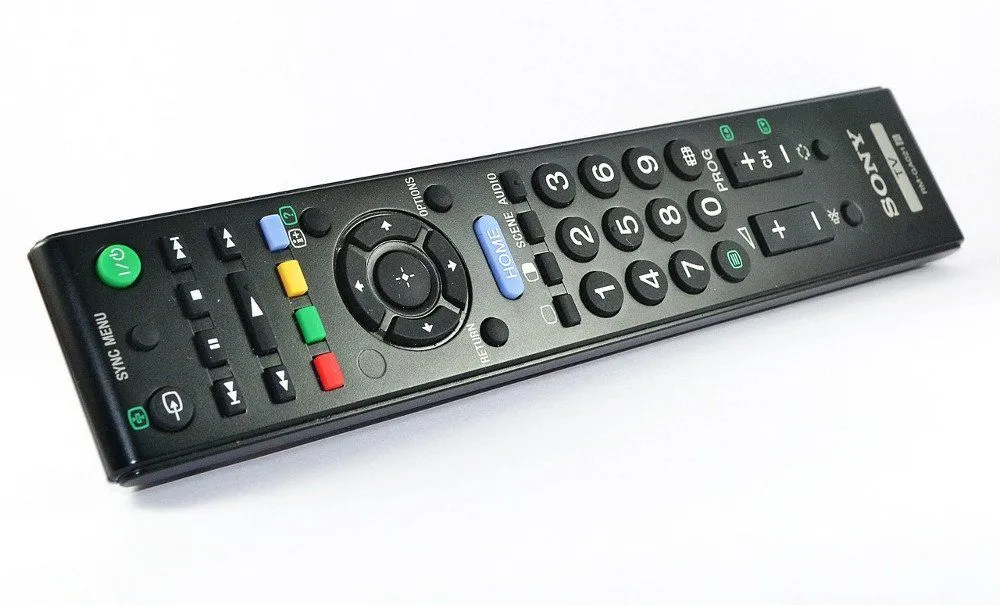
As mentioned earlier, the flow of current through the oxide layer already hampers the flow of current and makes the remote not work (sometimes). Another thing that contributes to this problem is that a TV remote does not use much power. Furthermore, the small amount of power it does use is not applied very often, i.e., the power is used just long enough for a light pulse whenever a button is pressed on the remote.
As such, the small current draw is not able to overcome the oxide layer, so the remote becomes unresponsive.
Wetting Current
Wetting current is the minimum electric current that needs to flow through a contact to break through the surface film resistance. Depending on the application, that threshold typically lands somewhere between a few and several tens of milliamps. In the case of a TV remote, the current draw is far smaller, and it only flows for a brief pulse, so it’s unable to overcome the resistance of the oxide layer.
In a camera, however, the current draw is significantly higher; that’s why it is able to overcome the resistance of the oxide layer.
What Does Whacking The Remote Accomplish?
Slapping the remote does exactly what you might expect: it shakes the insides of the remote… and quite vigorously. In fact, there is a fancy name for this crude whacking of a remote (or any other device that works after taking a ‘beating’) – percussive maintenance.
Percussive Maintenance
Also colloquially referred to as “Ape Mechanics”, “Technical Tap”, “the Fonzarelli Fix” or “Emergency Repair Procedure #1″, percussive maintenance is just a clever way of saying “hitting a machine several times and seeing if that helps.”
People use percussive maintenance not just for malfunctioning remotes, but for scores of other devices too, including toasters, car batteries and even televisions, CPU cabinets, photocopiers etc.

By slapping, whacking or vigorously shaking the remote, you essentially reposition the battery contacts ever so slightly. This may help achieve a better connection between the contacts and the terminals. (Pro tip: you can achieve better contact by rolling the batteries around in their lodgings, or simply taking them out and putting them back in.)
Also, whacking the remote shocks the springs against the battery terminals, which scratches the oxide layer, thereby reducing the resistance (offered by the oxide layer) and making the current flow through it again.
Why Does Rolling The Batteries Make It Work?
If smacking the remote feels too dramatic, there’s a gentler version of the same trick that I like even more: pop the back off and give each battery a quick spin or roll in its slot before snapping it shut. People also swear by simply taking the cells out and putting them straight back in. It looks like superstition, but the science behind it is the same physics we just covered, only applied with a bit more finesse.
Here is what is really happening. The flat ends of the battery don’t press against a smooth plate; they press against a small metal tab or a coiled spring. When you roll or reseat the cell, that contact point drags sideways across the terminal a tiny distance. Engineers actually design connectors to do this on purpose: a patented coiled spring contact is shaped so that, when compressed, it “imparts a lateral sliding motion against the abutting battery terminal that scrapes away a substantial portion of any existing insulating contaminant layer.” That insulating layer is our friend the oxide film. So rolling the battery is really you performing a manual wiping action, mechanically rupturing and scraping off the thin oxide film so the metal underneath can touch metal again and the current can flow.
This also explains a frustration plenty of people have run into: the remote refuses to work even with brand-new batteries. Fresh cells have a full charge, so the problem isn’t the battery at all, it’s the contacts. Over time, micro-movements and humidity drive a process called fretting corrosion on the springs and tabs, and the oxide film that builds up there acts as an insulator that raises the contact resistance regardless of how new your cells are. A quick roll, or a wipe of the springs with a pencil eraser, scrapes that film away and gets things going.
One popular explanation you can safely ignore is that rolling “sloshes the chemicals around” or coaxes a bit more life out of a dying cell. For a sealed modern battery, there is no loose liquid to slosh, and a truly exhausted cell has run out of stored chemical energy that no amount of spinning can restore. The roll trick works on the contact, not on the chemistry inside the can. That is also why it’s only ever a temporary fix: once the oxide creeps back, you’ll be rolling again, and eventually it really is time for new batteries.
References (click to expand)
- What Is Wetting Current? Cadence PCB Design & Analysis.
- Wetting current - Wikipedia. Wikipedia
- percussive maintenance - Wiktionary. Wiktionary
- Conical Coiled Spring Contact for Minimizing Battery-to-Device Contact Resistance. US Patent 6,635,383 (Google Patents).
- Self-Wiping / Self-Cleaning Electrical Contact. US Patent 5,456,621 (Google Patents).
- Fretting Corrosion Explanation (Electrical Connectors and Connections). Newgate Simms.