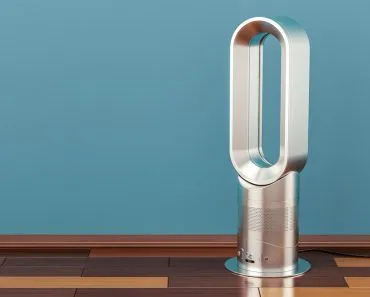
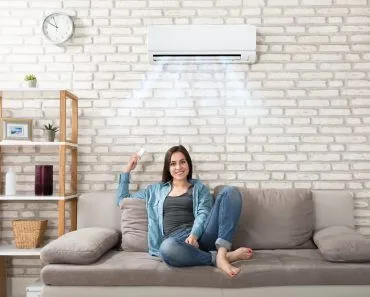
That overhead blast of air at a mall, supermarket, or office entrance is called an air curtain (or air door). It's a downward-facing fan that pushes a high-velocity stream of air across the doorway, creating an invisible barrier that stops outside air, dust, fumes, and flying insects from mixing with the building's conditioned air. The result: lower heating and cooling bills, fewer drafts, and cleaner indoor air, all without needing a physical door to stay shut.
Every large public building, especially those whose doors must remain partially or completely open during operational hours, usually delivers a blast of hot or cold air at its entrance. You feel this blast of rushing air the moment you step inside the building through the doors.
If you’re stepping inside the building after spending hours in the scorching heat outside, the cold air blast hitting your body from above is one of the nicest feelings imaginable!

Similarly, there are also blower fans that blow hot air down from above the entrance.
As pleasant as the blast of cold/warm air feels when entering the building, have you ever wondered what the purpose is behind such air blowers? Are they there just to give the people entering the building a fleeting moment of fulfillment, or do they serve a much bigger, important purpose?
Of course, it’s the latter, but before we get to their real purpose, let’s quickly look at the underlying issue.
The Need For Energy-efficient Buildings
The construction and development of energy-efficient buildings has never been more important than it is today. With a rapidly growing global population and expeditious industrialization, there is unprecedented stress on our limited natural resources – resources that could be used to generate power – and those resources are being exhausted at an alarming rate. It’s obvious and necessary, therefore, that stringent steps should be taken to minimize the stress we place on these limited natural resources. Developing energy-efficient buildings is one of those steps.
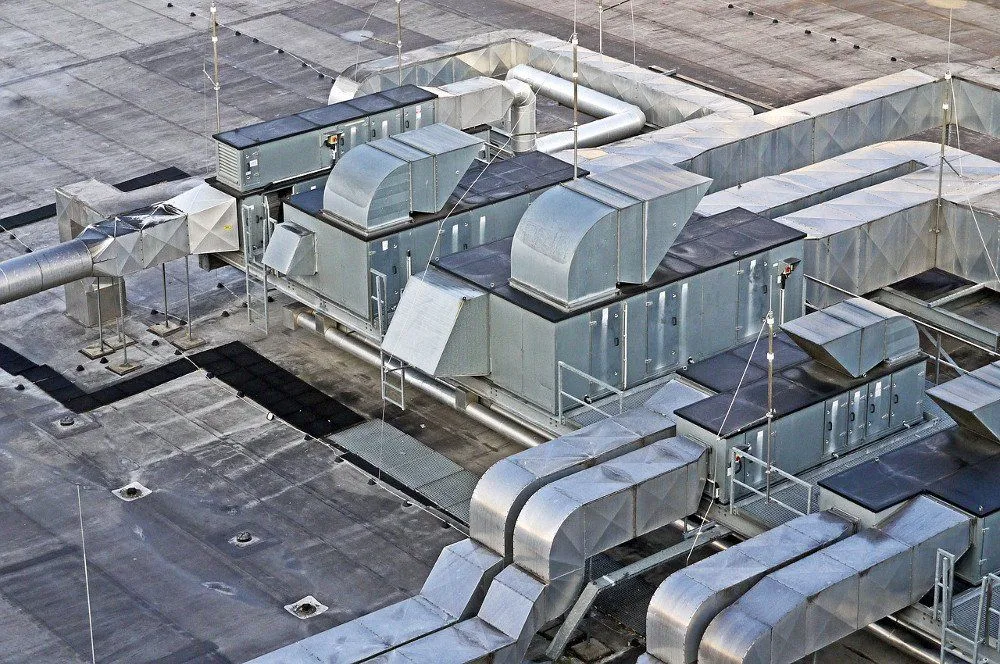
In large buildings and complexes, air conditioning is one of the largest contributors to the building’s total power consumption. Therefore, prior to installing large air-conditioning systems in these buildings, a great deal of effort goes into the analysis of the weather profile of their location. Depending on its design and how the building is going to be used, different parts of the building play smaller or larger roles in the total electricity consumption of the building.
It has been observed that the entrance(s) of these buildings play a significant part in their electricity consumption, especially in buildings that are frequently used, such as supermarkets, shipping centers etc.

It should be noted that the infiltration of outdoor air, i.e., the entry of outdoor air through the entrance and its subsequent mixing with the air inside the building, represents the largest energy loss for some buildings.
Enter air doors!
What Is An Air Door?
An air door, as the name suggests, is a device that prevents air or contaminants from moving from one space to another. According to the American Society of Heating, Refrigerating and Air-Conditioning Engineers (ASHRAE), an air door is defined as “a continuous broad stream of air circulated across a doorway of a conditioned space. The air stream layer moves with a velocity and angle such that any air that tries to penetrate the curtain is entrained.”
Also known as an air curtain, it acts like a barrier for the outside air (and the contaminants it contains), which is why it’s called the air door.
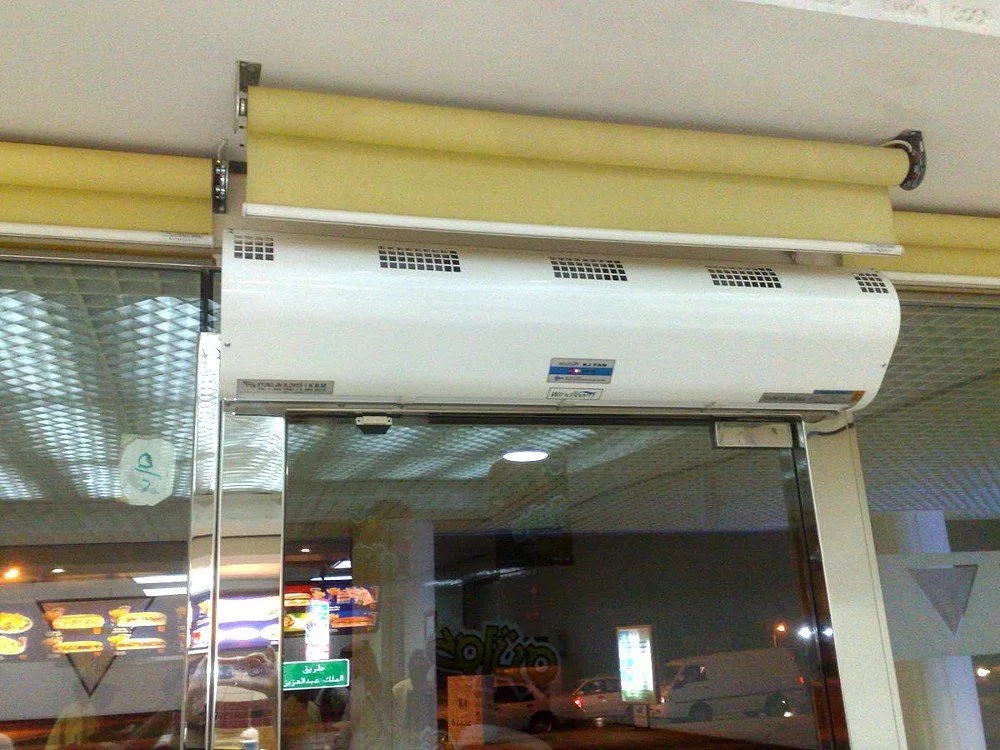
The most common type of air door is a blower fan, usually facing downwards towards the entrance, installed over the entrance of shopping malls, supermarkets, corporate buildings etc.
Note that air doors are not only used over the entrance of the building, but over any opening between two spaces that are conditioned at different temperatures. That’s why you may have noticed that individual shops inside a shopping mall may have blower fans installed in their respective entry points too, so that the ‘mall air’ doesn’t infiltrate into their ‘shop air’.
Advantages Of Air Doors
The primary and the most crucial advantage that an air curtain offers is that it reduces penetration of outside, unconditioned air into a conditioned space by forcing an air stream over the entire entrance.
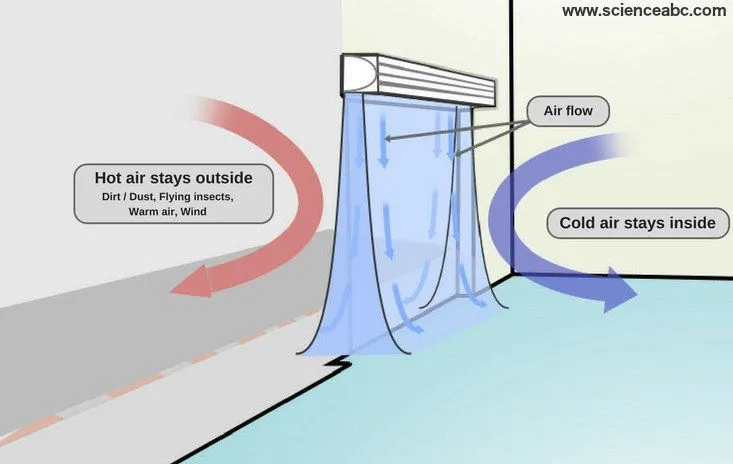
By doing its thing, an air door essentially isolates, to a great extent, the ‘inside climate’ of the building from the outside climate. The effectiveness of an air door, when it comes to preventing infiltration through an entrance, usually ranges from 60% to 80%.
Now you know that the prevention of air filtration through the entrance of a building is mostly related to curbing its electricity consumption. Air doors do a very good job at reducing the electricity bills of these buildings.
However, they do have a couple other advantages too, which have nothing to do with electricity consumption. They also keep dirt and dust from outside from entering the guiding premises. That’s partly why these buildings do not get as dirty as their ‘air door-less’ counterparts. These air barriers can also keep out fumes and unpleasant odors.
Furthermore, air doors also keep numerous bugs from entering the building, thereby indirectly enhancing the comfort of the people inside, at least to some extent.
It’s clear that those ‘feel good’ blower fans at the entrances of malls and supermarkets deserve much more credit than they’re actually given, wouldn’t you say?
Is An Air Curtain The Same As The Air Conditioning?
It's a natural thing to assume, especially when that cool blast hits you on a scorching afternoon, but no, an air curtain is not an air conditioner. The two do completely different jobs. According to the Air Movement and Control Association (AMCA), an air curtain unit is simply an air-moving device, a fan that produces a wide, shallow boundary of air (at least five times wider than it is deep) and isn't connected to any ductwork. It carries no compressor and no refrigerant, so on its own it doesn't cool, heat, or dry the air the way an air conditioner does.

So what is it actually doing? It is guarding the air your air conditioner has already chilled. Every time the doors swing open, the curtain throws up its invisible barrier and stops the cool, treated indoor air from spilling out (and hot outdoor air from rushing in). The real cooling stays with the AC, while the curtain just polices the doorway, so the two work as a team rather than as rivals, and the AC ends up running less to hold the same indoor temperature. And if an entrance ever greets you with a blast of warm air in winter, that's because many units add a heating element (electric, hot water, or steam) to temper the down-stream, turning the same barrier into a cozy buffer against the cold outside.
Do Air Curtains Really Keep Bugs Out?
Surprisingly well, when they're set up correctly. To a fly or a mosquito, that fast-moving sheet of air is a wall it simply can't power through, yet people, shopping trolleys, and forklifts pass underneath without a second thought. It is the same reason the curtain blocks dust and fumes, except here the "particles" have wings.

The numbers are genuinely impressive. In a study run by the US Department of Agriculture's Agricultural Research Service, a pair of air curtains mounted on either side of an airport walkway kept roughly 99% of flying insects (mosquitoes and flies) out of the boarding area, all at an air speed of at least 1 m/s. A review of fly-control research reports a similar pattern indoors: an overhead curtain moving 8 to 9.1 m/s (measured about 91 cm above the floor) shuts out around 80% of house flies, while units mounted vertically on both sides of a doorway can stop 98 to 100% of them at speeds as low as 4 m/s.
That is exactly why you see these blowers over the doors of restaurants, supermarkets, and food-processing plants. In the United States there is even a dedicated standard, NSF/ANSI 37, for air curtains used at food-service entrances, and a unit listed to it counts as a chemical-free, insecticide-free way of keeping flying pests out of a kitchen.
Where Else Are Air Curtains Used?
Once you know what to look for, you start spotting air curtains everywhere, not just at the mall. The rule is simple: wherever two spaces need to stay at different temperatures, humidities, or pressures while an opening has to remain usable, an air curtain is a candidate.

The biggest behind-the-scenes job is cold storage. Walk-in coolers, freezer rooms, and refrigerated warehouses leak a lot of cold every time a door opens, and the warm, moist air that pours in dumps frost onto the evaporator coils. AMCA notes that an air curtain over the doorway curbs that exchange, which means less frost build-up, fewer energy-hungry defrost cycles, and a lighter load on the refrigeration plant. You'll also find them over loading-dock doors, in food-prep areas, at drive-through and service windows, and in hospitals and clean rooms, where the aim is to stop airborne contaminants from drifting from one zone into another. Smaller over-door units are even sold for homes (think a patio door, or the gap between a garage and a living space), though they remain far more common in commercial buildings than in houses.
References (click to expand)
- N KARLSSON. Air Infiltration through Building Entrances. Chalmers University of Technology
- Open Refrigerator | Physics Van | UIUC. The University of Illinois Urbana-Champaign
- Giráldez, H., Pérez Segarra, C. D., Rodríguez, I., & Oliva, A. (2013, November). Improved semi-analytical method for air curtains prediction. Energy and Buildings. Elsevier BV.
- Younes, C., Shdid, C. A., & Bitsuamlak, G. (2011, October 24). Air infiltration through building envelopes: A review. Journal of Building Physics. SAGE Publications.
- R Upham. Air Leakage Through Automatic Doors - AIVC. Air Infiltration and Ventilation Centre
- Air Curtain Blocks Unwanted Insect Pests From Airplanes. USDA Agricultural Research Service.
- A Review of Alternative Controls for House Flies. NCBI PMC.
- Optimizing Cold-Storage Environments with Air Curtains. AMCA International.
- AMCA Publication 222-16: Application Manual for Air Curtain Units. AMCA International.