Table of Contents (click to expand)
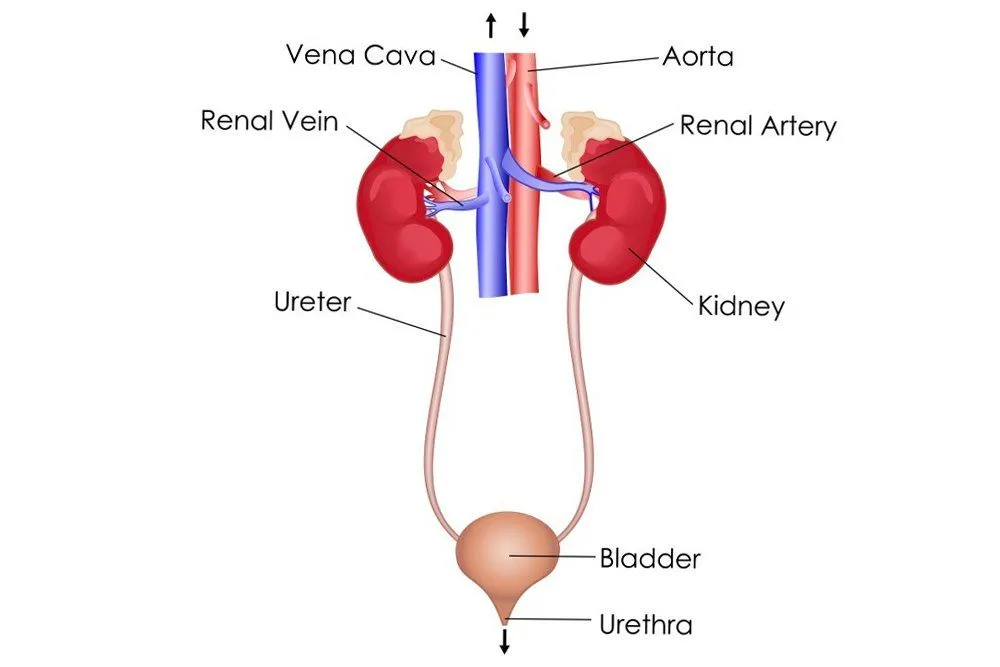
The human excretory (urinary) system removes nitrogenous waste, excess water and electrolytes from the body as urine. Its main organs are the kidneys, where about one million nephrons per kidney filter the blood; the ureters, which carry urine to the bladder; the urinary bladder, which stores it; and the urethra, which expels it. The kidneys filter roughly 180 litres of blood a day, producing 1–2 litres of urine.
Excretion is one of the most necessary and unavoidable processes for most living beings. We need to regulate the items we put into our body by regularly eliminating them, along with waste products, excess substances, water, etc. Most often, people include defecation and urination as part of the excretory system. However, defecating is usually studied under the digestive system, while urination is studied under the excretory system. Therefore, the excretory system can also be studied as the urinary system.
Kidney
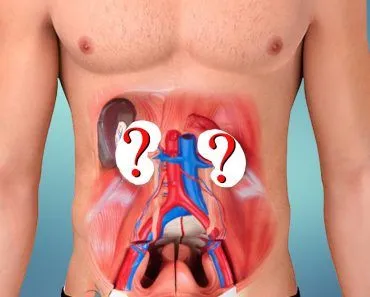
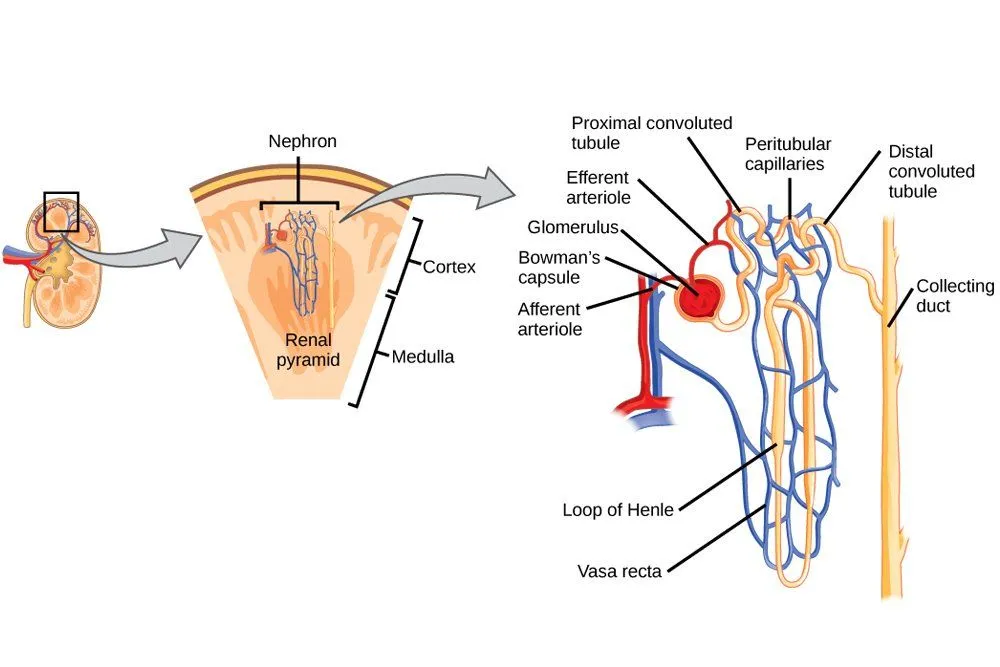
Our kidneys are the organs responsible for the production of urine. We have a pair of kidneys located in our abdomen. The right kidney is slightly lower than the left one, so as to accommodate the liver. The kidneys can structurally be divided into 2 regions – an outer cortex and an inner medulla. The cortex is lighter in color than the medulla. The basic functional unit of the kidneys are the nephrons. Each kidney has over one million nephrons, which carry out the process of forming urine.
Nephrons
Production of urine in the nephrons occurs due to the close functioning of the nephrons and the renal blood vessels. The blood enters through the renal artery, which divides to form arterioles. This forms an extensive network known as the glomerulus, which fits in a part of the nephron known as the Bowman’s Capsule. The width of the afferent arterioles – which bring blood to the Bowman’s Capsule – is wider than the efferent arterioles – which take the blood away. This causes a pressure gradient, thus forcing water through the semi-permeable membrane of the Bowman’s Capsule. This process is known as ultrafiltration. The filtered water is known as the glomerular filtrate.
The Bowman’s Capsule then leads down a tubule known as the proximal convoluted tubule (PCT), followed by the Loop of Henle, and then the distal convoluted tubule (DCT). These 3 parts of the nephron are responsible for the reabsorption of water and other salts back into the blood. This is controlled by the amount of water in the blood stream and by the endocrine system. Hormones like ADH (anti-diuretic hormone, also called vasopressin), which is a peptide hormone secreted by the posterior pituitary rather than an enzyme, control how much water gets reabsorbed back into the bloodstream.
DCT leads to the collecting ducts, which collect all the urine. No reabsorption of substances takes place here, as they merely facilitate the transfer of the formed urine. Most parts of the nephrons are located in the cortex, while the Loop of Henle descends into the medulla before entering the cortex once again.
Excretion
The collecting ducts eventually empty into a vessel that forms the ureter. This exits the kidney from a point known as the hilum. The ureters carry the urine formed to the urinary bladder, which is a sac-like structure used for the storage of urine. This leads to the urethra, which is the tube connecting the bladder to the external environment of the body.
Sphincter muscles are ring-shaped muscles located at the junction of the bladder and the urethra. These give us control over our micturating (the act of expelling urine)
It is important to keep in mind that the nephrons don’t just reabsorb substances; they also secrete molecules into the urine. Many drugs and metabolites (H+, K+, ammonia, certain medications) are actively secreted from the blood into the tubule, which is why drug tests work. Diabetes can be detected by checking a urine sample, but for a slightly different reason: when blood glucose climbs above the renal reabsorption threshold (around 180 mg/dL), the nephrons can no longer mop up all the filtered glucose, and the leftover sugar spills into the urine, a condition called glucosuria.
What Organs Make Up The Excretory System?
When most people picture the excretory system, they think of the kidneys and the plumbing that follows: the two kidneys that filter the blood, the ureters that carry urine down to the bladder, and the urethra that finally empties it out. That urinary tract is the core of the system, and it is what does the heavy lifting of removing nitrogenous waste and balancing water and salts.

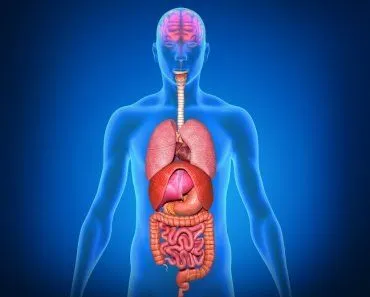
But the kidneys are not the only organs that take out the trash. Excretion simply means getting rid of metabolic waste, and several other organs quietly do their share. The lungs are excretory organs too: every time you breathe out, you expel carbon dioxide, the gaseous waste produced by cells throughout the body. The skin excretes as well, since sweat carries away excess water and salts along with a small amount of urea. And the liver acts as the body's chemical processing plant, converting the toxic ammonia left over from protein breakdown into urea (which the kidneys then excrete) and passing bilirubin, a waste product from worn-out red blood cells, into bile.
So the excretory system is best thought of as a team. The kidneys handle dissolved waste in liquid form, the lungs handle gaseous waste, the skin offers a minor backup route, and the liver prepares many wastes for disposal before they ever reach the kidneys.
How Does The Excretory System Work With Other Body Systems?
No organ system in the body works alone, and the excretory system is one of the most connected of all. It cannot filter a single drop of waste without help from its neighbors, and in return it keeps the rest of the body running cleanly.
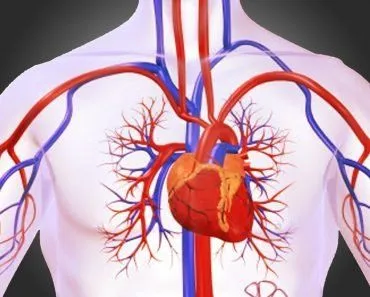
Its closest partner is the circulatory system. The kidneys can only clean the blood that the heart pumps to them, and they receive a remarkably large share of it. An average adult's kidneys filter roughly 180 litres (about 48 gallons) of fluid from the blood every day, reclaiming almost all of it and passing only 1 to 2 litres out as urine. In doing so, the kidneys also adjust the volume and salt content of the blood, which is one of the main ways the body controls long-term blood pressure.
The excretory system also teams up with the respiratory system to keep the blood from turning too acidic or too alkaline. The lungs control the level of carbon dioxide (and therefore carbonic acid) by changing how fast and deep you breathe, a correction that happens within minutes to hours. The kidneys handle the slower half of the job, reabsorbing bicarbonate and secreting hydrogen ions into the urine over hours to days. Working together, the lungs and kidneys hold blood pH within a narrow, life-sustaining range.
Finally, the excretory system leans on the digestive system and, in particular, the liver. When the body breaks down protein from food, it produces ammonia, which is highly toxic. The liver converts that ammonia into far safer urea, and only then can the kidneys filter it out and flush it away. This constant cooperation between organ systems is a textbook example of homeostasis, the body's drive to keep its internal conditions stable.
References (click to expand)
- THE EXCRETORY SYSTEM - www2.estrellamountain.edu
- http://web.archive.org/web/20210928203528/http://www.auburn.edu/academic/classes/zy/hist0509/html/Lec14Excretorysystem.html
- Excretory system.
- Excretory system.
- Physiology, Osmoregulation and Excretion. StatPearls. NCBI Bookshelf.
- Physiology, Acid Base Balance. StatPearls. NCBI Bookshelf.
- Organs of Excretion. Human Biology. Thompson Rivers University (Pressbooks).