Yes, the Six Degrees of Separation theory says that any two people on the planet are connected by a chain of about six acquaintances. Stanley Milgram's 1967 small-world experiment found a median of around 5.5 intermediaries, and Meta's 2016 analysis of Facebook friendships pegged the average at just 3.57. So Barack Obama probably sits closer to you than you think.
The world is a pretty big place, but the number of humans that populate it seems even bigger. Right now, there are roughly 7.1 billion people living on Earth, going to work, watching TV, cooking dinner, and who knows what else. It’s perfectly natural to feel disconnected from the lives of different people whom you know nothing about. Psychologically, humans have a tendency to live in their own little bubbles, often represented by families or communities. However, the fact that each human has an individual bubble that occasionally intersects with another individual’s bubble is what unites everyone on the planet.
What Is The Idea Behind ‘Six Degrees Of Separation’?
The Six Degrees of Separation is a theory that each and every person on this planet is connected to everyone else, by way of introduction or familiarity, like a chain of ‘friend of a friend’ within a maximum of six steps. In other words, the theory posits that you know every individual on Earth by a maximum of six jumps in a friendship chain. You might be friends with a friend of a friend of Barack Obama, Johnny Depp, or even a Cambodian pirate. The idea was first introduced in 1929 by Frigyes Karinthy, a Hungarian writer, in a short story originally titled Láncszemek (“Chain-Links” in English). Interestingly, Karinthy actually proposed connecting any two people through no more than five intermediaries. The popular “six degrees” framing came much later, after Stanley Milgram’s 1967 experiment and John Guare’s 1990 play.

Plausibility
Is The World Shrinking?
Due to technological advances in communication and travel, friendship networks can now grow much larger and span greater distances. Even if more habitable environments are discovered, due to easier communication, social distances are being decreased. This idea influenced a great deal of early thought on social networking websites, with the searches being inexplicably easier for this very reason.
Is The World ‘Small’ To Begin With?

If you just take a look at the numbers, the six degrees of separation idea seems pretty plausible. Assuming that everyone knows at least 44 people, and that each of those people knows an entirely new 44 people, and so on, the math shows that in just six steps, everyone could be connected to 44^6, or about 7.26 billion people, more than are alive on Earth today. That being said, this assumption is slightly inaccurate, because most people share many of the same friends, so another individual’s 44 contacts won’t all be unique.
The famous empirical test came in 1967, when Harvard psychologist Stanley Milgram ran his “small-world experiment.” Milgram mailed packets to randomly chosen people in Omaha, Nebraska and Wichita, Kansas, with instructions to forward them by hand to a stockbroker target in Boston, but only through someone they knew personally on a first-name basis. Of the 296 starting letters in the main study, 64 chains completed, with a median of about 5.5 intermediaries. That number, rounded up to six, is the origin of the phrase “six degrees of separation.”
The math behind the small-world idea had been worked out earlier, by political scientist Ithiel de Sola Pool (MIT) and mathematician Manfred Kochen. Their paper Contacts and Influences circulated in manuscript from the late 1950s but was finally published in Social Networks in 1978. They concluded that in a U.S.-sized population without social-structure barriers, almost any two people could be connected through just two intermediaries; once you add real-world clustering by class, geography, and profession, the number rises.
The first large-scale Internet replication came in 2003, when sociologist Duncan Watts and colleagues at Columbia University ran an email-forwarding experiment published in Science. About 61,168 participants from 166 countries started 24,163 chains aimed at 18 targets in 13 countries. Only 384 chains completed (a brutal 1.6% finish rate, mostly due to attrition), but the median completed chain was 5 to 7 steps, broadly consistent with Milgram.
An early example of a social networking site was SixDegrees.com (launched in 1997), which at its peak had about 3.5 million registered members. It let users list friends, family members and acquaintances, send messages, and see their connection to any other user up to three degrees away. Since then, Facebook has done the same thing at planetary scale. Meta’s own 2016 analysis of 1.59 billion users found that the average pair of Facebook users is separated by just 3.57 intermediaries, not six. LinkedIn similarly displays your network out to 3 degrees by default. In the era of social media, the chain is closer to three or four than to six.
What Is The “Seven People Theory”?
If you spend any time on social media, you have probably bumped into the “seven people theory,” sometimes written as the “7 person theory”: the claim that you are only about seven people away from being introduced to anyone on Earth, from a farmer in Mongolia to the President of the United States. It looks like a rival to six degrees of separation, but it is really the same idea wearing a slightly different number. (It should not be confused with the unrelated “seven friends theory,” a separate social-media trend about the different roles friends are supposed to play in your life.)

So why seven and not six? The original “six” was tuned for a country-sized population. The classic back-of-the-envelope version goes like this: if every person knows roughly 30 others, and each of those people knows 30 more, then repeating that step six times reaches a population the size of the United States. Stretch the same chain to cover the whole planet and you need about one extra step. Run the numbers on the global population and the average chain length lands closer to seven than to six. That single extra link is exactly where the viral “seven” comes from.
The empirical work backs this up. When Duncan Watts and his colleagues ran their worldwide email experiment in 2003, the chains that actually reached their target took a median of roughly five to seven steps. So whether you call it six degrees or seven people, the headline is the same: in a world of eight billion strangers, the path between any two of us is astonishingly short.
Criticisms Of The Theory
Despite all the empirical work, the theory is not universally accepted. The bigger problem is that not everyone on Earth is actually plugged into the global network. Several uncontacted or recently contacted indigenous communities are effectively isolated from the rest of humanity. For them, the chain doesn’t exist at all.
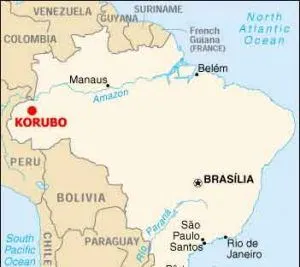
The Korubo are an Indigenous people living in the lower Javari Valley (Vale do Javari) of the western Amazon Basin in Brazil. The total Korubo population is estimated at a few hundred, and a contacted splinter group of roughly 30 people was first reached by FUNAI in 1996. The remainder are uncontacted by choice. As long as that isolation persists, there is no friendship chain (short or long) that links them to, say, an engineer in Dubai.
In popular culture, the game “Six Degrees of Kevin Bacon” was invented as a playful spin on the concept. The aim is to find the shortest chain of co-stars linking any actor back to Kevin Bacon. The Oracle of Bacon at the University of Virginia (oracleofbacon.org) computes these on demand. Even non-actors can be ranked: Barack Obama, for instance, has a Bacon number of 2 (through his cameos and documentary appearances). Google used to surface the number directly when you typed “bacon number [name]” into its search box.

Mathematicians built a similar number for their own field, the Erdős number, named for the famously prolific Hungarian mathematician Paul Erdős. The rules are simple: Erdős himself has an Erdős number of 0. Anyone who co-authored a paper directly with him has an Erdős number of 1. Anyone who co-authored with one of his collaborators (but not with Erdős himself) has an Erdős number of 2, and so on. Most active mathematicians end up with an Erdős number of 5 or less.

American playwright John Guare wrote a play in 1990 popularizing the concept of six degrees of separation. Although romanticized, it is his most widely known work and he is believed to have brought this concept to a much broader audience. He finds it comforting that everyone is so close to us, but at the same time, discomforting that we have to find the right six people in order to be close to someone else.
Is Everyone On Earth Actually Related?
Six degrees of separation is about who you know. A stranger question is who you are related to by blood. Here the arithmetic is blunt. You have 2 parents, 4 grandparents, 8 great-grandparents, and the count doubles every generation as you go back. After about 40 generations (roughly a thousand years) that doubling demands more ancestor “slots” than the total number of humans who have ever lived. The only way to fill them is for the same people to appear in your family tree over and over, and for your tree to overlap heavily with everyone else’s. Genealogists call this pedigree collapse, and it means that, given enough time, we must all share ancestors.

Just how recently did those shared ancestors live? In a 2004 paper in Nature, Douglas Rohde, Steve Olson and Joseph Chang modelled the world’s genealogy and reached a startling conclusion. The most recent common ancestor of everyone alive today, a single person from whom every living human descends, probably lived just a few thousand years ago. Their model placed this individual around 1,500 BC, most likely somewhere in eastern Asia.
Go back a little further and it gets even more dramatic. The team also found an identical ancestors point: a moment, around 5,400 BC in their model, before which every person then alive falls into one of two camps. Either they left no descendants at all, or they are an ancestor of every single human on Earth today. Beyond that line, all eight billion of us share exactly the same set of ancestors. These dates assume a fair amount of migration and intermarriage between regions, and long-isolated groups push them deeper into the past, but the conclusion holds: at the genealogical level, the human family is far smaller, and far more recent, than it feels. (For the much deeper story of where we all came from, see our timeline of human evolution.)
References (click to expand)
- Six degrees of separation. Wikipedia.
- Small-world experiment (Milgram 1967). Wikipedia.
- Dodds, Muhamad, Watts (2003). An Experimental Study of Search in Global Social Networks. Science.
- Three and a half degrees of separation. Meta Research.
- Erdős number. Wikipedia.
- Proof! Just six degrees of separation between us. The Guardian.
- Rohde, Olson, Chang (2004). Modelling the recent common ancestry of all living humans. Nature.
- Human populations are tightly interwoven. Nature News (2004).
- Identical ancestors point. Wikipedia.