Decision fatigue is the popular idea that making lots of choices gradually wears down your willpower. The everyday feeling is real and familiar, but its lab foundation is shaky: the underlying “ego depletion” effect failed to appear in large preregistered studies spanning dozens of labs. Most researchers now treat it as unproven rather than settled science.
Do you know what Mark Zuckerberg, Barack Obama, Angela Merkel and Christopher Nolan all have in common? They are all famous for wearing more or less the same kind of outfit every day. Albert Einstein is said to have leaned on a row of near-identical grey suits for the same reason. What’s with high achievers and their deliberately limited clothing choices?
When asked about why they do it, many successful people cite a phenomenon called decision fatigue. So, what is decision fatigue and how can we overcome it? Will wearing the same thing every day do the trick? Or is there a deeper psychological element at work here?
Let’s find out!
What Is Decision Fatigue?
Like it or not, decision-making is a part and parcel of our everyday lives. From the moment we wake up, we deal with an endless stream of choices (when to get up, what to eat, what to wear, and so on), most of which we barely notice. You may have seen the eye-catching claim that we make around 35,000 decisions a day. It is worth knowing up front that this oft-repeated figure has no solid research behind it. It seems to have spread from a magazine line rather than an actual count, so treat it as a vivid illustration, not a measured fact.
So, what happens when making decisions stresses us out? Does our brain really get overwhelmed when it is forced to deal with too many choices?

To clarify… imagine yourself in these situations.
- You enter a store, add items to your cart, but suddenly feel so overwhelmed by the large number of options displayed all around you that you leave without finishing your shopping.
- You’re feeling worn out and cranky after a hectic day at work. Then you find yourself snapping at a family member or friend without any good reason when they ask where you want to eat that night.
- You spend a night tossing and turning in bed trying to make up your mind about your relationship, career or some other pressing issue.
Do any of these examples sound familiar? If so, you may have run into what people call decision fatigue.
Decision fatigue is the idea that the mind becomes worn out after making too many decisions in a short span of time, leaving later choices feeling harder or more careless.
What Causes Decision Fatigue?
It is a no-brainer that when we are presented with too many options, we have moments of feeling overwhelmed, stressed out, weary and almost queasy, unable to think. It’s sort of like the physical fatigue you’d experience after a long workout session at the gym, except the tiredness starts in your mind, not your muscles.
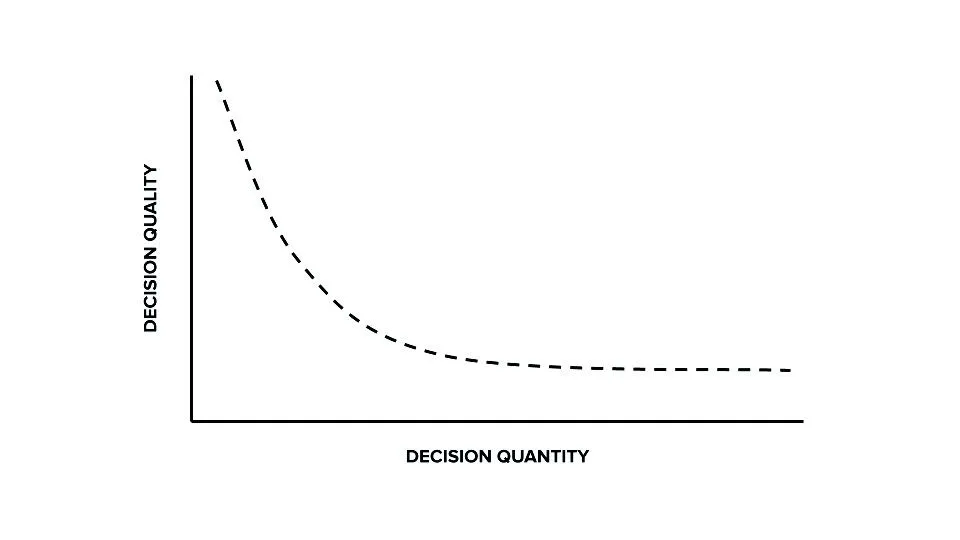
In this state, one may feel tired, have “brain fog”, become easily irritable, and may even experience other signs of physical or mental exhaustion.
Where does the idea come from? Social psychologist Roy F. Baumeister coined the related term ego depletion in the late 1990s, the notion that self-control draws on a limited inner reserve. The phrase “decision fatigue” itself was popularized later, in a widely read 2011 New York Times Magazine piece by John Tierney, drawn from the book Willpower that Tierney wrote with Baumeister.
Baumeister borrowed the word “ego” loosely from Freud, not in the everyday sense of having too much pride, but as the part of the mind that manages willpower and links our conscious and unconscious impulses. Decision fatigue is treated as one everyday symptom of ego depletion.
So, what is the ego depletion theory of willpower? The idea is that we have a limited amount of mental energy (see: willpower and self-control) that can decrease over time.
For example, imagine that you have healthy meals for breakfast and lunch. You also exert enough self-control to say no to donuts at work and the french fries a friend offers you. Then, at the end of the day, you can’t help letting loose and find yourself binging on a pile of unhealthy snacks and beverages.
Why does it happen? By going against those little indulgences all day long, you have spent all your available willpower (the limited mental strength you had). Now, you have arrived at a state of ego depletion, where you can easily lose self-control.
Decision fatigue is therefore a psychological concept that has gathered a lot of steam since the early 2000s. The question is… is it real?
To find that answer, we must understand whether we have been thinking about willpower and self-control in the right way.
Ego Depletion Research: Are We In A Pickle?
Most modern psychiatrists disagree with Sigmund Freud on many concepts, and the same applies to decision fatigue, a theory based on Freud’s psychoanalytic understanding of the human mind.
Here is where things get awkward for the theory. Early ego-depletion experiments looked convincing, but they have not held up well under stricter testing. In 2016, a multilab replication led by Martin Hagger pooled 23 laboratories and more than 2,100 participants, and the depletion effect essentially vanished, with an average effect statistically indistinguishable from zero. A second large preregistered project in 2021 (36 labs, over 3,500 people) reached the same flat result. This is part of the broader “replication crisis” in psychology, the uncomfortable discovery that many celebrated findings do not reappear when independent teams repeat the experiment carefully.
To complicate matters further, whether you show the effect at all may depend on what you already believe. Cross-cultural work has even reported reverse ego depletion, where a demanding mental task leaves people more energized for the next one rather than drained. In one study, participants who took for granted that willpower is limited tended to fade after hard tasks, while those from cultural backgrounds that treat effort as invigorating did not.

That belief angle has been pinned down directly. In a now-classic 2010 study by Veronika Job, Carol Dweck and Gregory Walton, people who endorsed the “willpower is a limited resource” view ran out of steam after an effortful task, while those who saw willpower as renewable did not. In other words, part of the effect may live in your expectations rather than in some literal fuel gauge in the brain.
So is decision fatigue a myth? Probably not entirely. There is more to the story…
Reaching The Final Verdict… Let’s Wait Until Lunch?
If the lab evidence is so wobbly, why does decision fatigue feel so convincing? Part of the answer is a single, much-quoted study, and it is worth looking at honestly.
The famous example comes from the courtroom. A 2011 analysis of roughly 1,100 Israeli parole rulings by Shai Danziger and colleagues reported that judges granted parole around 65% of the time at the start of a session and right after a food break, with the rate sliding toward zero just before each break. The tidy story was that tired, hungry judges retreat to the safe “no.”
It is a great story, but it has taken a real beating. Critics pointed out that cases were not heard in random order: unrepresented prisoners, who are less likely to win parole for unrelated reasons, tended to be scheduled last in each block. A 2016 simulation by Andreas Glöckner went further, showing that ordinary scheduling quirks could mimic the pattern, and that an effect this large is frankly implausible. As one critic put it, if hunger really swung our judgment that hard, society would tip into chaos every day around 11:45 a.m. So treat the hungry-judge study as a vivid illustration, not as proof.

None of this means that mental tiredness is imaginary. Decision fatigue (the specific willpower-as-fuel idea) is shaky, but plain cognitive fatigue is on firmer ground. A 2022 neuroimaging study in Current Biology found that a long, demanding day of mental work was linked to a build-up of glutamate (a signaling molecule) in the lateral prefrontal cortex, a region central to self-control and decision-making. The authors suggest the brain may push us toward easier, more impulsive choices late in the day partly to limit that build-up. That is a real, measurable reason your judgment can feel duller after hours of hard thinking.
Other Effects Of Decision Fatigue
When shopping, have you ever wondered why candy, soda and other junk food is usually placed by the checkout counter?
By the time we reach the end of the store aisle, we have already gone through the tiring process of weighing all the options (the dizzying range of prices, offers). Thus, we end up tossing a few unhealthy items into the cart and give in to impulse purchasing.
The other way people may react to decision fatigue is decision avoidance. When we have too many options to choose from, it is hard to make up our mind, so we end up choosing nothing. This experience is referred to as choice paralysis or decision paralysis. Retailers know that this is a key reason why people sometimes abandon their shopping carts in the middle of a store.
These everyday patterns are why decision fatigue resonates so widely, even though, as we have seen, the lab science behind it is far from settled. The feeling is familiar; the tidy “limited willpower” explanation is the part scientists still argue about.
A Final Word
So, what should you do when you’re tired of making decisions?
As the popular story goes, Einstein favored a closet of near-identical gray suits so he would not, in the spirit of the famous line, waste any brainpower in the mornings deciding what to wear. Whether or not the quote is word-for-word accurate, the instinct behind it is sound: cut down the trivial choices so the important ones get your best attention.
Whether decision fatigue exists or not, it all boils down to this equation:
Having fewer choices = less time and energy wasted = a simplified life!
The best way to achieve this is to stick to a routine of regular tasks. That way, your brain doesn’t have to sweat those little, mundane decisions every day. While shopping or doing any kind of cognitively demanding activities, try to make a list, and cross things off as you go. This will reduce decision fatigue and help you make choices more rationally, fairly, and objectively… not to mention the dopamine burst every time you tick off a box!
References (click to expand)
- Pignatiello, G. A., Martin, R. J., & Hickman, R. L., Jr. (2018, March 23). Decision fatigue: A conceptual analysis. Journal of Health Psychology. SAGE Publications.
- Englert, C., & Bertrams, A. (2021, May 6). Again, No Evidence for or Against the Existence of Ego Depletion: Opinion on “A Multi-Site Preregistered Paradigmatic Test of the Ego Depletion Effect”. Frontiers in Human Neuroscience. Frontiers Media SA.
- Savani, K., & Job, V. (2017, October). Reverse ego-depletion: Acts of self-control can improve subsequent performance in Indian cultural contexts. Journal of Personality and Social Psychology. American Psychological Association (APA).
- Job, V., Dweck, C. S., & Walton, G. M. (2010, September 28). Ego Depletion—Is It All in Your Head?. Psychological Science. SAGE Publications.
- Wiehler, A., Branzoli, F., Adanyeguh, I., Mochel, F., & Pessiglione, M. (2022, August). A neuro-metabolic account of why daylong cognitive work alters the control of economic decisions. Current Biology. Elsevier BV.
- Hagger, M. S., Chatzisarantis, N. L. D., et al. (2016). A Multilab Preregistered Replication of the Ego-Depletion Effect. Perspectives on Psychological Science. SAGE Publications.
- Vohs, K. D., Schmeichel, B. J., et al. (2021). A Multisite Preregistered Paradigmatic Test of the Ego-Depletion Effect. Psychological Science. SAGE Publications.
- Danziger, S., Levav, J., & Avnaim-Pesso, L. (2011). Extraneous factors in judicial decisions. Proceedings of the National Academy of Sciences (PNAS).
- Glöckner, A. (2016). The irrational hungry judge effect revisited: Simulations reveal that the magnitude of the effect is overestimated. Judgment and Decision Making. Cambridge University Press.