Table of Contents (click to expand)
In Marvel canon, the Hulk’s pants stay on because they are not made of ordinary fabric. They are stitched from “unstable molecules”, a fictional Marvel material first introduced by Reed Richards (Mr. Fantastic) of the Fantastic Four. Stan Lee himself said, only half-joking, that Bruce Banner is a friend of Reed Richards and was given a pair of his stretchy trousers, which is why they expand with the Hulk instead of shredding off like the rest of his clothes.
If you briefly shift your attention away from the blitzkrieg and high-octane action scenes of superhero movies, you might observe a number of quirky little things that escape people’s attention at first glance. Take the Hulk, for example; every follower of Marvel’s superheroes knows about the Hulk and the colossal physical damage his unrestrained rage can bring about.
That being said, even for a superhero like the Hulk, with all his incredible abilities, there’s one rather unusual thing.
Has the question ever popped into your head of why the Hulk’s pants manage to stay on, even when all the other articles of clothing on his body shred to pieces when he transforms?
How Did Bruce Banner Become The Hulk?
Bruce Banner (name of the ‘human’ form of the Hulk) was supervising the trial of an experimental gamma bomb that was designed for the U.S. Defense Department at a nuclear research facility. At the last moment, however, a teenager unwittingly wandered into the testing field. Although Bruce successfully shoved him away to safety at the last instant, he could not save himself and was struck by a full-force gamma blast. He survived the blast, but was irretrievably irradiated by gamma rays. And thus, the Marvel universe got another superhero in Dr. Bruce Banner: The Incredible Hulk!

Bruce assumes the form of the Hulk whenever he becomes too excited, agitated, or angry, due to the sudden rush of adrenaline. As Bruce transforms to become the Hulk, he becomes immensely strong; far stronger, bigger and bulkier than any ‘normal’ human being.
Even after taking a lot of precautions, Bruce occasionally loses control and becomes the Hulk without actively wanting to do so. In such situations, he has to deal with a rather important issue. Unlike other things that the Hulk has to take care of when he transforms, this one does not pertain to his enemies; instead, it deals with an embarrassing wardrobe malfunction. Since he can’t always control himself and automatically becomes the Hulk at times, he ensures that the pants he wears are made to deal with the rapid size shift.
What’s The Deal With The Hulk’s Pants?
Even when all of Bruce Banner’s other articles of clothing, including his shirt, socks, shoes are torn to pieces upon his transformation into the Hulk, his rather unusual pair of pants manages to stay on. Why is that?

In the Marvel comics, it is suggested that the Hulk’s pants are made of special material, and it has been hinted that Hulk’s pants are made out an incredible fabric made of ‘unstable molecules’. This fabric contracts and expands along with the shape of its wearer. Unstable molecules, in the Marvel universe, are molecules that fall apart upon experiencing enormous force and subsequently ‘stretch’ the fabric to accommodate the wearer.
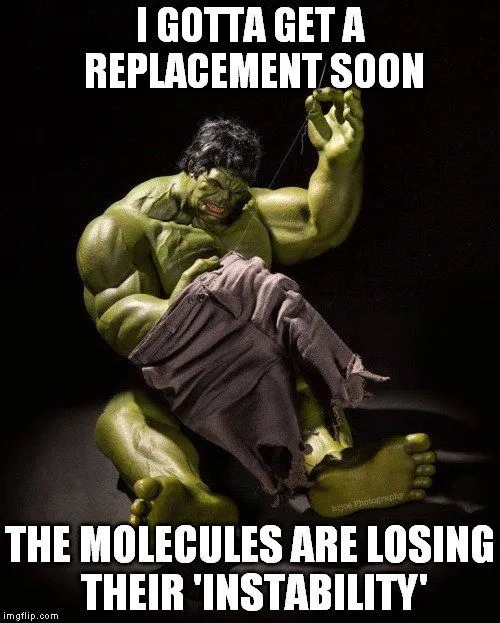
Furthermore, in one of his interviews, Stan Lee (who co-created the Hulk with Jack Kirby in The Incredible Hulk #1 in 1962) pointed out that the fabric of the Hulk’s pants is invented by Reed Richards, one of the members of the Fantastic Four, whose superpower is the ability to infinitely stretch and elongate his body.

Following is an excerpt from that interview:
I just figured that Bruce Banner had probably been a friend of Reed Richard, and Reed had given him some elastic trousers. There’s an explanation for everything, but you may not be technically advanced enough to follow me on all of this.
There you have it! In short, the Hulk’s pants are not made out of regular fabric; they’re specially made by ‘unstable molecules’, which the creators have not expounded on much in either the comics or the movies. Therefore, it’s fair to say that it’s just another liberty that the creators of ‘the superhero realm’ have taken, but it also gives scientists a little something to scratch their heads about… bringing that sort of extendable fabric to the real world would be pretty amazing!
Could A Real Fabric Actually Do This?
Strip away the comic-book magic for a moment, and the Hulk’s pants pose a genuinely interesting materials-science puzzle: why do ordinary clothes shred at all, and could real fabric ever behave like Reed Richards’ trousers?
The reason your shirt would rip rather than grow comes down to a property called breaking elongation, the amount a fiber can stretch before it snaps. Cotton is terrible at this. A single cotton fiber pulls apart after stretching only about 4–8% of its length, and the woven yarns sit in roughly the same range. So when Bruce Banner suddenly balloons in size, the body underneath expands far past anything those threads can accommodate, and they part one by one along a tear line. Wool manages around 25–45% and polyester can exceed 50%, but none of these come remotely close to keeping pace with a man who doubles in bulk in seconds.

This is where a real material genuinely earns the comparison. Elastane, the fiber sold as spandex or Lycra, is a segmented polyurethane polymer that can stretch roughly 400–700% of its original length and then snap back to almost exactly its starting shape. That is the secret behind leggings, swimsuits and compression wear that hug the body and recover their fit again and again. A pure-elastane garment would not give you the Hulk’s wardrobe, but it does explain why his stretchy trousers aren’t pure fantasy: rubbery, elastomeric fibers really do exist that stretch many times their length without tearing.
Stranger still are auxetic materials, which have a negative Poisson’s ratio. Pull on a normal sheet of fabric and it gets thinner in the middle, the way a stretched rubber band narrows. Pull on an auxetic structure and it does the opposite, expanding sideways at the same time, so it grows thicker in every direction at once. Textile engineers build this behavior into knitted and woven fabrics using re-entrant, bow-tie-shaped cell geometries, and reviews of the field describe garments and protective gear designed to swell to fit the wearer rather than constrict. A fabric that genuinely expanded in all directions to track a body changing shape is, in spirit, exactly what the Hulk’s pants are supposed to be, even if no real textile yet keeps up with a body that doubles in size in seconds.
References (click to expand)
- 23 Times the Hulk Wore Something Other Than Ripped Pants. marvel.com
- Glossary:Hulk's Pants | Marvel Database - Fandom. Fandom
- Impact of the Elastane Percentage on the Elastic Properties of Knitted Fabrics under Cyclic Loading. Materials (Basel). PMC, NIH.
- Mechanical Properties of Auxetic Cellular Material Consisting of Re-Entrant Hexagonal Honeycombs. Materials (Basel). PMC, NIH.
- Rant D. et al. Auxetic textiles. Acta Chimica Slovenica (2013). PubMed, NIH.